
There are moments when reality doesn’t just surprise you — it directly contradicts what you thought was unquestionable. Not opinions, not interpretations, but something we tend to treat as absolute: DNA testing.
Because under normal circumstances, there’s no room for doubt. DNA establishes biological relationships with remarkable accuracy. It’s used in courts, in medicine, in science. When a result says “not the mother,” the conclusion seems final.
But in the case of Lydia Fairchild, reality turned out to be far more complex.
When everything suddenly becomes suspicious
It started in the United States, in what should have been a routine administrative process. Lydia Fairchild applied for public assistance, and authorities requested DNA tests to confirm the biological relationship between her, her children, and their father.
The tests were carried out using standard procedures.
The father’s results were exactly what everyone expected: a clear genetic match.
Hers were not.
The analysis showed that she was not the biological mother of the children she had carried, given birth to, and raised.
It wasn’t a one-time lab error. The tests were repeated.
The result stayed the same.
At that point, the situation escalated quickly. What had started as paperwork turned into suspicion — fraud, possible child substitution, even the risk of losing custody.
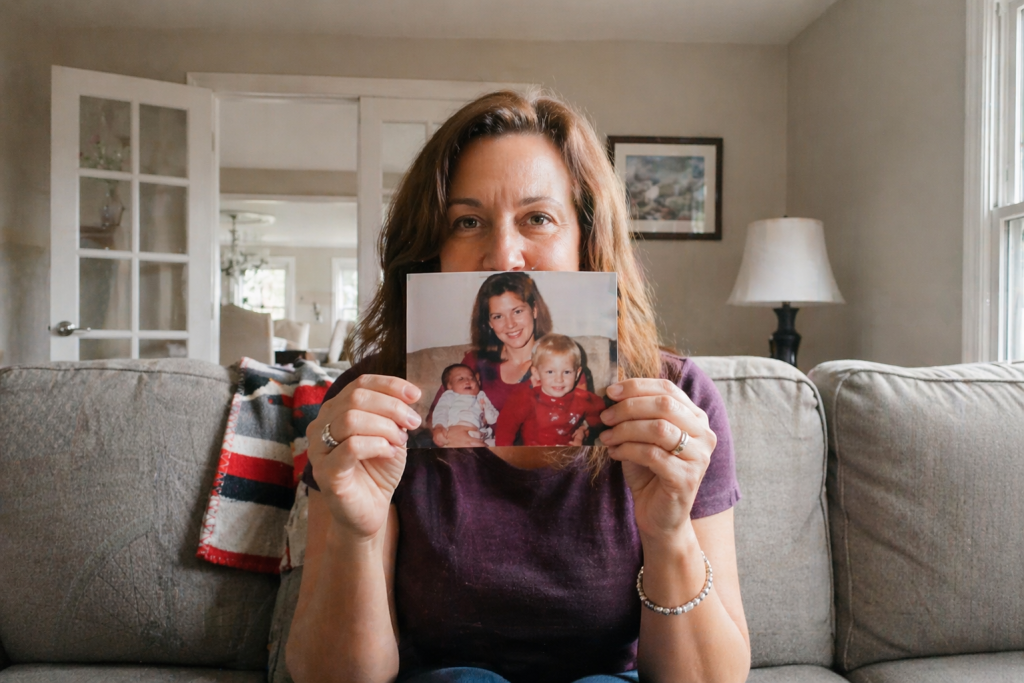
When you have to prove something that should be obvious
For the authorities, the data seemed clear. For her, reality was just as clear — but impossible to prove through the usual methods.
In a drastic step, the court decided to go further.
During a subsequent pregnancy, the process was closely monitored. There would be no room for confusion this time. The birth was observed, documented, controlled.
The baby was tested immediately after delivery.
The result did not change.
Genetically, the tests said that the woman who had just given birth was not the child’s mother.
The explanation that changed everything
Only then did the case reach specialists in genetics, and a rare possibility was considered: human chimerism.
Chimerism is a condition in which a single person carries two distinct sets of DNA. It usually originates very early in development, when two embryos — essentially fraternal twins — fuse into one.
The result is a single individual whose body is not genetically uniform.
Some tissues may carry one DNA profile, while others carry another.
Why DNA tests can appear “wrong”
Standard DNA tests typically rely on samples taken from blood, saliva, or cheek cells. These are assumed to represent the person’s genetic identity as a whole.
In a chimeric individual, that assumption can fail.
In Lydia Fairchild’s case, the samples initially tested came from tissues with one genetic profile. However, her ovaries — the source of the eggs that led to her children — carried the second DNA line.
In simple terms, the children were biologically hers, but they matched a different genetic profile than the one the test had analyzed.
For the test, she wasn’t the mother.
For reality, she was.
How rare is this, really?
Human chimerism is considered extremely rare and often goes undetected for an entire lifetime. Most people are never tested in ways that would reveal the presence of two distinct genetic lines.
There are different forms of chimerism. The type relevant in cases like this is tetragametic chimerism, which results from the fusion of two embryos. Another form, microchimerism, involves a small number of cells exchanged between individuals, most commonly between mother and fetus, but it doesn’t lead to the same kind of discrepancies.
Documented cases such as Lydia Fairchild’s, as well as that of Karen Keegan, have helped scientists better understand how complex human genetics can be — and how rare exceptions can challenge assumptions that seem unshakable.
What this case changed
This case didn’t prove that DNA testing is unreliable.
It showed that biological reality can, in rare situations, be more complex than the frameworks we use to interpret it.
After further investigation — including testing multiple types of tissue — it was confirmed that Lydia Fairchild was, without any doubt, the biological mother of her children.
But getting to that conclusion required going beyond what most systems are designed to handle.
The question that remains
The story of Lydia Fairchild is not just a medical curiosity.
It’s a reminder that even the most trusted tools can have limits we don’t often think about.
And that, sometimes, the human body can hold answers that don’t fit neatly into the rules we rely on.