
When you arrive in Vancouver on a typical gray morning, with damp air and soft light filtering through the clouds, the city doesn’t feel built in the traditional sense. It feels reflected. Towers don’t just stand there—they echo the sky, the water, even the distant outline of the mountains. It creates a quiet illusion that the city is less about concrete and more about light.
That’s where the nickname “City of Glass” comes from. It’s not an official title, and it wasn’t created as a branding strategy. It’s simply what people end up calling it after seeing how consistently glass defines its skyline.
“Vancouverism”: the planning idea behind the look
This visual identity didn’t happen by accident. Starting in the 1980s, Vancouver began reshaping former industrial areas—especially around False Creek—with a very deliberate approach to urban planning.
That approach is now widely known as “Vancouverism.” The goal was straightforward in theory but complex in execution: increase density without sacrificing livability. Instead of bulky, block-like buildings, planners encouraged tall, slender towers set on low-rise podiums that include shops, services, and shared community spaces.
Glass became the dominant material not just for aesthetics, but for function. In a city that sees more than 150 rainy days a year, natural light matters. Floor-to-ceiling windows help bring that light deep into living spaces, while also making buildings feel less heavy and more integrated into their surroundings.
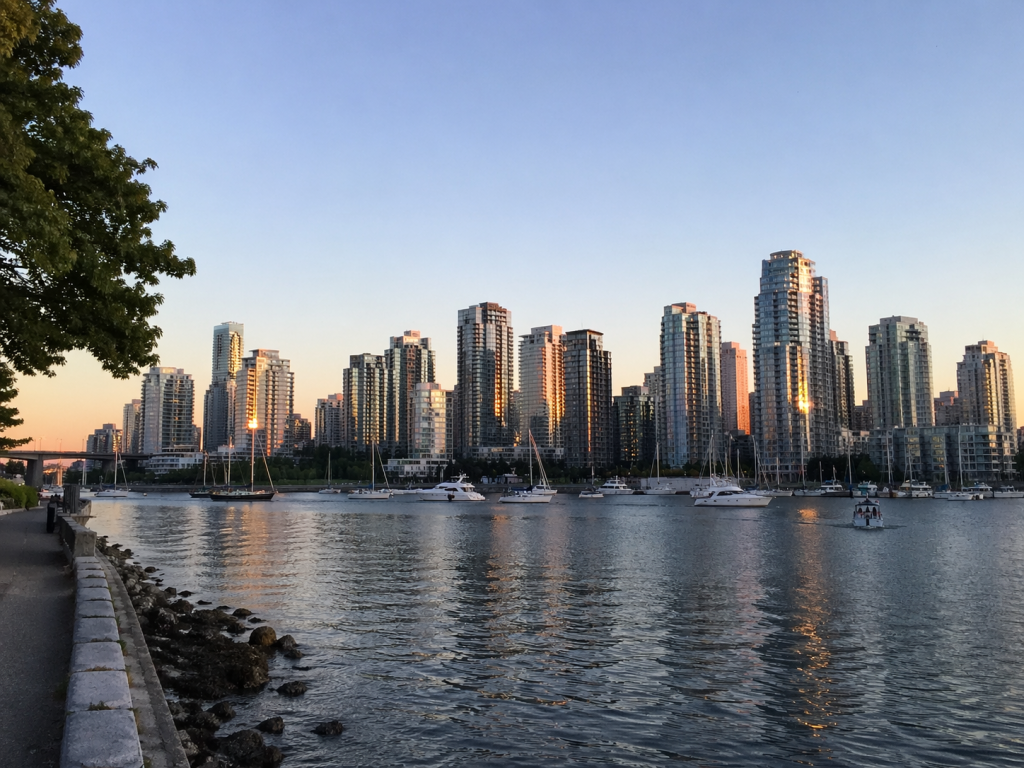
Neighborhoods like Yaletown and Coal Harbour show this model at its most refined. Towers are carefully spaced and oriented to preserve view corridors toward the ocean and the mountains, something that’s actually regulated by city planning guidelines.
A geography that shaped the skyline
Vancouver’s location plays a major role in how it developed. The city is bordered by the Pacific Ocean on one side and the North Shore Mountains on the other, leaving limited room to expand outward.
Instead of spreading endlessly, the city grew upward—but in a controlled way. At the same time, access to nature remained a priority. Places like Stanley Park, one of the largest urban parks in North America, sit just minutes away from dense clusters of high-rise buildings.
The climate also contributes to the city’s unique appearance. Vancouver’s coastal weather brings frequent cloud cover and diffused light, which interacts differently with glass than in sunnier cities. The result is a softer, more uniform reflection—less glare, more atmosphere.
The science behind all that glass
Behind the visual appeal, there’s a significant amount of engineering. Most modern buildings in Vancouver use what’s known as a curtain wall system, where the glass exterior is not structural but acts as a protective outer layer.
These façades typically use double- or triple-glazed glass with low-emissivity (low-E) coatings. These coatings help regulate indoor temperatures by reflecting heat back inside during colder months and reducing solar gain during warmer periods. In a damp, temperate climate, that balance is essential for comfort and energy efficiency.
Still, glass-heavy architecture comes with trade-offs. Large reflective surfaces can contribute to localized heat buildup and pose risks to birds, which often can’t distinguish reflections from open sky. In response, newer buildings increasingly incorporate bird-friendly design elements and treated glass to reduce these impacts.
The reality behind the image
For all its visual appeal, Vancouver is also one of the most expensive cities in North America when it comes to housing. Many of the glass towers that define its skyline are financially out of reach for a large portion of the population.
High demand, including international investment, combined with geographic constraints and zoning policies, has driven prices upward over time. The result is a city that consistently ranks high in quality-of-life indexes, yet remains difficult to afford for many of the people who live there.
More than just a skyline
Vancouver is often described through its reflections, but what makes it interesting goes beyond appearance. It’s a city shaped by deliberate choices—about density, design, and how to balance urban life with access to nature.
From a distance, it can feel almost ideal, where glass towers meet ocean views and mountain backdrops. Up close, it becomes clear that this balance is carefully maintained and not without tension.
And maybe that’s what defines it most. Not just how it reflects the world around it, but how it quietly raises a deeper question: how much of a city is built to be seen, and how much is built to be lived in.