
Some of the most remarkable moments in filmmaking never fully reveal themselves on screen. In the case of Kate Winslet, her ability to remain underwater for over seven minutes is not just an impressive behind-the-scenes detail, but a clear example of how far the human body can be trained when preparation is done properly.
More than just a film requirement
For her role in Avatar: The Way of Water, the preparation went far beyond standard acting work. Instead of relying on editing tricks or short takes, she committed to real freediving training, a discipline that focuses less on pushing through discomfort and more on learning how the body uses oxygen and how the mind reacts when natural breathing urges intensify.
Working in a controlled environment, under the guidance of professional instructors and with full safety support, Kate Winslet managed to hold her breath for approximately 7 minutes and 14 seconds, a figure that has been publicly confirmed by the production team. The number alone is striking, but it becomes far more meaningful when you understand what is happening inside the body during that time.
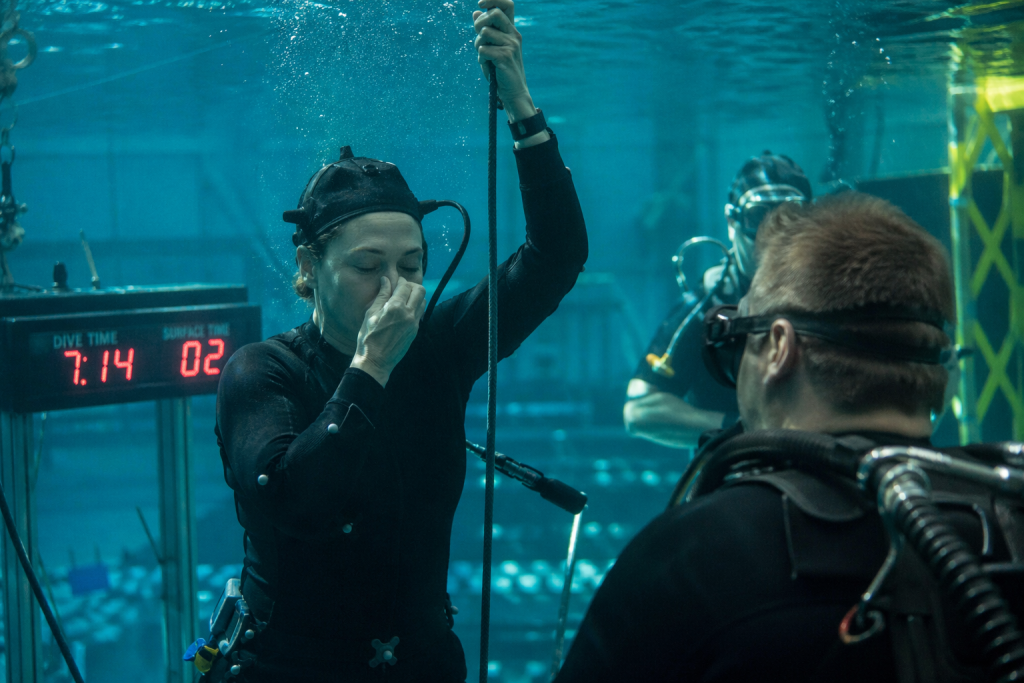
What actually happens inside the body
For most untrained people, holding their breath becomes uncomfortable after 30 seconds and rarely exceeds one to two minutes. This limit is not caused by an immediate lack of oxygen, but by rising carbon dioxide levels, which trigger the strong urge to breathe. That is why freediving training begins with breathing control, relaxation, and learning how to manage that urge rather than fight it.
As the body adapts, a well-documented physiological response called the mammalian dive reflex begins to take effect. Heart rate slows down, blood flow is reduced to the limbs, and oxygen is prioritized for vital organs such as the brain and heart. In practical terms, the body shifts into a conservation mode where efficiency replaces effort.
What appears to be a simple act of holding one’s breath is, in reality, a balance between physical adaptation and mental control, with the mental component becoming increasingly important as the body signals the need to breathe more intensely.
A useful point of comparison
There was already a notable benchmark in the film industry set by Tom Cruise, who trained to hold his breath for about six minutes while filming Mission: Impossible – Rogue Nation. At the time, that achievement was widely considered exceptional for an actor performing his own underwater sequences.
Kate Winslet exceeding that duration is not about competition, but it does provide context. In breath-hold training, the difference between six and seven minutes is not marginal; each additional second becomes progressively more demanding as the body operates closer to its physiological limits.
Beyond the headline number
What ultimately matters is not just the duration itself, but the process behind it. This was not a spontaneous feat or a natural ability, but the result of structured training, repeated practice, and careful supervision. Every aspect, from breathing techniques to safety protocols, plays a role in making such performances possible.
As filmmaking continues to move toward greater realism, this kind of preparation is becoming part of a broader standard where actors do more than portray a role — they physically adapt to it.
Seen in this light, Kate Winslet’s underwater performance is more than an interesting production detail. It is a concrete example of how far the human body can go when science, discipline, and training are applied with precision.