
If you’ve read this far still wondering “so is it arthritis or not?”, the most accurate answer isn’t a simple yes or no, but one that depends on context and probability. In a large number of cases, fingers that begin to change shape are linked to joint-related conditions, most commonly osteoarthritis and rheumatoid arthritis, yet the way these conditions affect the body is fundamentally different and leaves distinct patterns over time.
In osteoarthritis, the process develops gradually, often over many years, starting with the breakdown of cartilage, the smooth tissue that cushions the ends of bones. Because cartilage has limited ability to repair itself, repeated mechanical stress eventually leads to thinning and loss. As a response, the body attempts to stabilize the joint by forming small bony growths known as osteophytes. These changes are well documented in imaging studies and explain why joints may appear enlarged or slightly deformed, even in the absence of significant inflammation.
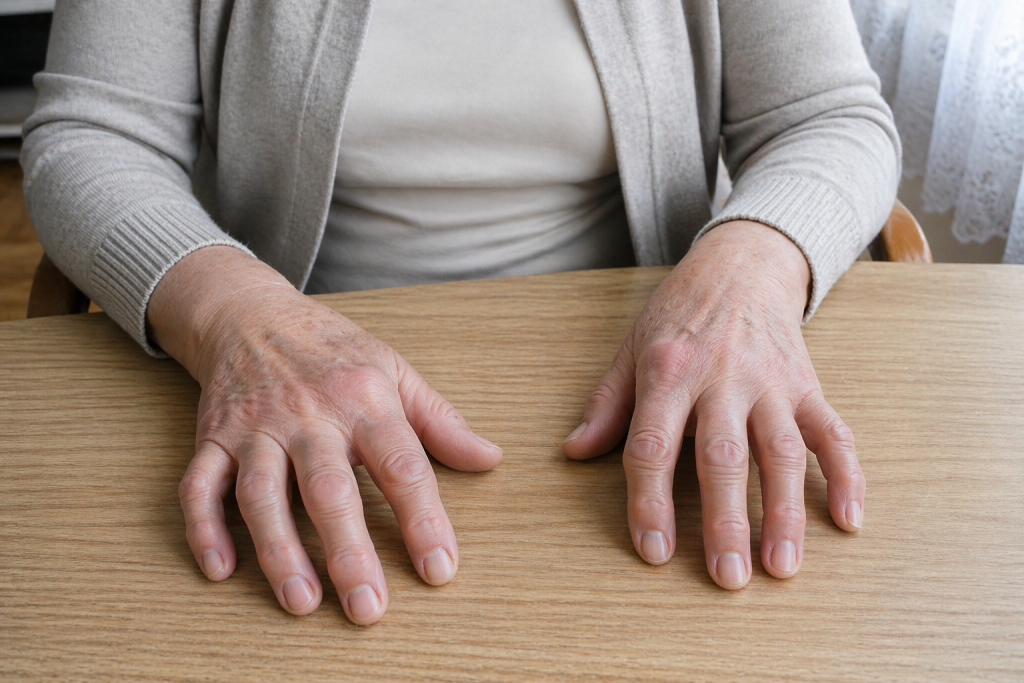
Rheumatoid arthritis follows a different path. It is driven by an autoimmune response, where the immune system mistakenly targets the lining of the joints. This leads to chronic inflammation, thickening of the synovial membrane, and progressive damage to cartilage and bone. Over time, the supporting structures of the joint weaken, and tendons may shift from their normal position, which is why fingers can begin to drift or deviate in characteristic ways. This is not simply wear and tear, but a structural reorganization of the joint caused by persistent inflammation.
When it’s not arthritis, but looks similar
There are also situations where the fingers change shape without the joint being the primary source of the problem. In Dupuytren’s contracture, the issue originates in the connective tissue of the palm. This tissue can gradually thicken and tighten, forming cord-like structures that pull the fingers inward, most often affecting the ring and little fingers. The joints themselves may initially be normal, but the position of the fingers is altered by external tension.
In other cases, muscle imbalances or nerve-related conditions can affect how the fingers are controlled. When certain muscles weaken or lose proper nerve input, opposing muscles may become dominant, gradually shifting the position of the fingers. These mechanisms are well recognized in neurology and can explain why deformities sometimes appear without early pain or visible joint inflammation.
The role of age, hormones, and everyday use
As the body ages, tissues naturally become less resilient. Collagen, which provides structure and flexibility, changes in quality and becomes less elastic, while cartilage becomes thinner and less capable of absorbing stress. At the same time, the lubricating properties of joint fluid may decline. These changes are part of normal aging, but they increase vulnerability to deformation when combined with years of repetitive use.
In women, hormonal changes after menopause, particularly the decline in estrogen, are associated with reduced collagen production and changes in bone metabolism. Epidemiological data consistently show a higher prevalence of joint changes and deformities after this stage, highlighting the role hormones play in maintaining tissue integrity.
Why similar-looking hands can have very different causes
One of the most important things to understand is that similar visual changes do not always mean the same underlying cause. Two people may have fingers that appear equally deformed, yet one may be experiencing a slow degenerative process, while the other is dealing with an active inflammatory condition or a soft tissue contracture.
This overlap is why diagnosis is never based on appearance alone. It relies on a broader context that includes symptoms, progression over time, and sometimes imaging or laboratory tests.
How to read the signals your body is giving you
What truly helps differentiate these situations are the details that accompany the visible changes. Prolonged morning stiffness, joint swelling, and persistent pain may point toward an inflammatory process, while stiffness that worsens with use and the presence of firm bony enlargements are more typical of degenerative changes. In contracture-related conditions, the inability to fully straighten a finger, often without early pain, can be a key sign.
At its core, when fingers begin to change shape, the body is not acting randomly. It is adapting to long-standing imbalances that may have developed quietly over time. Arthritis is one of the most common explanations, but it is not the only one, and understanding these differences provides a clearer, more accurate picture of what is actually happening beneath the surface.