
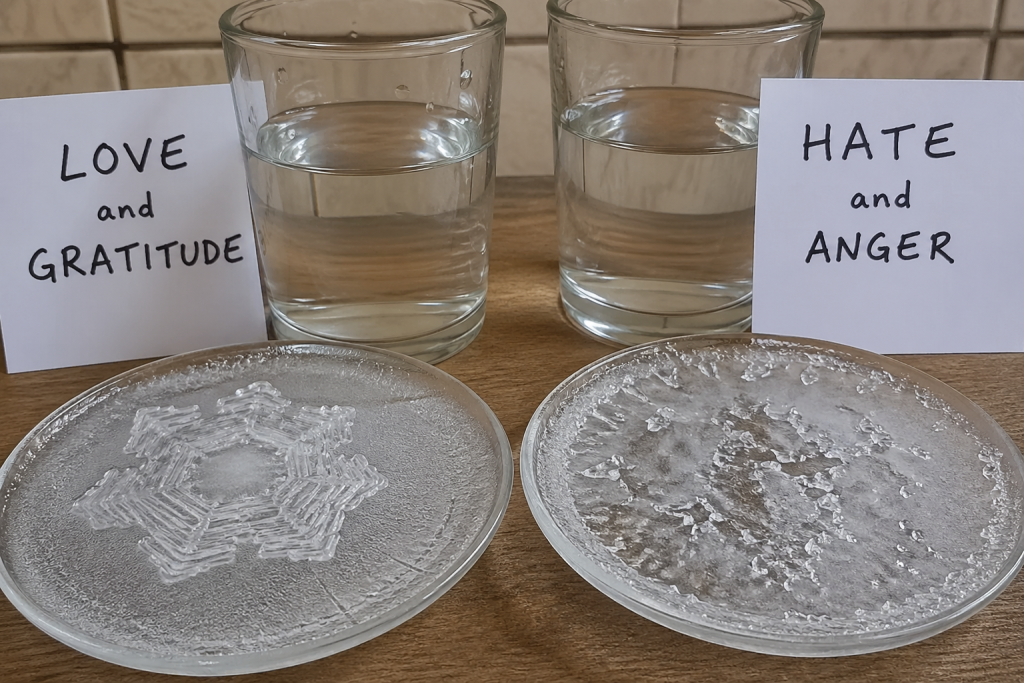
You’ve probably seen it at least once — the idea that water can “remember” what you say to it. That if you speak kindly, it freezes into beautiful, symmetrical patterns, and if you expose it to negative words, it turns chaotic and disordered. It’s one of those concepts that feels so intuitive and poetic that it almost bypasses skepticism.
But when you look at it through a scientific lens, the story changes.
Where this idea comes from
Much of the popularity of this concept can be traced back to Masaru Emoto, who photographed frozen water crystals and claimed their shapes were influenced by words, music, or intention.
The issue isn’t that such a hypothesis is impossible to test, but that the way it was presented doesn’t meet scientific standards. The experiments lacked strict controls, the selection of images was subjective, and, most importantly, independent researchers have not been able to reproduce the same results under controlled conditions. In science, if findings cannot be consistently replicated, they are not considered reliable.
What actually happens inside water
Water is one of the most thoroughly studied substances we have. Its molecules are in constant motion, forming and breaking hydrogen bonds at an incredibly fast rate — on the scale of picoseconds. Any temporary structure that appears disappears almost instantly.
When water freezes, the shapes of ice crystals are influenced by physical conditions such as temperature, freezing speed, impurities, and even slight environmental disturbances. Two samples that seem identical can produce very different crystal patterns without any external “emotional” influence.
Can water be “programmed”?
The idea that you can “charge” water with intentions and then drink it is appealing because it suggests a simple way to influence your well-being. However, there is no known mechanism by which water can store complex information like words or emotions and then transfer that information into the human body.
That doesn’t mean your experience isn’t real. Context matters. If you drink water while feeling calm, safe, or positive, your body responds differently than it does under stress. But that shift comes from your own physiological and psychological state, not from any change in the water itself.
Why the idea persists
Part of the reason this belief sticks is because it speaks to something deeply human. We like to think that our thoughts and words have a direct impact on the world around us in ways we can’t always see. Add visually striking images of ice crystals, and the story becomes even more convincing.
In reality, those patterns are shaped by physics, not feelings.
The takeaway
Water does not have “memory” in the way it’s often described, and it cannot be programmed through words or intention. It remains essential, fascinating, and complex — but its behavior follows the laws of chemistry and physics, not human emotion.
And maybe the more interesting question isn’t whether water is listening to us… but why we feel the need to believe that it might.
Have you ever come across this idea before? Did it seem believable at first?
/