
When a mirror stops feeling neutral
Most of us don’t think twice about mirrors. They’re part of daily routines, almost invisible in how familiar they are. But for some people, there’s a subtle tension that appears the moment they face one. It’s not about vanity or dissatisfaction. It’s a deeper, harder-to-explain discomfort that can build into real anxiety. This reaction is known as eisoptrophobia.
The term comes from the Greek word for mirror, and it refers to an intense, persistent fear linked to reflections. It doesn’t mean simply avoiding mirrors out of preference. It describes a response that can feel involuntary, even when the person knows there’s no actual danger.
It’s not just about how you look
It might seem logical to connect this fear to self-image, but eisoptrophobia goes beyond that. It isn’t the same as feeling unhappy with your appearance or avoiding your reflection for emotional reasons tied to confidence.
For some individuals, the unsettling part is the idea of seeing themselves as a separate image. A reflection can create a sense of distance between “you” and what you’re looking at. The brain is highly tuned to recognize faces, especially its own, and even small inconsistencies in movement, lighting, or perspective can feel unusual when attention is focused on them.
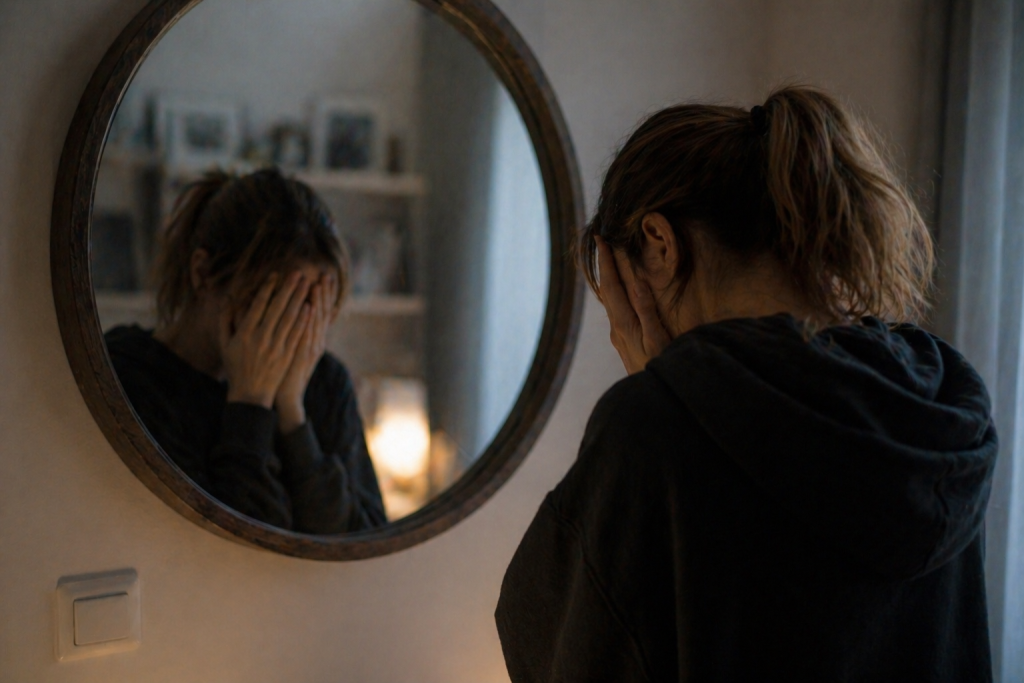
In most cases, the brain filters out these differences instantly. But when that filtering doesn’t happen as smoothly, the experience can become uncomfortable.
What science suggests about mirror-related discomfort
From a neurological perspective, recognizing your own face involves several brain regions working together, including those responsible for visual processing and identity recognition. At the same time, the amygdala plays a role in detecting potential threats, even subtle or ambiguous ones.
Research has shown that prolonged eye contact with one’s own reflection, especially in dim lighting or under focused attention, can lead to temporary perceptual distortions. People sometimes report that their face appears to shift, change expression, or feel unfamiliar. These effects are known in scientific literature and are generally harmless, but they can feel intense in the moment.
For someone already sensitive to these sensations, that temporary distortion can be enough to trigger anxiety.
The role of culture and meaning
Mirrors have never been just practical objects. Across cultures, they’ve been associated with identity, truth, and even the idea of something hidden beneath the surface. Stories, superstitions, and symbolic meanings have shaped how people think about reflections for generations.
Even if someone doesn’t consciously believe in those ideas, they can still influence emotional responses. A mirror can feel less like a simple surface and more like something that invites interpretation, and sometimes that interpretation leans toward discomfort.
How this fear can show up
Eisoptrophobia doesn’t look the same for everyone. Some people avoid mirrors entirely, covering them or choosing spaces where reflections are limited. Others may only feel uneasy in certain situations, such as being alone, being tired, or encountering mirrors in low light.
The physical response can include increased heart rate, tension, restlessness, or a strong urge to look away. In some cases, the anticipation alone — knowing a mirror is nearby — can be enough to create discomfort.
Not as unusual as it sounds
Even though it might seem like a rare or strange fear, the mechanisms behind it are not unusual. The brain is constantly trying to make sense of what it sees, and when something feels slightly “off,” it reacts.
Most of the time, these small inconsistencies go unnoticed. But when attention locks onto them, or when someone is more sensitive to perceptual changes, the reaction can become stronger and more persistent.
A different way of looking at reflections
At its core, eisoptrophobia says something interesting about how we relate to ourselves. A mirror doesn’t just reflect an image. It creates a moment of direct confrontation with identity, one that is usually effortless but not always neutral.
For most people, that moment passes without thought. For others, it becomes something more complex, where perception, emotion, and interpretation overlap in ways that are difficult to ignore.
And perhaps that’s what makes this fear less about mirrors themselves, and more about how the mind interprets what it sees — especially when what it sees is itself.