
In the spring of 1994, the small African nation of Rwanda became the center of one of the fastest mass killings in modern history. In roughly one hundred days, an estimated 800,000 people were murdered in a wave of violence that shocked the international community and permanently changed how the world studies propaganda, ethnic conflict, and mass manipulation.
Most of the victims were members of the Tutsi minority, although thousands of moderate Hutu who opposed the killings were also targeted. Today, the Rwanda genocide is examined in universities, legal institutions, and human rights organizations as a case study of how quickly a society can collapse when fear, political extremism, and coordinated hate campaigns are allowed to spread unchecked.
Among the survivors who later shared their experiences publicly was Yolande Mukagasana, a former nurse whose testimony became one of the most recognized personal accounts connected to the genocide.
The Historical Tensions That Shaped Rwanda
To understand how the violence escalated so rapidly, historians often point to decades of political division that existed long before 1994.
During the colonial era, first under German rule and later Belgian administration, authorities reinforced social distinctions between Hutu and Tutsi communities. Identity classifications became increasingly formalized, and ethnic categories were eventually included on official identification documents.
Although both groups shared the same language, traditions, and communities, political propaganda gradually transformed those differences into a source of hostility. After Rwanda gained independence, cycles of ethnic violence continued periodically, forcing many Tutsi families to flee to neighboring countries.
By the early 1990s, tensions intensified further because of the civil war between the Rwandan government and the Rwandan Patriotic Front (RPF), a rebel force largely composed of Tutsi refugees and their descendants.
At the same time, extremist media outlets began spreading increasingly aggressive messages. One of the most infamous was RTLM — Radio Télévision Libre des Mille Collines — a radio station later examined by international tribunals for its role in encouraging violence and dehumanizing civilians. Broadcasts frequently referred to Tutsi people as “inyenzi,” a term commonly translated as “cockroaches.”
The Assassination That Triggered the Killings
On April 6, 1994, the plane carrying Rwandan President Juvénal Habyarimana was shot down near Kigali. Within hours, organized attacks began across the country.
Roadblocks appeared almost immediately, political opponents were assassinated, and extremist militias known as the Interahamwe started targeting civilians neighborhood by neighborhood.
Thousands of frightened families sought refuge in churches, schools, and public buildings, believing those places would offer some degree of protection. In many cases, however, those locations became sites of large-scale massacres.
The Nyamata Church Massacre
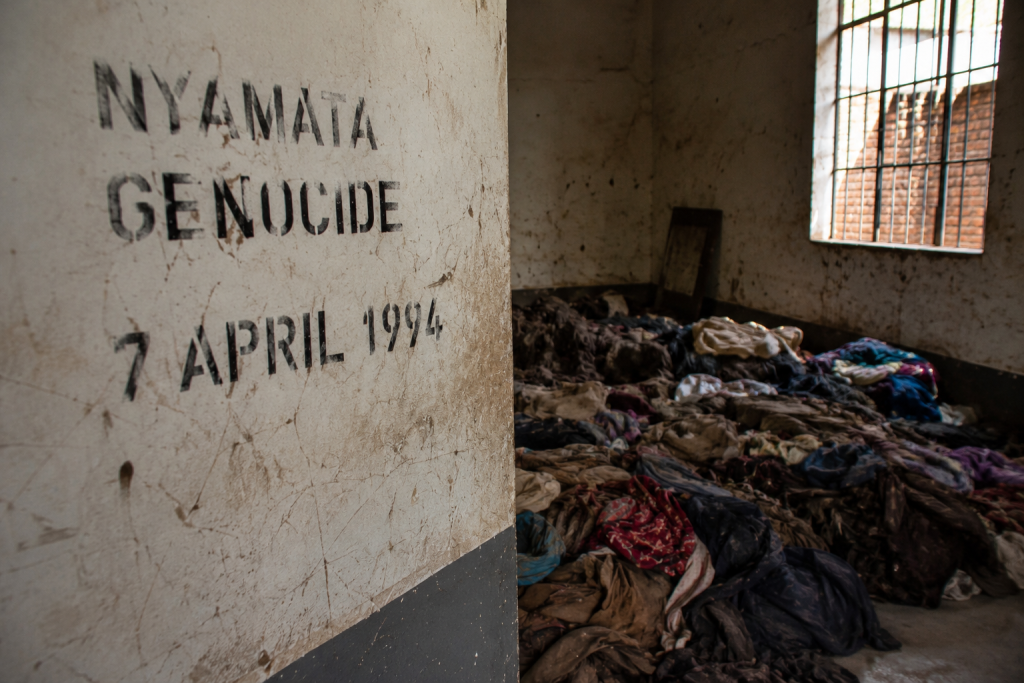
One of the most widely documented massacres took place in Nyamata, a town located south of Kigali.
Large numbers of civilians gathered inside the local church, hoping the building would shield them from the violence outside. Survivor testimonies and historical investigations later revealed that attackers surrounded the church and launched assaults using grenades, firearms, and machetes.
Today, the Nyamata Genocide Memorial remains one of Rwanda’s most visited remembrance sites. Inside the former church, visitors can still see clothing, personal belongings, and structural damage connected to the attack. The memorial serves both as a historical archive and as a reminder of how vulnerable civilian populations can become during organized campaigns of hatred.
Researchers, journalists, and survivors who have visited the site often describe the atmosphere as deeply unsettling because many traces of the events were intentionally preserved.
The Survival of Yolande Mukagasana
At the time the genocide began, Yolande Mukagasana was a 39-year-old nurse living with her husband and children.
During the violence, her family was killed. Yolande herself survived after hiding and receiving help from individuals who risked their own safety to protect people being hunted during the massacres. Although such acts of rescue were far less common than the violence itself, several documented cases exist of civilians secretly sheltering neighbors despite enormous personal danger.
After the genocide ended and the RPF gained control of the country in July 1994, Yolande eventually relocated to Belgium, where she began writing about what she had experienced.
Her memoir, published in French under the title La mort ne veut pas de moi (“Death Does Not Want Me”), became one of the best-known survivor testimonies connected to Rwanda. Through interviews, public appearances, and written accounts, she later spoke extensively about trauma, grief, survival, and the long-term psychological effects of mass violence.
Over the years, Yolande Mukagasana also participated in educational and memorial projects intended to help future generations understand the consequences of extremist ideology and ethnic hatred.
How Radio Propaganda Influenced Violence
The Rwanda genocide is frequently studied in the fields of psychology, sociology, and media communication because of the role propaganda played in escalating the killings.
In 1994, internet access in Rwanda was extremely limited, but radios were common in homes throughout the country. That made radio broadcasts one of the fastest ways to spread political messaging into both cities and rural communities.
Researchers later analyzed how repeated exposure to fear-based rhetoric and dehumanizing language contributed to radicalization. Some academic studies even explored links between stronger radio signal coverage and higher levels of violence in certain areas.
The International Criminal Tribunal for Rwanda later prosecuted several media figures connected to incitement campaigns, marking one of the most significant legal precedents involving propaganda and mass violence.
Rwanda After the Genocide
Rebuilding the country after 1994 was an enormous challenge.
The government removed ethnic classifications from official identity documents and promoted a national identity centered around unity rather than ethnic division. At the same time, both international and local justice systems were used to prosecute crimes connected to the genocide.
Rwanda also implemented community-based courts known as gacaca, designed to process the overwhelming number of genocide-related cases.
Memorials established in Kigali, Nyamata, and other locations became central spaces for remembrance, education, and historical preservation.
Why Rwanda’s Story Still Matters
More than three decades later, the Rwanda genocide continues to be referenced in discussions about hate speech, political extremism, misinformation, and the dangers of organized dehumanization.
Historians often describe Rwanda as one of the clearest modern examples of how rapidly ordinary communities can unravel when propaganda becomes normalized and fear is weaponized for political purposes.
The story of Yolande Mukagasana remains significant not only because she survived unimaginable loss, but because she chose to document what happened and speak openly about memory, trauma, and reconciliation.
Today, places like the Nyamata memorial stand as reminders of how fragile societies can become when division and hatred are allowed to replace humanity.