
For many parents, the first weeks of daycare feel nothing like the cheerful images shown in advertisements or parenting brochures. Instead of smiling babies calmly stacking blocks and drifting peacefully into afternoon naps, the reality can feel emotional, unsettling, and unexpectedly painful.
The experience becomes even more intense when the child is barely a year old. At that age, children cannot explain what frightened them, what hurt, or whether they felt lonely during the day. Parents are left trying to interpret small details after pickup: a sudden clinginess, dirty socks, tired eyes, unexplained crying, or the uneasy feeling that their child spent hours in situations they were too young to understand.
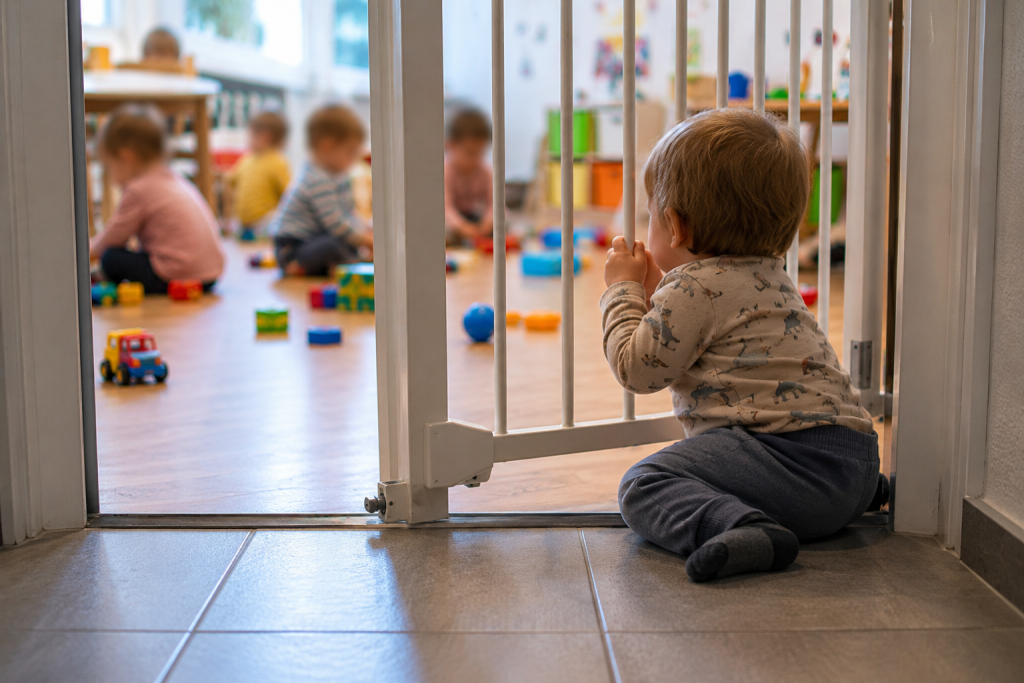
In recent years, many daycare centers have introduced live camera access for families. While the idea was meant to create transparency and reassurance, it has also changed the emotional experience of parenting. Watching your child in real time can sometimes become overwhelming. Seeing a toddler sitting on the floor beneath a table, pulling a chair toward themselves, or wandering alone near a gate for even a few seconds can trigger a deep instinctive fear in adults.
Why Babies and Toddlers Spend So Much Time on the Floor
From a developmental perspective, this behavior is completely normal. Around the age of one, children learn primarily through movement, touch, and physical exploration. The floor becomes their main environment because it feels stable enough for crawling, standing, falling, climbing, and experimenting with balance.
Child development specialists explain that this stage is critical for motor coordination, spatial awareness, and sensory learning. Babies at this age do not understand danger the way adults do. They cannot predict that a chair may fall, that a sharp corner may hurt, or that a closing door could injure their fingers.
Because of this, small accidents happen frequently in environments filled with very young children, even when caregivers are attentive. A toddler can lose balance in a second, stumble while trying to stand, or accidentally bump into another child who is also still learning how their own body works.
This reality does not automatically mean a daycare center is unsafe. The important difference lies in supervision, room organization, and how quickly adults respond when something happens.
The Emotional Impact of Seeing Dirty Socks and Small Details
Many parents admit that what unsettled them most was not necessarily a major incident, but small visual details. A pair of dirty socks, dusty knees, or signs that a child spent most of the day on the floor can become emotionally loaded symbols.
Once parents begin worrying, the mind naturally fills in the gaps. Was the child ignored? Did they cry for too long? Were they comforted quickly enough? Did anyone notice when they fell?
In reality, many daycare programs intentionally allow children to spend significant time on the floor because sensory play and unrestricted movement are considered beneficial for early development. Floors are typically cleaned multiple times throughout the day, and dirty clothing alone is not proof of neglect.
Still, context matters enormously. If parents repeatedly notice unsafe conditions, poor hygiene, overcrowded rooms, or a lack of active supervision, their concerns may be completely justified.
Why Doors and Safety Gates Cause So Many Injuries in Young Children
One of the most common sources of injury in infants and toddlers involves doors, gates, and hinged barriers. Children around one year old are fascinated by movement and repetition. Opening and closing objects becomes part of how they explore the world.
The problem is that young children do not yet understand cause and effect in a fully developed way. One child may push a gate shut out of curiosity without realizing another child’s fingers are nearby.
Pediatric safety experts note that finger injuries caused by doors are among the most frequent accidents involving small children, both at home and in childcare environments. Most incidents are minor, but some can result in bruising, nail injuries, or fractures.
For this reason, many modern childcare centers install protective hinge covers, slow-closing systems, or safety mechanisms designed specifically for infant classrooms.
The Anxiety Parents Rarely Talk About Openly
What often goes unspoken is how emotionally exhausting the adjustment period can become for adults themselves. Research on early separation shows that parents frequently experience elevated anxiety during the first weeks of daycare attendance.
Live cameras can intensify that stress. Human brains are naturally wired to react strongly to images involving one’s own child, especially when vulnerability is involved. Even a harmless moment may feel alarming when viewed through the lens of parental fear.
Many parents describe repeatedly checking cameras throughout the day, analyzing every interaction and every expression. Did someone comfort the baby quickly enough? Why was the child standing alone for a moment? Why did they seem quieter than the others?
At this age, children cannot come home and describe their experience. That silence often leaves adults carrying an uncomfortable sense of uncertainty.
Is Daycare the Problem, or Are Some Daycares Better Than Others?
This question has become increasingly common among modern parents, especially as more families return to work earlier than previous generations did.
The answer is complicated because daycare experiences vary enormously depending on the facility, staff training, group size, and overall environment.
Some children adapt remarkably well and eventually benefit from structured social interaction, routine, and exposure to other children. Others become overwhelmed in settings that are too crowded, understaffed, or emotionally overstimulating.
Early childhood experts consistently emphasize that caregiver-to-child ratios are among the most important factors influencing both safety and emotional wellbeing. When too few adults are responsible for too many very young children, supervision inevitably becomes more difficult.
Parents are often encouraged to look beyond isolated accidents and focus instead on broader patterns. Does the staff communicate honestly? Do caregivers respond calmly and attentively? Does the environment feel emotionally warm and physically safe?
These factors usually matter far more than a single scraped knee or a pair of dirty socks.
Signs a Child May Be Struggling With the Adjustment
Specialists generally agree that crying during drop-off is common during the adjustment period, particularly for children around one year old. However, certain behavioral changes may suggest a child is experiencing excessive stress.
These can include sleep disturbances, sudden feeding difficulties, extreme clinginess after pickup, prolonged inconsolable crying, developmental regression, or visible fear associated with the daycare environment itself.
Every child adapts differently. At this stage of development, the brain is still forming emotional attachment systems, and separation from primary caregivers can feel extremely significant to a young child.
The Part Many Families Quietly Carry Alone
For many parents, the hardest part is not a fall, a bruise, or a messy outfit. It is the realization that, for several hours each day, their child exists in a world they can no longer fully control.
That feeling can bring guilt, fear, and endless second-guessing. Some parents wonder whether they returned to work too early. Others feel trapped between financial reality and emotional instinct.
Yet there is no single universal daycare experience. Some children thrive once they settle into a nurturing environment. Others may struggle if the setting is not the right fit for their temperament or developmental needs.
In the end, the most important question is rarely whether daycare itself is inherently good or bad. More often, it comes down to the quality of care, the responsiveness of adults, the emotional atmosphere, and whether parents truly feel that their child is seen, protected, and comforted in a place where they are still far too young to speak fully for themselves.