
A few years ago, most people only heard about their heart rate during a doctor’s appointment. Today, millions check it dozens of times a day without even realizing it. A small vibration on a smartwatch can instantly turn an ordinary evening into a moment of fear.
For many smartwatch users, the situation feels familiar. You glance at your wrist and suddenly see a warning saying your heart rate is unusually high. Other times, the app reports a very low pulse during the night or while you are resting quietly in bed. Some people immediately search symptoms online. Others begin counting their heartbeat manually. In many cases, the anxiety becomes so intense that it actually changes the heart rate itself, creating even more panic.
Doctors and psychologists have started discussing a growing phenomenon linked to wearable technology: perfectly healthy people becoming hyperaware of every normal fluctuation in their bodies because they now have access to constant real-time data. For some users, that information can be genuinely useful and, in rare cases, lifesaving. For others, it becomes a continuous source of stress.
The reality is that the human heart is not designed to beat at one fixed number all day long. Heart rate changes constantly depending on movement, emotions, stress, temperature, sleep, hydration, hormones, caffeine intake, illness, and even simple thoughts. The problem begins when a single number on a screen is treated like a final diagnosis instead of a piece of information that needs context.
What Heart Rate Actually Means
Heart rate refers to the number of times the heart beats in one minute. Every beat pushes blood through the body, delivering oxygen and nutrients to tissues and organs.
Many people imagine a healthy heart as something that beats perfectly evenly every second of the day, but biology is far more dynamic than that. Even healthy hearts speed up and slow down naturally throughout the day.
Standing up quickly, drinking coffee, feeling stressed, becoming frightened, exercising, or even thinking about something emotional can temporarily increase heart rate. During deep sleep, it can drop significantly.
Ironically, constantly monitoring heart rate can sometimes influence it. When someone becomes anxious about what they see on their smartwatch, the brain releases adrenaline, and the heart responds immediately.
What Is Considered a Normal Heart Rate?
Most medical guidelines consider a resting heart rate between 60 and 100 beats per minute normal for adults. However, that range is not as rigid as many people think.
Some completely healthy individuals naturally sit around 55 bpm with no symptoms at all. Well-trained athletes may regularly have resting heart rates between 40 and 50 because their hearts pump blood more efficiently.
On the other hand, people dealing with chronic stress or anxiety may often sit near 90 or even 100 bpm without having a dangerous heart condition.
In general:
- 60–100 bpm is considered the standard resting range for adults
- Below 60 bpm is called bradycardia
- Above 100 bpm at rest is called tachycardia
What matters most is the overall context, including symptoms and the circumstances surrounding the change.
Heart Rate Changes With Age
Children naturally have faster heart rates than adults because their metabolism and circulatory systems work differently.
Approximate resting heart rate ranges include:
- newborns: 100–160 bpm
- infants: 90–150 bpm
- children ages 1–5: 80–140 bpm
- children ages 6–12: 70–120 bpm
- teenagers and adults: 60–100 bpm
As people age, heart rate may also be influenced by fitness level, medications, chronic conditions, and overall health.
Do Men and Women Have Different Heart Rates?
Yes. Studies have consistently shown that women tend to have slightly higher resting heart rates than men on average.
The reasons involve hormones, metabolism, and differences in heart size. This means two healthy people can naturally have different resting heart rates without either one being unhealthy.
Why a Smartwatch Sometimes Shows an Extremely Low Heart Rate
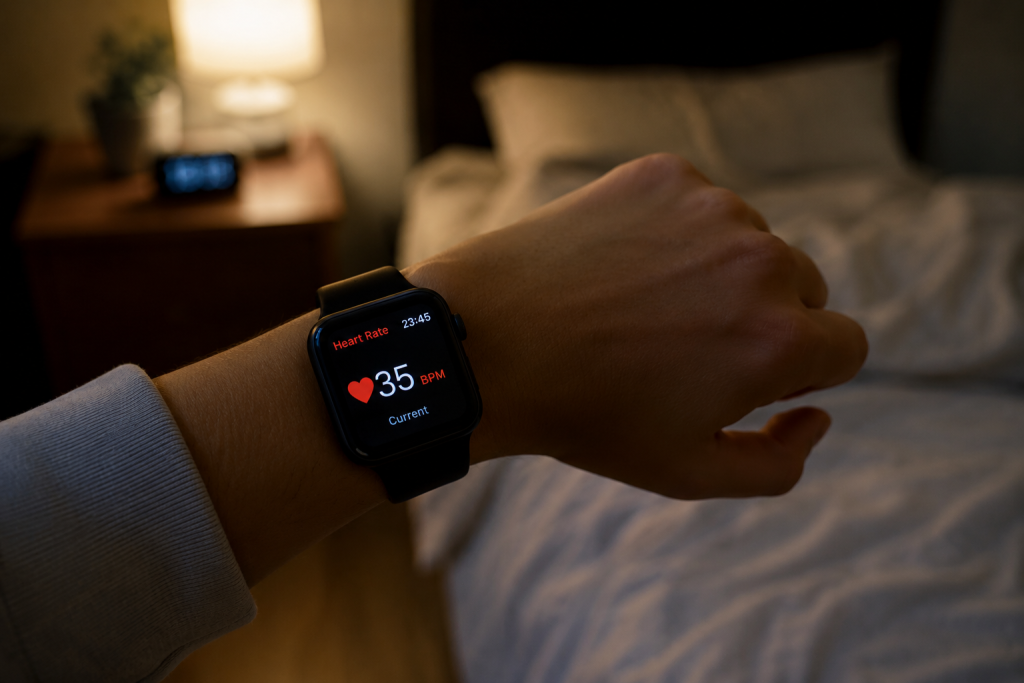
One of the most frightening situations for smartwatch users is seeing a heart rate reading around 35 bpm while fully awake and alert. For many people, that number immediately feels terrifying.
During deep sleep, lower heart rates can be completely normal, especially in younger or physically active individuals. The body enters a recovery state, breathing slows, and the nervous system reduces heart rate to conserve energy.
But the situation feels much more alarming when someone is awake, lying quietly in bed, and the smartwatch continues displaying a very low number for several minutes.
This is where an important detail often gets overlooked: smartwatches do not measure heart activity the same way hospital equipment does. Most wearable devices rely on optical sensors that estimate blood flow using light beneath the skin. If the signal becomes unstable, the watch may misinterpret beats and display unusually low readings for longer than just a few seconds.
Several things can interfere with the measurement:
- poor skin contact
- cold hands
- certain sleeping or resting positions
- tiny wrist movements
- sweat
- tattoos
- a watch worn too loosely
Specialists explain that there are situations where a smartwatch may display values such as 35 bpm for several minutes even if the heart was not actually beating that slowly the entire time.
Still, cardiologists also caution against automatically dismissing repeated low readings simply because the device might be wrong. If episodes happen frequently or are accompanied by symptoms, they deserve proper medical evaluation.
The most important factor is how the person feels during the episode. When a truly low heart rate affects blood circulation, symptoms often include:
- dizziness
- fainting
- severe weakness
- shortness of breath
- confusion
- chest discomfort
If someone remains fully alert, speaks normally, and experiences no major symptoms, the situation becomes less concerning medically, even though it can still feel emotionally overwhelming.
Doctors emphasize that a single smartwatch reading alone cannot diagnose a heart condition. What matters is the pattern over time, the presence of symptoms, and whether the readings can be confirmed through medical testing such as an ECG or Holter monitor.
Why Heart Rate Sometimes Suddenly Jumps to 140
A high heart rate notification can be just as frightening.
However, a pulse of 140 bpm does not automatically mean a heart attack or dangerous cardiac event. The heart can speed up for many reasons that are not life-threatening.
Common triggers include:
- anxiety
- panic attacks
- caffeine
- energy drinks
- sleep deprivation
- fever
- dehydration
- nicotine
- certain medications
- anemia
- thyroid disorders
During panic attacks, adrenaline floods the body, causing the heart to race even if the person is sitting completely still.
Ironically, seeing the high number on a smartwatch can create even more fear, which leads to even more adrenaline and keeps the heart rate elevated longer.
The Strange Sensation of “Skipped” Heartbeats
Many people describe feeling like their heart suddenly skips a beat or produces a strange thump in the chest. In many cases, these sensations are caused by premature beats known as extrasystoles.
They are extremely common and can happen even in healthy people. Stress, anxiety, exhaustion, caffeine, and lack of sleep can make them more noticeable.
For someone experiencing them for the first time, they can feel terrifying. But occasional extrasystoles do not automatically indicate serious heart disease.
Heart Rate and Blood Pressure Are Not the Same Thing
People often confuse heart rate with blood pressure, but they measure completely different things.
Heart rate refers to how fast the heart beats.
Blood pressure measures the force of blood pushing against artery walls.
A person can have a fast pulse and normal blood pressure, or normal pulse with elevated blood pressure. That is why a smartwatch showing heart rate alone cannot provide a complete picture of cardiovascular health.
What Happens to Heart Rate During Exercise
Heart rate naturally increases during physical activity because muscles need more oxygen.
A commonly used formula estimates maximum heart rate like this:
Estimated Maximum Heart Rate=220−age
This formula is only an estimate and varies between individuals, but it is widely used in fitness and sports medicine.
During intense exercise, healthy individuals may temporarily reach 70–85% of their estimated maximum heart rate without danger.
How Accurate Are Smartwatches?
Modern smartwatches can be surprisingly useful, especially at rest. But they are not perfect medical devices.
Accuracy can decrease when:
- the watch is loose
- the wrist moves frequently
- skin is cold
- sweat interferes with sensors
- tattoos affect light detection
- exercise becomes intense
- the device shifts position
Sometimes watches display completely inaccurate readings for brief periods. Specialists refer to these as measurement artifacts.
That means a smartwatch can occasionally show values like 35 bpm or 180 bpm even if the heart never actually reached those numbers.
When Smartwatches Really Have Detected Serious Problems
There are also documented cases where wearable devices helped identify genuine heart conditions.
In recent years, some users discovered atrial fibrillation and other rhythm disorders after repeated smartwatch alerts encouraged them to seek medical evaluation. Some newer devices can even record simplified ECG readings.
Still, cardiologists stress that these devices are best viewed as screening tools, not full diagnostic systems.
When Should Someone Actually Seek Medical Advice?
Not every unusual heart rate requires emergency care. But certain situations deserve proper evaluation, especially when symptoms are present.
Medical attention becomes more important if someone experiences:
- persistent high heart rate at rest
- chest pain
- shortness of breath
- fainting episodes
- severe dizziness
- repeated abnormal heart rhythms
- recurring very low heart rates with symptoms
Doctors may recommend ECG testing, blood work, or Holter monitoring to better understand what is happening.
The Hidden Psychological Side of Constant Monitoring
Psychologists increasingly discuss the anxiety created by constant body monitoring.
In the past, most people did not know their exact heart rate every minute of the day. Now, every fluctuation appears instantly on a screen. For anxious individuals, normal biological changes can begin to feel dangerous.
Paradoxically, technology designed to help people feel safer can sometimes make them feel less safe instead.
The Part Many People Quietly Relate To
Some people start checking their heart rate before bed, immediately after waking up, after every coffee, or after every stressful moment. Eventually, they stop trusting their own body unless the watch confirms everything is “normal.”
And when a notification suddenly appears, the calmness of an ordinary day can disappear in seconds.
The human heart was never meant to stay at one fixed number all the time. It speeds up and slows down constantly to adapt to real life. The difference between a harmless fluctuation and a true medical problem is rarely defined by a single number alone.
Sometimes the biggest issue is not the heart rate itself, but the fear created by seeing that number appear on a screen.