
In April 2008, residents along Brazil’s southern coastline witnessed a scene so unusual that it seemed more fitting for a work of fiction than real life. A Catholic priest sat suspended beneath a vast cluster of colorful helium balloons, preparing to lift off into the sky as part of a charitable mission that he hoped would capture public attention and support an important community project.
What began as an ambitious fundraising effort would soon become one of the most remarkable and tragic stories ever associated with a humanitarian cause.
The man at the center of that story was Adelir Antônio de Carli, a Brazilian priest whose determination to help others ultimately led him into circumstances far beyond anyone’s control.
A Priest Known for His Energy and Creativity
Before international headlines turned him into a household name, Adelir Antônio de Carli was known primarily within his local community in the southern Brazilian state of Paraná.
Friends and parishioners described him as energetic, approachable, and deeply committed to the people he served. Like many clergy members throughout Brazil, his responsibilities extended well beyond religious services. He participated in social programs, community outreach initiatives, and projects designed to assist people facing difficult circumstances.
Rather than relying solely on traditional fundraising methods, De Carli often looked for creative ways to draw public attention to causes he believed deserved support. His willingness to think differently eventually inspired an idea that would bring him worldwide recognition.
The Mission Behind the Flight
Contrary to popular assumptions, the flight was never intended as a stunt for personal fame.
The primary goal was to raise funds and awareness for charitable activities connected to Brazil’s long-haul truck drivers, a group that plays a vital role in the country’s economy.
Brazil is one of the largest nations on Earth, covering more than 8.5 million square kilometers. Because of its size, trucking serves as the backbone of domestic transportation. Many drivers spend days or even weeks away from home while moving goods across enormous distances.
Religious organizations in several regions had established chapels, rest stops, and support centers specifically for truckers. De Carli hoped his flight would generate publicity, attract donations, and help expand these initiatives.
His objective was simple: use an extraordinary event to support an ordinary community that often goes unnoticed.
The Science That Made the Flight Possible
At first glance, the concept sounds impossible.
Yet the underlying principle is the same one that has allowed balloons and airships to rise into the sky for centuries.
Helium is significantly less dense than the surrounding atmosphere. Because of this density difference, a balloon filled with helium experiences an upward buoyant force. While a single balloon provides only a small amount of lift, hundreds working together can generate enough force to carry a person and equipment into the air.
The challenge is that such a system offers very limited control over movement.
Unlike an aircraft equipped with engines and navigation systems, a balloon-supported platform is largely dependent on atmospheric conditions. Once airborne, winds become the dominant factor determining direction and speed.
This reality would prove crucial during De Carli’s journey.
Preparing for an Unusual Adventure
The flight was not entirely improvised.
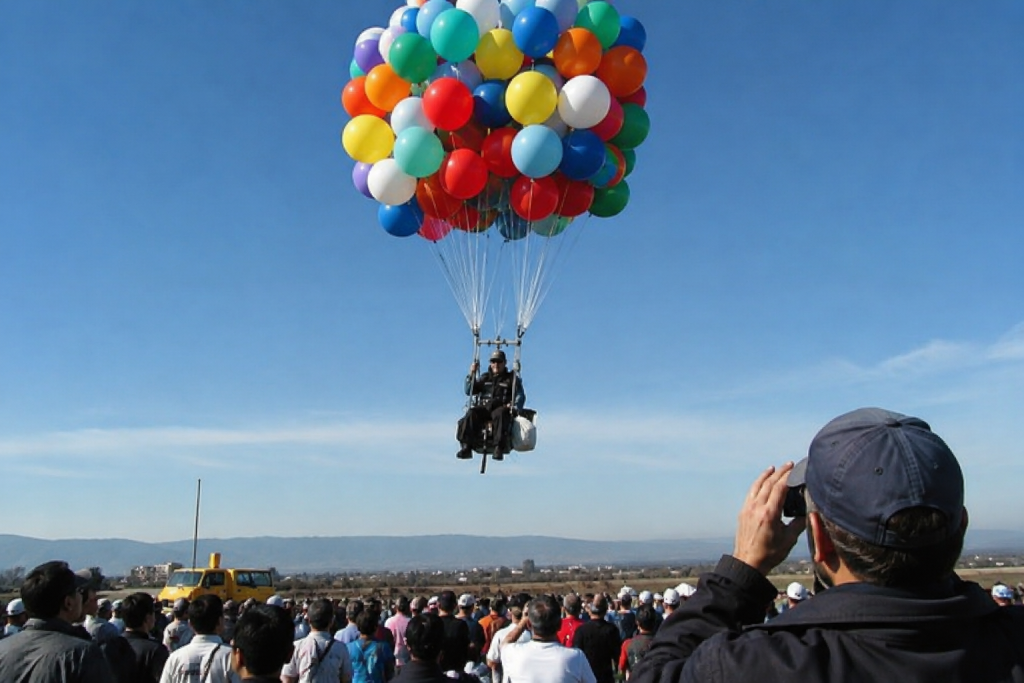
Reports from the time indicate that De Carli had participated in balloon-related projects before and had received training connected to navigation and flight preparation. His setup included a specially designed chair, safety harnesses, communication equipment, survival gear, food, water, and cold-weather clothing.
Different sources report varying numbers regarding the balloons involved. Some accounts mention roughly 600 balloons, while others suggest the total approached 1,000. Regardless of the exact figure, the cluster generated enough lift to carry him thousands of meters above the ground.
He also carried a GPS unit, radio equipment, and a parachute, all intended to increase safety during the trip.
On paper, the preparations appeared reasonable.
The atmosphere, however, does not always follow plans.
Launch Day
On April 20, 2008, De Carli lifted off from the coastal city of Paranaguá.
Witnesses watched as the colorful balloon cluster slowly rose above the landscape and drifted away from shore. Early stages of the journey appeared successful, and the flight initially progressed as expected.
Photographs and video recordings taken before departure show a man who seemed confident and optimistic about the mission ahead.
No one present could have predicted how dramatically the situation would change within a matter of hours.
When Weather Conditions Changed
As the flight continued, atmospheric conditions began pushing the priest away from his intended route.
Instead of remaining near the planned flight corridor, he drifted farther and farther toward the Atlantic Ocean.
This highlights one of the greatest risks associated with balloon-based travel. Wind patterns can vary dramatically at different altitudes, and even small changes in direction can result in enormous deviations over time.
As De Carli moved farther offshore, the possibility of a straightforward recovery operation became increasingly remote.
The ocean offered no landmarks, no roads, and no easy way to determine position without functioning navigation systems.
The Final Communications
Some of the most haunting details of the case come from De Carli’s final radio communications.
According to reports released after the incident, he contacted people on the ground seeking assistance with navigation and GPS-related issues. Maintaining an accurate understanding of his location had become increasingly difficult.
Over open water, spatial orientation can quickly become challenging. With nothing but sky above and ocean below, visual references disappear, making electronic navigation essential.
After roughly eight hours in the air, communication was lost.
No further confirmed contact was ever established.
The Human Body at High Altitude
Several reports indicate that De Carli may have reached an altitude of approximately 5,800 meters.
At such elevations, environmental conditions become significantly harsher than those experienced at sea level.
Atmospheric pressure decreases substantially, reducing the amount of oxygen available with each breath. Individuals who are not acclimatized may experience impaired judgment, dizziness, fatigue, slowed reaction times, and difficulty concentrating.
Temperature also drops rapidly with altitude. In the lower atmosphere, average temperatures typically decrease by about 6.5 degrees Celsius for every kilometer gained in elevation.
Combined, cold exposure and reduced oxygen levels can create a dangerous situation even for well-prepared individuals.
Scientists have long recognized that hypoxia and extreme cold can affect decision-making abilities, particularly during prolonged exposure.
A Massive Search Operation
Once contact was lost, Brazilian authorities launched an extensive search effort involving aircraft, vessels, and rescue personnel.
The scale of the challenge was immense.
The Atlantic Ocean covers more than 106 million square kilometers, and even a relatively small search zone can encompass a vast area. Without precise coordinates, locating a single individual becomes extraordinarily difficult.
Days turned into weeks.
Weeks turned into months.
As time passed, hopes of finding the missing priest alive steadily diminished.
The Discovery Three Months Later
In July 2008, nearly three months after the disappearance, crew members aboard a tugboat operating off Brazil’s coast discovered human remains floating at sea.
Authorities recovered the remains and initiated identification procedures.
DNA testing later confirmed that they belonged to Adelir Antônio de Carli.
The confirmation brought an end to months of uncertainty for his family, fellow clergy members, and countless people who had followed the story through international media coverage.
Although investigators were able to establish his identity, the precise sequence of events that led to his death was never fully reconstructed.
A Story That Continues to Be Remembered
Years later, the case remains one of the most unusual tragedies connected to a charitable mission.
What continues to fascinate people is the contrast at the heart of the story. A local priest set out to support a community project and raise awareness for truck drivers who spent their lives on the road. Instead, he became known around the world because of a disappearance that unfolded high above the Atlantic Ocean.
His story serves as a reminder that good intentions do not eliminate risk, and that nature often remains beyond human control.
Despite modern technology, advanced equipment, and careful planning, the atmosphere can still present challenges that are impossible to predict or overcome completely.
For that reason, the story of Adelir Antônio de Carli endures not only as a tale of tragedy, but also as a powerful reflection on ambition, faith, generosity, and the limits of human control in the face of the natural world.