
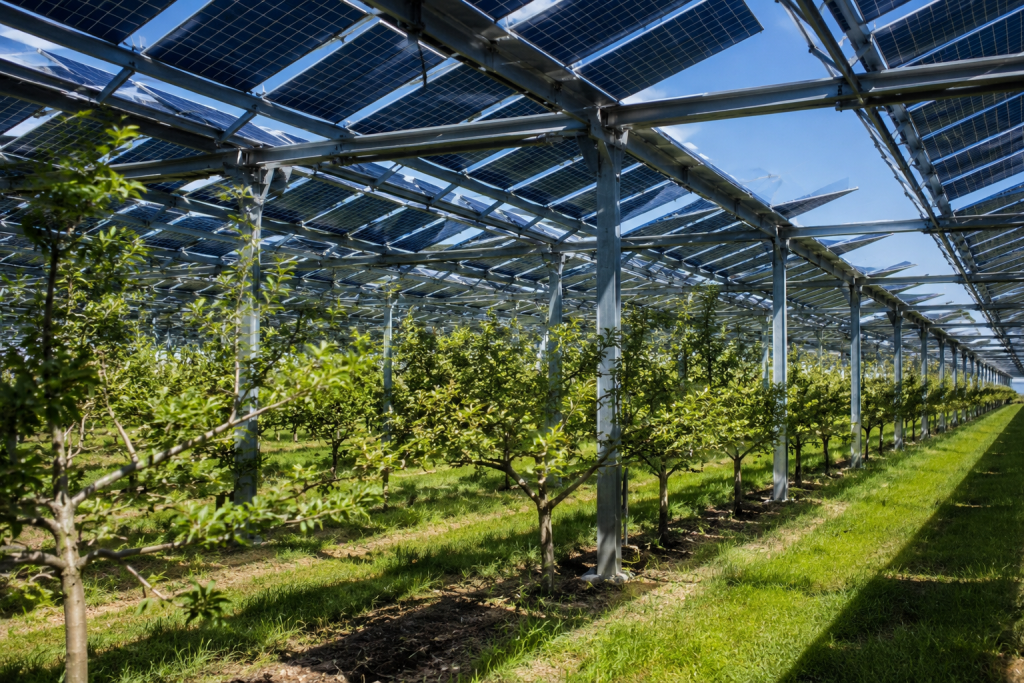
On a scorching summer afternoon in southern France, rows of grapevines stretch across the landscape beneath towering solar structures. At first glance, the installation resembles a conventional solar farm. A closer look reveals something far more innovative. The panels overhead are not simply generating electricity. They are constantly adjusting their position to help protect the plants growing below.
As temperatures rise, the panels can increase shade to reduce heat stress. When conditions become cooler or cloudier, they allow more sunlight to reach the crops. Some systems rely on weather sensors and automated software that continuously analyze environmental conditions, helping farmers balance the needs of agriculture with the production of renewable energy.
This approach is known as agrivoltaics, a rapidly developing field that combines farming and solar power on the same piece of land. What was once considered an experimental concept is now being tested on commercial farms across Europe, with France emerging as one of the most influential pioneers.
A New Solution to an Old Problem
For decades, agriculture and solar energy development were often seen as competing interests. As countries expanded renewable energy infrastructure, concerns grew about valuable farmland being converted into large solar parks.
Agrivoltaics was developed to address that challenge. Instead of choosing between food production and clean energy, the same land can be used for both purposes simultaneously.
The idea itself is not new. Researchers first began exploring dual land-use concepts in the 1980s. However, the technology available at the time was too expensive and limited for large-scale implementation. As solar panel costs declined and climate pressures intensified, interest in the concept accelerated dramatically.
By the 2010s, scientists, engineers, and farmers were working together to create systems capable of supporting crops while generating electricity. France became one of the first countries to move beyond theoretical discussions and launch real-world projects designed to test whether the concept could work at scale.
Why Too Much Sun Can Become a Problem
Many people assume that crops benefit from as much sunlight as possible. In reality, plants have limits.
When temperatures become excessively high, crops experience physiological stress. To conserve water, they partially close microscopic pores on their leaves known as stomata. While this helps reduce water loss, it also restricts the intake of carbon dioxide needed for photosynthesis.
As a result, growth slows and yields can suffer.
At the same time, extreme heat accelerates water evaporation from the soil, forcing farmers to rely more heavily on irrigation. In regions already facing drought conditions, this creates an additional challenge.
Agrivoltaic systems aim to address these issues by providing carefully controlled shade rather than complete coverage. The goal is not to block sunlight but to reduce excessive exposure during the hottest periods of the day.
Researchers have found that partial shading can lower soil temperatures, decrease water loss, and create a more stable growing environment for certain crops, particularly in areas vulnerable to heat waves and prolonged droughts.
How Intelligent Solar Panels Work
Unlike traditional solar installations, agrivoltaic systems are often elevated high above the ground, leaving enough space for farming activities to continue underneath.
Many modern designs incorporate movable panels mounted on tracking systems. These structures can rotate and adjust throughout the day in response to changing weather conditions.
Advanced installations may use artificial intelligence, climate data, and real-time field monitoring to determine how much sunlight should reach the crops at any given moment.
This creates a dynamic balance between agricultural productivity and electricity generation. Instead of maximizing energy production alone, the system is designed to support both objectives simultaneously.
The technology effectively transforms solar panels from passive energy collectors into active tools for crop management.
Why Vineyards Became the Perfect Testing Ground
Some of the earliest and most closely monitored agrivoltaic projects in France were installed in vineyards.
Grapevines are highly sensitive to changes in temperature and water availability. Excessive heat can alter ripening patterns, affect sugar concentration, reduce acidity, and ultimately influence the flavor profile of the wine.
In many French wine-producing regions, climate change has become a growing concern. Harvest dates have shifted, heat waves have intensified, and water stress has become increasingly common.
Researchers began exploring whether adjustable solar panels could help protect vines during critical stages of development. Early observations suggested that controlled shading may reduce water stress while helping stabilize growing conditions during extreme weather events.
For a country whose wine industry is deeply tied to both its economy and cultural identity, these findings attracted considerable attention.
An Unexpected Benefit for Solar Energy
Interestingly, the relationship works in both directions.
Solar panels operate most efficiently within certain temperature ranges. As panel temperatures rise, electrical efficiency gradually declines.
Vegetation growing beneath agrivoltaic systems can help cool the surrounding environment through natural processes such as evapotranspiration. This cooling effect may create conditions that improve panel performance compared with installations built over bare ground.
The result is a unique synergy where crops benefit from reduced heat exposure while solar equipment may benefit from a cooler microclimate.
This mutual interaction is one reason agrivoltaics has become an increasingly important area of scientific research.
France’s Effort to Protect Farmland
As enthusiasm for agrivoltaics expanded, so did concerns about potential misuse.
Some agricultural organizations warned that energy companies might prioritize electricity production while using the agrivoltaic label primarily as a way to gain access to farmland.
In response, France introduced one of the most comprehensive regulatory frameworks for agrivoltaic development in Europe.
Recent legislation requires agricultural activity to remain the primary purpose of the land. Solar installations must demonstrate measurable benefits for farming rather than simply occupying agricultural space.
The regulations are intended to ensure that agrivoltaic projects genuinely support crop production, livestock management, or climate resilience rather than becoming conventional solar farms in disguise.
Many policymakers view this approach as a potential model for other countries facing similar land-use challenges.
Not Every Crop Responds the Same Way
Despite its promise, agrivoltaics is not a universal solution.
Different crops have different light requirements. Some thrive under partial shade, while others depend on prolonged exposure to direct sunlight.
The success of an agrivoltaic installation depends on numerous factors, including crop type, climate, panel design, local weather patterns, and farm management practices.
Installation costs also remain relatively high. Structures must be tall enough to accommodate agricultural machinery while remaining durable enough to withstand wind, hail, and other environmental stresses.
For these reasons, most experts believe agrivoltaics will complement traditional agriculture rather than replace it.
A Glimpse of Agriculture’s Next Chapter
The challenges facing global agriculture are becoming increasingly complex. Farmers must produce more food while adapting to hotter temperatures, unpredictable rainfall, and growing pressure to reduce environmental impacts.
Agrivoltaics represents one possible answer to these competing demands.
Instead of forcing a choice between food production and renewable energy, the technology attempts to combine both within the same landscape.
Whether it ultimately becomes a defining feature of future agriculture remains uncertain. What is clear is that fields once used solely for farming are beginning to evolve into multifunctional spaces capable of generating both harvests and electricity.
Across parts of France, that future is no longer theoretical. It is already taking shape above vineyards, orchards, and croplands where solar panels and plants are learning to coexist, offering a glimpse of how agriculture may adapt to a changing world.