
Imagine walking through a crowded market in East Asia and noticing a small crowd gathered around a vendor. There are no flashy machines, no modern gadgets, and no elaborate kitchen equipment. Instead, a craftsman stands behind a simple counter holding what looks like a ring of pale dough. Within minutes, that ring transforms into a cloud-like bundle made of thousands of silky strands.
For many first-time observers, the process looks more like a magic trick than a culinary technique. Yet Dragon’s Beard Candy is very real, and its remarkable appearance is the result of centuries of tradition, patience, and skill.
Often referred to as one of China’s most visually impressive traditional sweets, Dragon’s Beard Candy combines culinary artistry, cultural heritage, mathematics, and food science in a way few desserts can.
A Sweet Surrounded by Imperial Legends
The exact origins of Dragon’s Beard Candy remain difficult to verify with complete certainty. Like many traditional foods that developed long before modern record-keeping, much of its early history has been preserved through stories passed down from generation to generation.
One of the most widely repeated legends traces the sweet back to the Han Dynasty, which ruled China from 206 BCE to 220 CE. According to the story, a confectioner serving at the imperial court developed a unique method of stretching sugar into incredibly fine strands.
When the dessert was presented to the emperor, he supposedly remarked that the delicate threads resembled the elegant beard of a dragon. The name Dragon’s Beard Candy was said to have originated from that observation.
While historians cannot confirm every detail of this tale, the connection between the dessert and imperial symbolism reflects important aspects of Chinese culture that have endured for centuries.
Why the Dragon Matters in Chinese Culture
To many people in the West, dragons are often portrayed as dangerous creatures to be feared or defeated. In Chinese tradition, however, dragons carry a very different meaning.
For thousands of years, dragons have symbolized strength, wisdom, prosperity, protection, and good fortune. They were closely associated with rainfall, agriculture, and the balance of natural forces.
Perhaps most importantly, the dragon became a symbol of imperial authority. Chinese emperors frequently incorporated dragon imagery into their clothing, palaces, ceremonial objects, and official insignia.
Because of this cultural significance, comparing a dessert to a dragon’s beard would have been seen as a compliment rather than a simple description.
A Dessert Born in an Era When Sugar Was Precious
Today, sugar is one of the most accessible ingredients in the world. Historically, that was far from the case.
Producing refined sugar required considerable labor, resources, and specialized knowledge. Elaborate sweets were often associated with wealth, privilege, and important celebrations.
In ancient societies, including imperial China, confectionery was not merely about satisfying a craving. Complex desserts demonstrated craftsmanship, status, and access to valuable ingredients.
Dragon’s Beard Candy stood out because it transformed a relatively simple ingredient into something that appeared almost impossible to create by hand.
The Technique That Fascinates Visitors Even Today
Many people assume Dragon’s Beard Candy is similar to cotton candy. Although both are sugar-based sweets, their production methods are entirely different.
Cotton candy is created by melting sugar and spinning it through tiny openings using machinery. Dragon’s Beard Candy relies on manual stretching and folding techniques that require years of practice to master.
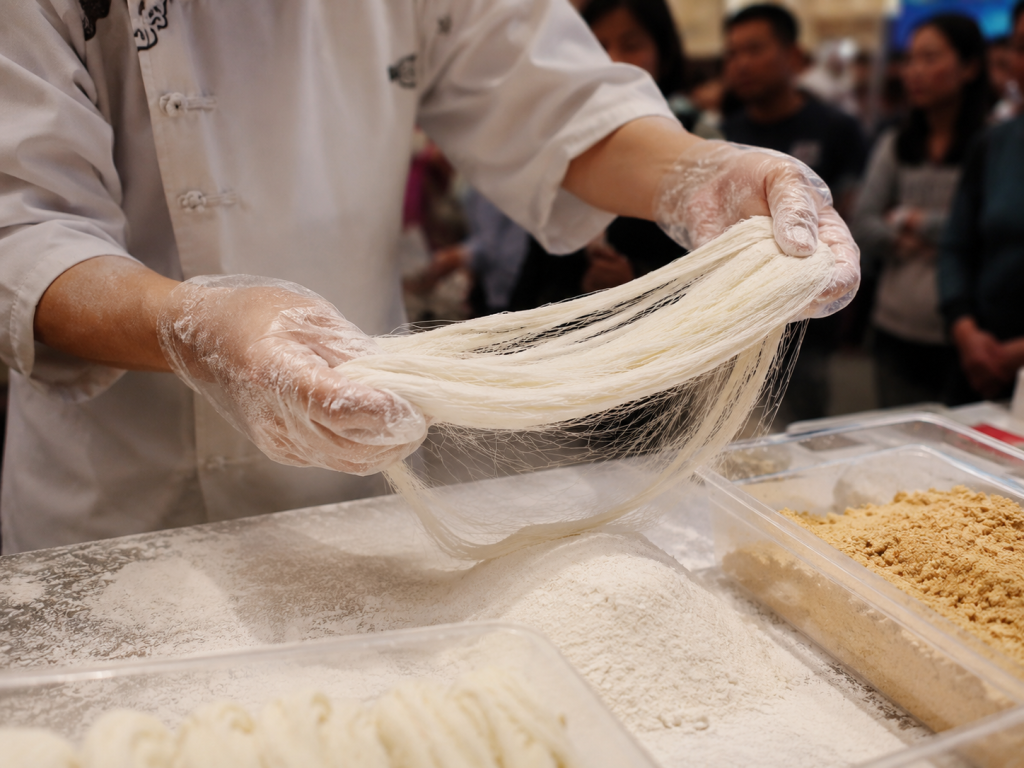
The process begins with a carefully prepared mixture of sugar and maltose syrup. Once cooled to the correct consistency, the mixture becomes flexible and elastic.
The confectioner shapes it into a large ring and coats it with starch to prevent sticking.
What follows is the most remarkable part of the process.
The ring is stretched, folded, and stretched again. With each repetition, the number of strands doubles.
Two strands become four.
Four become eight.
Eight become sixteen.
The pattern continues over and over until the original ring is transformed into thousands of hair-thin threads.
Watching the process unfold in real time is often what leaves audiences most amazed.
The Mathematics Hidden Inside the Dessert
One reason Dragon’s Beard Candy appears so extraordinary is that it demonstrates a principle known as exponential growth.
Every fold doubles the number of strands.
After ten folds, there are theoretically more than one thousand strands.
After fifteen folds, the number exceeds thirty thousand.
After twenty folds, the theoretical count rises beyond one million.
In practice, physical limitations prevent the process from continuing indefinitely, but the underlying mathematical principle explains how a relatively small ring of sugar can become a dense cloud of delicate fibers.
This combination of craftsmanship and mathematics is one reason the dessert continues to attract attention from both food enthusiasts and curious observers.
The Food Science Behind the Delicate Threads
Creating Dragon’s Beard Candy requires more than manual skill. It also depends on a precise understanding of how sugar behaves.
Maltose plays a particularly important role because it provides elasticity that allows the mixture to stretch repeatedly without immediately breaking apart.
Temperature is equally critical.
If the mixture becomes too cold, it hardens and cracks.
If it becomes too warm, it softens excessively and loses its structure.
Humidity presents another challenge. The fine strands absorb moisture from the air very quickly, which can alter both texture and appearance.
Experienced confectioners learn to recognize subtle changes in the candy’s consistency and adjust their technique accordingly.
Why Mastering the Craft Takes Years
Unlike many modern recipes that can be replicated by carefully following written instructions, Dragon’s Beard Candy requires extensive hands-on practice.
The confectioner must develop an intuitive understanding of texture, resistance, temperature, and timing.
A slight mistake can cause the strands to break, stick together, or lose their characteristic appearance.
For this reason, the skill has traditionally been passed from master to apprentice, often over many years of training.
In some regions, demonstrations of Dragon’s Beard Candy are considered part of the living preservation of traditional culinary heritage.
What Is Hidden Inside the Sweet
While the delicate strands attract most of the attention, they are only part of the experience.
The finished candy typically contains a flavorful filling made from ingredients such as crushed peanuts, toasted sesame seeds, coconut, or finely ground nuts.
This combination creates a contrast between the airy exterior and the rich, crunchy center.
The result is a dessert that offers much more than visual appeal.
Its texture is often what people remember most after tasting it.
Why It Is Best Eaten Fresh
One of the most unusual characteristics of Dragon’s Beard Candy is its short lifespan.
Because the strands are extremely thin, they readily absorb moisture from the surrounding environment.
As humidity increases, the candy gradually loses the delicate texture that makes it unique.
For that reason, it is often prepared in front of customers and enjoyed shortly after completion.
Unlike mass-produced sweets designed for long-term storage, Dragon’s Beard Candy is at its finest when freshly made.
Preserving a Tradition in the Modern World
The rise of industrial food production during the twentieth century caused many traditional culinary crafts to decline.
Dragon’s Beard Candy was no exception.
As factory-made sweets became more common, fewer artisans continued practicing the labor-intensive techniques required to produce the candy.
Fortunately, growing interest in cultural heritage, traditional foods, and authentic travel experiences has helped keep the craft alive.
Today, demonstrations can still be found in markets, festivals, and specialty shops across parts of Asia and in Chinese communities around the world.
Visitors often discover that watching the candy being made is every bit as memorable as tasting it.
More Than a Dessert
Dragon’s Beard Candy represents something increasingly rare in the modern food industry: a handcrafted tradition that has survived centuries of social and technological change.
Its enduring appeal comes not only from its sweetness but also from the remarkable process behind it. A simple mixture of sugar is transformed, through patience and expertise, into thousands of delicate strands that seem almost impossible to create by hand.
Whether viewed as a culinary performance, a cultural artifact, or a demonstration of mathematics and food science in action, Dragon’s Beard Candy remains one of the most fascinating traditional sweets still made today.
In an age dominated by automation and mass production, it serves as a reminder that some of the world’s most impressive creations still begin with nothing more than skilled hands, generations of knowledge, and an extraordinary amount of practice.