
Most People Visit This Mountain for a Few Hours. Some Call It Home for Weeks.
For most travelers, reaching the summit of a mountain marks the end of a journey. They take photographs, admire the view, and eventually return to the comfort of lower elevations.
On Omu Peak, the highest summit in Romania’s Bucegi Mountains, some people do the opposite.
At approximately 2,505 meters (8,219 feet) above sea level, meteorologists working at the mountain weather station remain long after the hikers have disappeared. During their rotations, they live and work on the summit, surrounded by wind, snow, clouds, and some of the most dramatic scenery in Eastern Europe.
Their workplace is isolated, exposed to extreme weather, and inaccessible during certain winter conditions. Yet every day, observations collected from this remote outpost contribute to weather forecasts used by millions of people.
A Weather Station on the Roof of the Carpathians
Stretching across Central and Eastern Europe, the Carpathian Mountains form one of the continent’s largest mountain systems. Romania is home to more than half of the entire Carpathian range, and some of its most spectacular landscapes can be found in the Bucegi Mountains.
Rising above rocky plateaus and deep valleys, Omu Peak occupies a strategic location for atmospheric monitoring. Its elevation allows meteorologists to observe weather systems that cannot be studied as effectively from lower-altitude stations.
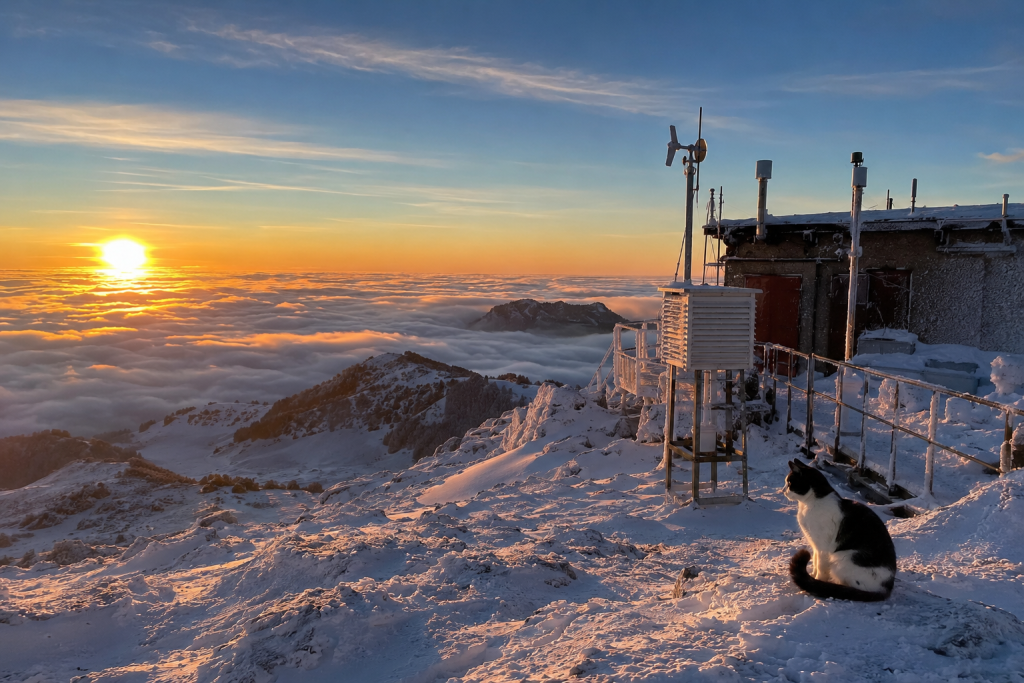
For decades, scientists have collected measurements here, building a valuable record of temperature, wind, humidity, precipitation, cloud cover, and atmospheric pressure. These observations help meteorological agencies understand how weather develops over the Carpathian region and how it may affect areas hundreds of kilometers away.
While satellite technology has transformed modern forecasting, mountain stations like Omu remain essential sources of ground-based observations.
Living Where the Weather Never Takes a Break
Weather can change rapidly in mountainous terrain, but few places demonstrate this better than Omu Peak.
A clear morning may turn into dense fog within minutes. Sunshine can give way to freezing rain, snow, or thunderstorms with little warning. During winter, powerful winds regularly sweep across the summit, while deep snow and ice transform the landscape into a frozen world.
Unlike office workers who commute home after their shift, station personnel remain on-site throughout their rotation. The weather station serves as a workplace, a shelter, a dining room, and a temporary home.
Life at this altitude requires planning and adaptability. Supplies must be carefully managed, equipment must remain operational regardless of conditions, and every task becomes more challenging when carried out in an environment shaped by cold, wind, and isolation.
Watching Storms From Above
One of the most extraordinary aspects of working on Omu Peak is the perspective.
Many people experience storms from below. Meteorologists at the summit sometimes watch them from above.
Temperature inversions frequently fill valleys with thick layers of cloud while the mountain rises into clear skies. The result is a breathtaking phenomenon often described as a “sea of clouds,” where entire landscapes disappear beneath a white blanket stretching to the horizon.
Thunderstorms can create equally remarkable scenes. Lightning may illuminate cloud tops below the station while the summit remains in relatively calm conditions.
Such moments are not merely beautiful. They also provide valuable opportunities for observing atmospheric processes that help scientists better understand mountain weather systems.
Rodica, the Cat Who Became a Local Legend
Scientific instruments are not the only residents of Omu Peak.
Over the years, a black-and-white cat named Rodica has become one of the station’s most recognizable figures. Photographs of her exploring snowy pathways, sitting beside weather equipment, or gazing across the mountains have attracted attention far beyond Romania.
Part of her appeal comes from the contrast she represents. Cats are usually associated with urban apartments, warm fireplaces, and quiet neighborhoods. Seeing one thrive in a harsh alpine environment more than 8,000 feet above sea level feels almost surreal.
Visitors who make the climb often hope to catch a glimpse of Rodica, whose presence has become closely associated with life at the station.
Foxy and the Wild Side of the Mountains
Rodica is not the summit’s only famous animal.
A red fox known locally as Foxy has become another familiar sight around the station. Like many foxes living in mountain regions, she has adapted remarkably well to challenging conditions and occasionally appears near the buildings.
The red fox is one of the most widespread and adaptable predators in the Northern Hemisphere. From forests and grasslands to urban edges and alpine environments, the species has demonstrated an extraordinary ability to survive in diverse habitats.
Photographs featuring Foxy against snowy ridges and dramatic sunsets have become popular among nature enthusiasts, offering a reminder that even in one of Romania’s most remote locations, wildlife remains an integral part of the ecosystem.
A Front-Row Seat to Climate Change
Mountain weather stations provide more than daily forecasts.
Because they collect observations over long periods, they also help researchers study environmental change. Temperature trends, snowfall patterns, precipitation levels, and seasonal variations recorded at high-altitude stations can reveal important clues about how mountain ecosystems are evolving.
Scientists often consider long-term meteorological records among the most valuable tools for understanding climate change. Remote stations such as Omu contribute data that may eventually help answer some of the most important environmental questions of the 21st century.
In this sense, the work carried out on the summit extends far beyond local forecasting.
Nights Few People Ever Experience
When darkness falls and the last hikers have descended, another side of the mountain emerges.
Far from major cities and largely free from light pollution, the summit offers exceptionally clear views of the night sky. On favorable evenings, the Milky Way stretches across the horizon in extraordinary detail.
During winter storms, the atmosphere changes completely. Winds howl across the ridges, snow accumulates against buildings, and the station becomes a solitary outpost surrounded by darkness and ice.
These are experiences that cannot be replicated in cities or even in most mountain destinations. They belong to a world that few people ever see and even fewer call home, however temporarily.
One of Europe’s Most Unusual Workplaces
Modern technology has automated many aspects of weather observation, yet mountain stations continue to rely on human expertise.
Meteorologists remain responsible for monitoring conditions, verifying observations, maintaining equipment, and ensuring the continuity of data collection. Their work requires scientific knowledge, practical problem-solving skills, and a willingness to live in an environment that can be both breathtakingly beautiful and physically demanding.
For most visitors, Omu Peak is a destination reached after hours of hiking.
For the men and women who work there, it is something entirely different.
It is a place where clouds drift beneath the windows, where storms can be observed from above, where wildlife occasionally shares the landscape, and where science continues quietly in one of Europe’s most remarkable mountain settings.
High above the valleys of the Romanian Carpathians, the weather station on Omu Peak stands as a reminder that some of the most important work happens far from cities, in places where nature still sets the rhythm of everyday life.