
The internet has a remarkable way of turning a few seconds of footage into a global phenomenon. Sometimes the images themselves are enough to capture the world’s attention. Other times, it is the story attached to those images that spreads even faster than the facts.
Few cases illustrate this better than the widely shared video of a man seen clinging to the outside of a high-rise residential building in China. The footage has resurfaced repeatedly over the years, generating millions of views and countless discussions. With every new wave of attention, the same dramatic explanation tends to follow: a tale of infidelity, panic, and a desperate attempt to avoid being discovered.
Yet the deeper people looked into the story, the more complicated it became.
While the incident shown in the video appears to be genuine, many of the details that transformed it into an international sensation have never been conclusively verified. What began as a shocking real-life event eventually became a fascinating example of how modern myths are created online.
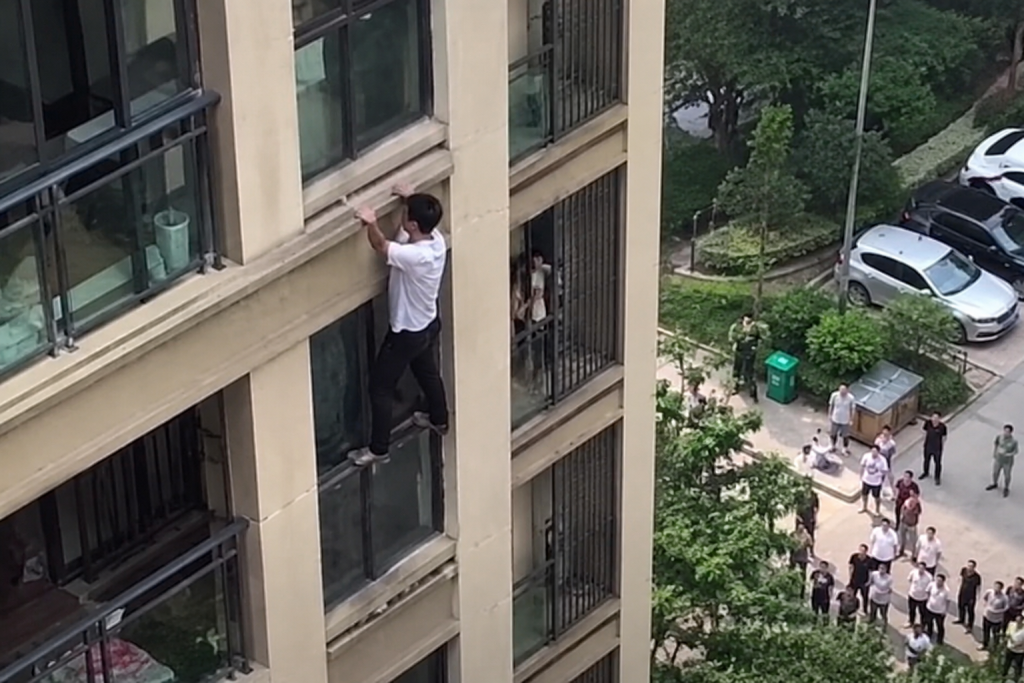
A Disturbing Scene Captured on Camera
The video itself is unsettling from the very first moments.
A man can be seen outside a multi-story residential building, positioned in a place where no one would reasonably expect another person to be. He is not standing on a balcony. He does not appear to be wearing any safety equipment. There are no visible signs that he is performing maintenance work or engaging in any legitimate activity that would explain his location.
People on the ground notice the unusual scene and begin recording.
Viewers are immediately confronted with a troubling question: how did he end up there?
The footage offers no obvious answers. It captures only the final stage of an event that had already unfolded before anyone started filming.
That absence of context would ultimately become one of the main reasons the video spread so widely.
The Story That Traveled Around the World
As the footage gained attention online, explanations began appearing almost immediately.
The version that eventually dominated social media claimed that the man was a fitness coach involved in a relationship with a married woman. According to this account, he was visiting her apartment when her husband unexpectedly returned home.
Faced with the possibility of being discovered, he allegedly climbed outside the building in an attempt to hide.
The story contained everything needed for viral success. There was secrecy, tension, danger, and a dramatic ending. It was easy to understand and easy to share.
Within a short period of time, countless social media posts, discussion forums, and entertainment websites repeated the same narrative. For many readers, the repetition itself became evidence that the story had already been verified.
However, repetition and verification are not the same thing.
What Can Actually Be Confirmed?
When journalists and fact-checkers attempted to trace the origins of the story, they encountered a significant problem.
The video appears to be authentic.
The incident itself appears to have genuinely occurred.
What is far less certain is the explanation attached to it.
Publicly available information confirms that the footage circulated online years before its most recent resurgence. It is not a newly discovered video, nor is it believed to be fabricated.
Beyond that, however, many of the details become difficult to verify independently.
Different reports identify the man differently. Some provide additional background information, while others offer very few specifics. Certain articles present the alleged affair as an established fact, whereas others acknowledge that the circumstances remain unclear.
Most importantly, publicly accessible evidence does not appear to conclusively support every detail that became part of the viral narrative.
As a result, a distinction must be made between what viewers can see in the footage and what people later assumed had happened.
How Rumors Become Accepted as Facts
The popularity of this story highlights a well-documented psychological phenomenon.
Researchers have long studied what is known as the “illusory truth effect.” This tendency causes people to perceive information as more credible simply because they have encountered it repeatedly.
In other words, familiarity can be mistaken for accuracy.
The human brain often treats repeated information as trustworthy, even when the supporting evidence is weak. Social media platforms can accelerate this process dramatically.
Content that provokes strong emotional reactions is more likely to be shared. As more people share it, the story reaches a larger audience. The wider it spreads, the more legitimate it begins to appear.
Eventually, a claim can become widely accepted despite the absence of definitive proof.
The alleged affair at the center of this case may or may not have occurred exactly as described. What is certain is that millions of people came to believe it long before any comprehensive verification was possible.
Why We Prefer Simple Explanations
Human beings are naturally uncomfortable with uncertainty.
When confronted with an unusual event, most people instinctively search for a narrative that makes sense of what they are seeing. A mysterious image raises questions. A dramatic story provides answers.
In this case, the image of a man hanging from the outside of a building created an information vacuum. The alleged affair offered a straightforward explanation that filled that vacuum neatly.
Sociologists have observed similar patterns throughout history. Long before the internet existed, rumors and urban legends often emerged whenever a shocking event lacked a clear explanation.
The difference today is speed.
What once took months or years to spread can now reach millions of people within hours.
The Psychology of Decisions Made Under Extreme Stress
Regardless of the circumstances that led to the incident, experts agree on one important point: extreme stress can significantly alter human decision-making.
When people perceive an immediate threat, the body’s survival mechanisms activate. Adrenaline levels rise, heart rate increases, and attention narrows toward the perceived danger.
Under these conditions, individuals may make choices that appear irrational to outside observers.
Neuroscientists have found that intense stress can impair risk assessment and reduce the brain’s ability to carefully evaluate alternatives. Actions that seem impossible to justify afterward may have felt like the only available option in the moment.
This phenomenon has been documented in a wide range of emergencies, from natural disasters to accidents and life-threatening confrontations.
The Hidden Danger of Heights
Safety specialists have long warned that surviving on the exterior of a building without protective equipment is extraordinarily difficult.
Even physically fit individuals face significant challenges.
Grip strength declines over time. Muscles fatigue. Stress affects coordination and concentration. Sweaty hands reduce traction. Small shifts in body position can dramatically alter balance.
Professionals who work at height rely on multiple layers of safety systems precisely because human strength alone is not a reliable safeguard.
Without harnesses, anchor points, and fall-protection equipment, the margin for error becomes extremely small.
In situations involving significant heights, even a brief loss of control can have catastrophic consequences.
A Mystery That May Never Be Fully Solved
Years after the footage first appeared, many questions remain unanswered.
Who exactly was the man in the video?
What chain of events led him to that position?
Was the widely shared story accurate, partially accurate, or entirely speculative?
Without additional official information, the public may never know the complete truth.
Ironically, that uncertainty may be one of the main reasons the video continues to attract attention long after the incident occurred.
The Lasting Lesson Behind a Few Seconds of Footage
Ultimately, the most revealing aspect of this story may not be what happened before the camera started recording.
It may be what happened afterward.
A real incident was captured on video, shared around the world, and gradually surrounded by a narrative that became more famous than the verified facts themselves.
The case serves as a reminder that authenticity and accuracy are not always the same thing. A genuine video can be paired with assumptions, rumors, and speculation that eventually take on a life of their own.
In an age when information travels faster than ever before, the mystery of the man hanging from a high-rise building remains a powerful example of how easily fact and fiction can become intertwined.
Whether the full truth is ever known or not, the story continues to fascinate millions because it sits at the intersection of human curiosity, digital culture, and the enduring desire to find explanations for events we do not completely understand.