
Most people think of snow as the ultimate symbol of a lifeless environment. It covers mountains, forests, and fields in a blanket of ice and cold, creating the impression that nature has temporarily pressed pause until spring returns.
That assumption seems perfectly reasonable. After all, freezing temperatures slow biological activity, preserve food, and make survival difficult for countless organisms. The idea that fungi, algae, and microscopic life could actively exist inside snow sounds almost impossible.
Yet scientists have discovered that snow is far from sterile.
Beneath what appears to be a frozen and inactive surface, entire microscopic communities can survive, grow, and even thrive. Some of these organisms have evolved extraordinary adaptations that allow them to function in temperatures that would be lethal to most forms of life.
Their existence has not only changed our understanding of Earth’s ecosystems but has also influenced modern research into climate science and the search for life beyond our planet.
The Strange Sight That Confused Explorers for Centuries
Long before microscopes revealed the hidden world of microorganisms, travelers and explorers occasionally reported something remarkable.
Across remote mountain ranges and polar regions, patches of snow would sometimes appear pink, red, or even crimson. The phenomenon looked so unusual that many early observers struggled to explain it.
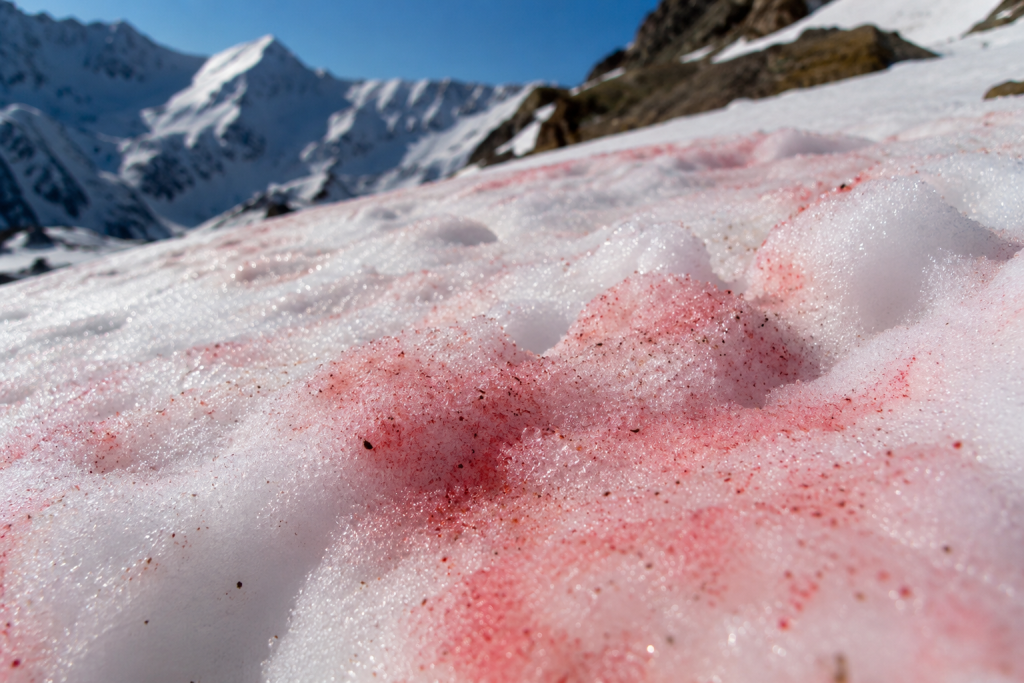
Historical accounts describe landscapes that appeared stained with blood. In an era when natural processes were poorly understood, such scenes inspired speculation, myths, and even supernatural explanations.
As scientific methods improved during the nineteenth century, researchers began collecting and analyzing samples from these mysterious locations.
The results were unexpected.
The color did not come from minerals, pollution, or animal remains. Instead, it originated from living organisms that had adapted to some of the coldest environments on Earth.
Snow Is Home to More Life Than Most People Realize
Modern studies have revealed that snow and ice contain far more biological activity than previously imagined.
Scientists have identified numerous species of bacteria, fungi, yeasts, and microscopic algae living within frozen environments. Many belong to a group known as psychrophiles, organisms specifically adapted to cold conditions.
Unlike most life forms, which struggle when temperatures approach freezing, these organisms perform remarkably well in such environments.
For them, extreme cold is not an obstacle.
It is home.
Some species actually experience stress when temperatures become too warm, demonstrating just how specialized their adaptations have become over millions of years of evolution.
Can Mold Actually Live in Snow?
The answer is yes.
Several species of fungi can survive and develop in snowy environments. One of the best-known examples is commonly referred to as snow mold.
Despite its name, snow mold is not a single organism but a group of fungal species that flourish beneath prolonged snow cover.
A thick layer of snow acts as a natural insulator. While air temperatures above the surface may drop far below freezing, the area between the snowpack and the ground often remains relatively stable.
Moisture is abundant, temperatures fluctuate less dramatically, and wind exposure is minimal.
For certain fungi, these conditions create an ideal environment.
When the snow eventually melts, gardeners and homeowners sometimes discover circular gray, white, or pink patches on grass and vegetation. These marks are evidence of fungal growth that occurred throughout the winter months.
The Biological Tricks That Make Survival Possible
One of the greatest challenges for life in cold environments is preventing cellular damage caused by ice formation.
When water freezes inside living cells, sharp ice crystals can rupture delicate structures and destroy the organism.
Cold-adapted microorganisms have evolved ingenious solutions to this problem.
Many produce specialized proteins that function similarly to antifreeze compounds. These molecules help regulate ice crystal formation and reduce the risk of cellular injury.
Others modify the chemical composition of their cell membranes, allowing them to remain flexible and functional even at extremely low temperatures.
These adaptations enable biological processes to continue under conditions that would halt or kill many other organisms.
The Mystery of Pink Snow
Among the most visually striking examples of life in snow is a phenomenon often called “watermelon snow.”
The name comes from its unusual pink or reddish coloration, which can transform entire sections of snow-covered landscapes.
This effect is caused by microscopic algae that thrive in cold environments. Species belonging to the genus Chlamydomonas are among the best-known contributors.
To protect themselves from intense ultraviolet radiation found at high elevations and polar latitudes, these algae produce red pigments.
As their populations increase, the snow gradually takes on shades of pink, red, or orange.
The phenomenon has been documented in locations ranging from the Alps and the Rocky Mountains to Greenland and Antarctica.
What appears to be a simple color change is actually a sign of a thriving microscopic ecosystem.
How Tiny Organisms Can Influence Melting Ice
For many years, snow algae were viewed primarily as a scientific curiosity.
Researchers now understand that they may play a larger environmental role.
Fresh snow reflects a significant portion of incoming sunlight back into the atmosphere. This reflective property, known as albedo, helps maintain cooler surface temperatures.
When algae and other microorganisms darken the snow, its ability to reflect sunlight decreases.
More solar energy is absorbed, causing the surface to warm more quickly.
As a result, snow and ice may melt faster than they otherwise would.
Scientists continue to investigate how these biological communities interact with glaciers and ice sheets, particularly as global temperatures continue to change.
Unexpected Life in Earth’s Coldest Regions
Few places appear more hostile to life than Antarctica.
For decades, many researchers assumed that vast portions of the continent contained little biological activity beyond a handful of hardy species.
Modern discoveries have challenged that view.
Microbial ecosystems have been identified within snow, ice, and even lakes hidden beneath thick layers of Antarctic ice.
Some of these environments may have remained isolated for thousands of years.
Their inhabitants demonstrate that life can persist under conditions once considered nearly impossible.
These findings continue to reshape our understanding of where living organisms can survive and how resilient biological systems can be.
What Snow Mold Has to Do With the Search for Alien Life
Perhaps the most fascinating aspect of this research is its relevance to astrobiology.
Scientists searching for life elsewhere in the Solar System often study Earth’s most extreme environments first. If organisms can survive in frozen deserts, beneath glaciers, or within permanently cold ecosystems, similar forms of life might potentially exist on other worlds.
This possibility has drawn attention to places such as Europa, one of Jupiter’s moons, and Enceladus, a moon orbiting Saturn.
Both are believed to contain liquid oceans hidden beneath thick shells of ice.
While no evidence of extraterrestrial life has been found, the discovery of cold-loving microorganisms on Earth has expanded the range of environments considered potentially habitable.
A Frozen Landscape That Is Far More Alive Than It Appears
At first glance, a snow-covered landscape seems silent, motionless, and empty.
Science tells a different story.
Beneath the white surface, microscopic organisms may be carrying out the processes of life, adapting to conditions that once appeared incompatible with survival.
The existence of mold, fungi, algae, and bacteria in snow serves as a reminder that nature is often more complex than it seems.
What appears to be a frozen wasteland can actually support thriving biological communities, revealing yet another example of life’s remarkable ability to adapt to environments at the very edge of possibility.
The next time you look across a field of snow or a distant glacier, it may be worth remembering that beneath that blanket of white lies an invisible world that scientists are still working to fully understand.