
In medical museums around the world, there is a device that often stops visitors in their tracks. It looks less like a piece of healthcare equipment and more like something imagined by a science-fiction writer from another era. A large metal cylinder with room for a single patient and an opening for the head, it seems almost impossible that lives once depended on it.
Most people glance at it, read the description, and move on.
For Martha Lillard, however, that machine is not a museum artifact.
It is the reason she is alive.
When she was placed inside an iron lung in 1953, she was only five years old. Dwight Eisenhower had just begun his presidency. Rock and roll was still in its infancy. Humans had not ventured into space, let alone walked on the Moon. The internet, smartphones, and artificial intelligence belonged to a future no one could yet imagine.
More than seventy years later, after extraordinary technological and medical advances, Martha remains one of the last publicly known people still associated with this remarkable piece of equipment.
Her story is not only about survival. It is also about one of the most feared diseases of the twentieth century, the ingenuity of early medical technology, and the scientific breakthroughs that transformed global public health.
The Summer Everything Changed
In the summer of 1953, Martha was an ordinary child living through an extraordinary period in history.
At the time, poliomyelitis—better known as polio—was one of the most feared diseases in the United States and many other parts of the world. Families followed news reports anxiously whenever outbreaks appeared. Communities worried about new infections. Hospitals prepared for the possibility of another difficult season.
What made polio especially frightening was its unpredictability.
Many infected people experienced only mild symptoms or none at all. Yet in a small percentage of cases, the virus attacked the nervous system, damaging the neurons responsible for controlling muscles.
Sometimes the result was weakness or paralysis in the arms or legs.
In the most severe cases, the muscles needed for breathing stopped working properly.
That is what happened to Martha.
Within a short period, her illness progressed to a point where breathing on her own became impossible. Without medical intervention, her chances of survival would have been extremely low.
A Disease That Terrified an Entire Generation
To understand Martha’s experience, it is important to understand the world she grew up in.
Before vaccines became available, polio outbreaks caused widespread fear. Parents often avoided crowded public spaces during the summer months. Swimming pools, movie theaters, and playgrounds were sometimes viewed with suspicion whenever infection rates increased.
The disease reached a devastating peak in the United States in 1952, when more than 57,000 cases were reported. Thousands of people were left with permanent paralysis, and more than 3,000 died.
For many families, polio represented an invisible threat that could strike without warning.
Children who seemed perfectly healthy one week could find themselves in a hospital bed the next.
The Machine That Helped Patients Breathe
When paralysis affected the muscles responsible for breathing, doctors turned to one of the most iconic medical devices of the twentieth century: the iron lung.
Despite its name, the machine was not an artificial lung.
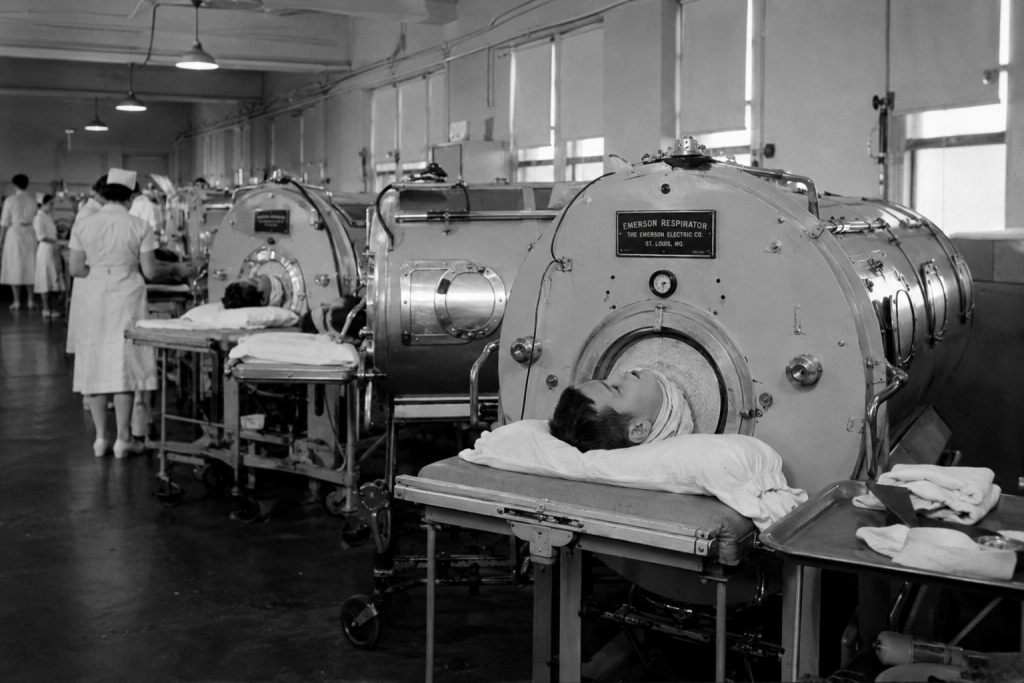
Instead, it was a form of negative-pressure ventilation. Patients lay inside a sealed metal chamber while their heads remained outside. The machine changed the air pressure around the body, causing the chest to expand and contract in a way that mimicked natural breathing.
Today, the technology appears surprisingly simple.
In the 1940s and 1950s, however, it represented a medical breakthrough.
Hospitals caring for polio patients often housed entire rooms filled with iron lungs operating day and night. Historic photographs from the era show rows of large metal cylinders, each containing a patient whose life depended on the machine’s rhythmic movement.
For many children, every cycle of the device meant another breath.
Watching the World Change
Martha survived the illness, but the effects remained with her throughout her life.
As the decades passed, the world transformed around her.
Television became a household staple. Humans landed on the Moon. Personal computers entered homes and workplaces. The internet connected billions of people across continents. Smartphones placed immense computing power into the palms of ordinary users.
Yet through all of these changes, Martha continued to live with the consequences of an illness contracted in childhood.
That contrast is one of the reasons her story continues to capture public attention.
She represents a direct connection between two vastly different eras: a time when polio epidemics filled hospital wards and a modern world where the disease has been pushed to the brink of eradication in many regions.
The Scientific Breakthrough That Changed History
Only two years after Martha contracted polio, medical history took a dramatic turn.
In 1955, researchers announced that Jonas Salk’s polio vaccine had proven safe and effective.
The news was celebrated across the United States. For millions of parents, it offered hope that future generations might never experience the fear that had dominated so many summers.
Later, Albert Sabin’s oral polio vaccine helped expand immunization efforts even further.
The results were extraordinary.
Over the following decades, global vaccination campaigns reduced polio cases by more than 99 percent. In many countries, the disease disappeared entirely.
Hospital wards once filled with iron lungs gradually emptied.
Machines that had once represented the front line of medical care became historical artifacts.
From Thousands of Patients to a Handful of Survivors
During the height of the polio epidemics, thousands of people relied on iron lungs.
As medical technology advanced, most patients transitioned to newer forms of respiratory support. Others passed away as the decades went by.
Today, only a very small number of individuals remain publicly associated with these machines.
Each of them serves as a living reminder of a period when medicine was engaged in one of its greatest battles against infectious disease.
Martha Lillard is among those rare survivors.
More Than a Medical Story
At first glance, this might seem like a story about an old machine.
In reality, it is a story about resilience.
It is about a child whose life was permanently altered by a virus that once terrified entire nations.
It is about scientists, physicians, nurses, and researchers who refused to accept that polio was unbeatable.
It is about the extraordinary progress of medicine and public health.
Most of all, it is about the human ability to adapt to circumstances that would seem unimaginable to others.
A Living Link to a Different Era
Today, most people encounter an iron lung only in photographs, documentaries, or museum exhibits.
For Martha Lillard, it remains something far more personal.
It is a reminder of a childhood illness, a witness to decades of history, and a symbol of the technology that helped her survive when few other options existed.
As the world continues to move forward, her story offers a rare glimpse into a chapter of medical history that is rapidly fading from living memory.
It reminds us how far science has come, how devastating infectious diseases once were, and how dramatically a single breakthrough can change the course of human lives.
Above all, it reminds us that behind every medical milestone and historical statistic is a person whose story deserves to be remembered.