
For centuries, humans have been fascinated by animals that seem to defy the limits of biology. While a broken bone in a person may take months to heal and a lost limb is gone forever, some species possess an astonishing ability to rebuild what has been damaged or removed. Certain salamanders can regenerate entire legs, tails, portions of their spinal cords, and even parts of vital organs.
This extraordinary talent has inspired generations of scientists to ask a deceptively simple question: if nature has already solved the problem of regeneration, why can’t humans do the same?
Recent research has brought renewed attention to that question. A study published in 2025 highlighted the role of a gene called CYP26B1 in limb regeneration, offering fresh insight into how some animals organize and control the rebuilding of complex body structures. The discovery does not mean that humans are on the verge of regrowing arms or legs, but it provides an important clue in one of biology’s most intriguing mysteries.
Humanity’s Long Fascination With Regeneration
The scientific study of regeneration stretches back hundreds of years. Early naturalists documented reports of salamanders regrowing missing limbs, observations that initially seemed almost impossible to believe.
As experimentation became more sophisticated during the eighteenth and nineteenth centuries, researchers confirmed that these animals truly possessed regenerative abilities far beyond anything seen in humans. What appeared to be a biological curiosity gradually became a major scientific puzzle.
Over time, scientists realized that regeneration is not evenly distributed across the animal kingdom. Some species can rebuild entire structures with remarkable precision, while others rely primarily on scar formation. Understanding why these differences exist remains one of the central goals of regenerative biology.
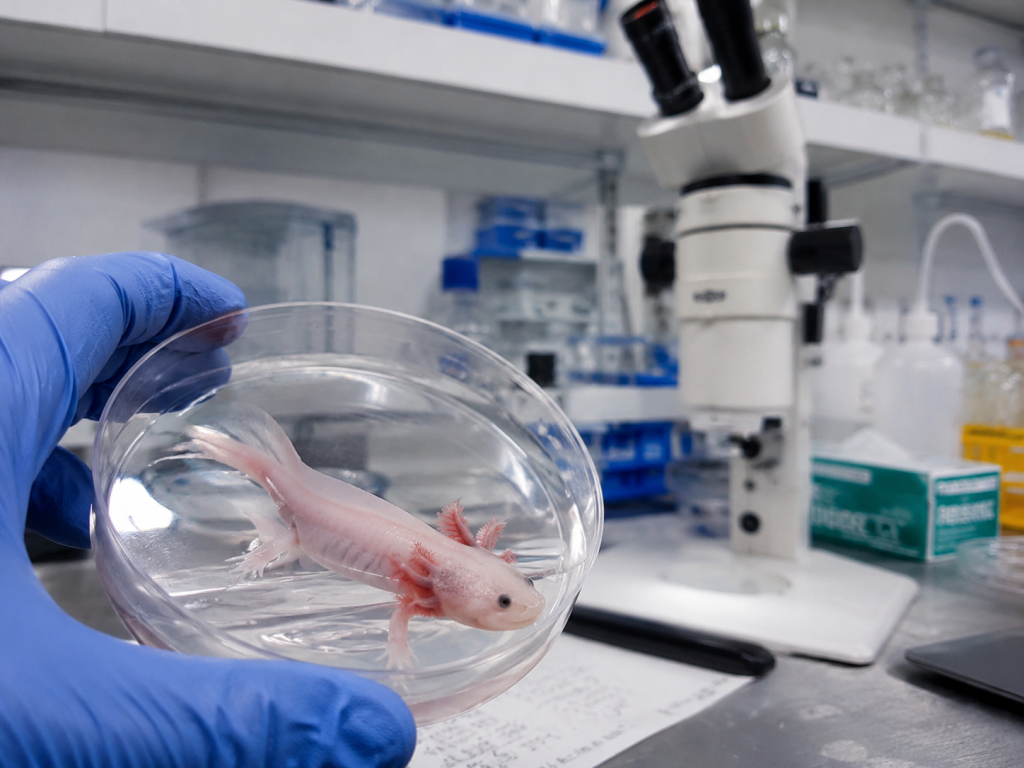
Meet the Axolotl: A Living Regeneration Expert
Axolotl has become one of the most important research organisms in regenerative medicine.
Native to the lake systems around Mexico City, this unusual amphibian has earned worldwide attention for its ability to reconstruct damaged body parts that would be permanently lost in most vertebrates.
An axolotl can regenerate a complete limb, sections of its spinal cord, portions of its heart, jaw tissue, and even parts of its brain. What makes this process especially remarkable is not simply that tissue grows back, but that it returns with the correct structure and function.
Bones reconnect properly. Muscles reform in the right locations. Blood vessels and nerves are restored. The regenerated limb often becomes nearly indistinguishable from the original.
For scientists, this raises an obvious question: how do the cells know exactly what to rebuild?
The Biological Instructions Hidden Inside Cells
When an axolotl loses part of a limb, the cells near the injury undergo a dramatic transformation.
Instead of immediately forming scar tissue, they gather into a structure known as a blastema. This temporary collection of highly active cells acts as a biological construction site where regeneration begins.
The challenge facing those cells is enormous. They must determine whether they need to rebuild a fingertip, a hand, a forearm, or an entire limb segment. Somehow, they retain information about their position within the body and use that information to guide reconstruction.
Researchers have spent decades searching for the molecular signals that provide these instructions.
Why Retinoic Acid Matters
One of the most important molecules involved in body patterning is retinoic acid, a compound derived from vitamin A.
Retinoic acid plays a crucial role during embryonic development, helping cells understand where they are located and what type of tissue they should become. It contributes to the formation of limbs, organs, the nervous system, and numerous other structures during early development.
Because of its powerful effects, the amount of retinoic acid present in tissues must be carefully regulated. Too little can disrupt normal development. Too much can be equally harmful.
This balance is maintained through a network of genes and enzymes that constantly control production and breakdown.
The Role of CYP26B1
CYP26B1 belongs to a family of genes responsible for metabolizing retinoic acid.
Rather than creating the molecule, the gene produces an enzyme that breaks it down. Although that might sound like a relatively simple task, it turns out to be critically important.
By determining how quickly retinoic acid is removed from tissues, CYP26B1 helps shape the chemical environment surrounding regenerating cells. Those differences influence how cells interpret positional information and decide what structures need to be rebuilt.
This became the focus of the 2025 study that captured widespread attention among regenerative biologists.
A Discovery That Helped Explain Regeneration
Researchers found that CYP26B1 activity varies across different regions of a regenerating limb.
These variations affect local concentrations of retinoic acid, creating gradients that provide cells with positional cues. In other words, cells are not receiving identical instructions everywhere. The information they receive depends partly on where they are located within the regenerating tissue.
To test the importance of this mechanism, scientists experimentally altered CYP26B1 activity and disrupted the normal breakdown of retinoic acid.
The results revealed that changes in retinoic acid levels could interfere with positional identity. Cells sometimes responded as though they belonged to a different part of the limb, leading to abnormal regenerative outcomes.
The findings strengthened the idea that precise regulation of retinoic acid is essential for accurate tissue reconstruction.
Why Humans Cannot Regrow Limbs
This is where public excitement often outruns scientific reality.
Humans possess both retinoic acid and the CYP26B1 gene. Many of the molecular pathways involved in development and tissue repair are shared across vertebrates.
However, regeneration is not controlled by a single gene.
The ability to rebuild an entire limb requires the coordinated activity of numerous signaling systems, growth factors, immune responses, developmental genes, and tissue-specific programs. Scientists have identified important pathways such as Wnt, FGF, BMP, and Sonic Hedgehog signaling, all of which contribute to tissue formation and regeneration.
CYP26B1 appears to be one important piece of this network rather than a standalone solution.
The Major Difference Between Humans and Regenerative Species
One of the greatest obstacles to human regeneration is scar formation.
When people experience significant injuries, the body’s immediate priority is survival. Rapid wound closure helps reduce blood loss and lowers the risk of infection. Scar tissue forms quickly, stabilizing the damaged area.
From an evolutionary perspective, this strategy is highly effective.
The downside is that scar formation often prevents the complex rebuilding programs seen in animals such as axolotls. Instead of recreating lost structures, the body focuses on sealing the injury.
Scientists increasingly believe that understanding how regenerative species avoid excessive scarring may be just as important as identifying the genes involved in regeneration itself.
Humans Still Retain Some Regenerative Potential
Although humans cannot regenerate limbs, our bodies are not completely devoid of regenerative abilities.
The liver can restore much of its lost mass after surgical removal of tissue. Skin continuously renews itself throughout life. Bone can repair fractures. Blood cells are constantly replaced through the activity of stem cells in the bone marrow.
Medical literature has even documented cases in which very young children partially regenerated fingertip tissue following injury under specific conditions.
These examples suggest that regenerative capacity was never entirely lost during human evolution. Instead, it appears to be more limited and tightly controlled.
What This Means for the Future of Medicine
The significance of the CYP26B1 discovery lies not in immediate clinical applications but in the deeper understanding it provides.
Every new insight helps researchers uncover how regeneration is organized at the cellular and molecular level. That knowledge could eventually contribute to advances in wound healing, tissue engineering, nerve repair, cartilage regeneration, and treatments for severe injuries.
Around the world, scientists are already exploring technologies such as stem-cell therapies, laboratory-grown organoids, bioengineered tissues, and regenerative approaches designed to repair damaged organs.
The path toward truly regenerative medicine remains long, but each discovery helps illuminate part of the journey.
A Small Piece of a Much Larger Puzzle
The story of CYP26B1 is a reminder that scientific progress often happens through incremental breakthroughs rather than dramatic leaps.
Researchers have not discovered a way for humans to regrow lost limbs. What they have uncovered is a deeper understanding of how regenerative organisms manage one of the most complex biological tasks imaginable: rebuilding an intricate body structure from scratch.
Every year, studies like this reveal another layer of the mechanisms that make regeneration possible. While the dream of fully restoring damaged organs or lost limbs remains a challenge for future generations, the scientific foundations are steadily being built.
For now, CYP26B1 is not the key that unlocks human limb regeneration. It is something arguably more important: a clue that helps scientists understand how nature performs one of its most extraordinary feats.