
The Day an Ordinary Hike Became a Mystery
On February 27, 2015, 18-year-old Daylenn “Moke” Pua set out on what appeared to be a routine adventure.
A senior in high school from Hawaii’s Big Island, Daylenn was visiting relatives on Oʻahu. There was nothing unusual about the trip, and nothing publicly known to suggest he was facing personal difficulties or planning to disappear. To those who knew him, he was simply a teenager enjoying time away from home and looking forward to exploring one of the island’s most famous landmarks.
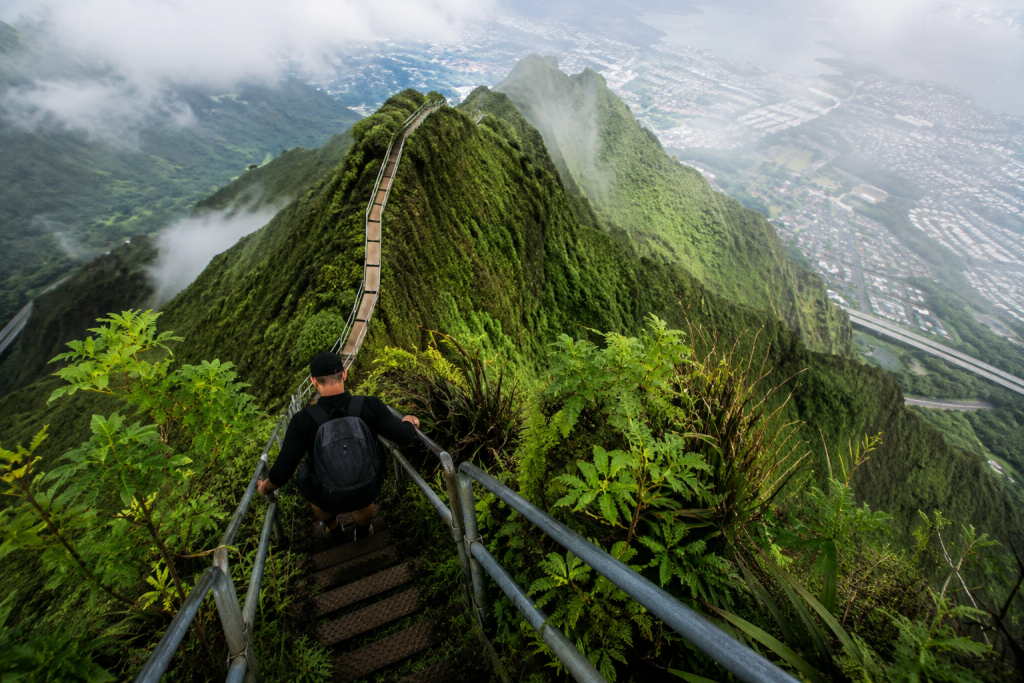
That destination was the Haʻikū Stairs, better known around the world as the “Stairway to Heaven.”
Today, Daylenn’s name is inseparable from one of Hawaii’s most puzzling unsolved disappearances. Yet on that February morning, he was just another young hiker heading toward a trail that had already become legendary among adventurers, photographers, and thrill-seekers.
By the end of the day, he would vanish without a confirmed trace.
More than a decade later, no one has been able to explain with certainty what happened after his final photographs were taken.
The Military Origins of a Modern Legend
To understand why Daylenn’s disappearance captured so much attention, it helps to understand the location itself.
The Haʻikū Stairs were never intended to be a tourist attraction. Their story began during World War II, when Hawaii became a critical military hub following the attack on Pearl Harbor.
In 1942, the U.S. military constructed a steep access route up the Koʻolau mountain range to reach a top-secret radio station. The facility played an important role in transmitting communications across the Pacific, particularly to naval forces operating far from shore.
The original staircase was built from wood before later being replaced with a more durable metal structure. Long after the war ended, the staircase remained, climbing dramatically through clouds and along narrow ridgelines overlooking the island.
As decades passed, photographs of the route began appearing in travel publications and outdoor magazines. The rise of social media transformed it into a global phenomenon.
Ironically, its popularity grew even as access became increasingly restricted.
Local authorities cited safety concerns. Residents living near the trail complained about trespassing, noise, and the constant stream of visitors crossing private property. Rescue operations became frequent and expensive. Despite the restrictions, thousands of hikers continued attempting the climb.
By 2015, the Stairway to Heaven had become one of Hawaii’s most famous forbidden destinations.
Reconstructing Daylenn’s Final Known Hours
Publicly available information allows investigators to piece together only part of Daylenn’s final day.
He left the Waianae area, where he was staying with family, and traveled toward the trail using public transportation. After that, much of what is known comes from photographs and messages he sent to relatives during the hike.
Those images show a young man enjoying the experience.
He appears calm and relaxed. The breathtaking scenery of Oʻahu stretches behind him. Nothing in the photographs suggests distress, injury, or confusion.
At the time, the images seemed completely ordinary.
In hindsight, they became something else entirely.
They represent the last confirmed record of Daylenn alive.
One of the reasons this case continues to attract attention is the abruptness with which the timeline ends. In many disappearances, there is a visible turning point—a distress call, a witness account, or evidence that something had gone wrong.
Here, there is no such moment.
The photographs simply stop.
After that, the trail disappears into uncertainty.
The Koʻolau Mountains: Beautiful, Remote, and Unforgiving
To many visitors, Oʻahu’s mountains look like a tropical paradise.
Search-and-rescue professionals see something different.
The Koʻolau Range is the heavily eroded remnant of an ancient volcano. Over millions of years, wind and rain carved its slopes into a maze of knife-edge ridges, deep valleys, hidden ravines, and nearly vertical cliffs.
Some sections of the ridgeline are astonishingly narrow.
Weather conditions can change rapidly. Rain turns dirt paths into slippery surfaces within minutes. Strong winds sweep across exposed sections of the ridge. Dense vegetation can conceal steep drop-offs that are difficult to spot until it is too late.
Perhaps most importantly, the landscape can hide evidence remarkably well.
Many people assume that helicopters and modern technology make locating a missing hiker relatively straightforward. Search professionals know otherwise. Thick tropical vegetation can completely obscure objects or people from aerial view. Even ground teams moving carefully through an area may miss clues hidden only a short distance away.
This reality has shaped numerous search operations across Hawaii over the years.
In difficult terrain, the absence of evidence does not necessarily mean evidence is absent.
A Search Effort That Produced No Clear Answers
Once Daylenn was reported missing, authorities launched an extensive search operation.
The Honolulu Fire Department coordinated efforts involving specialized rescue personnel, helicopters, and volunteer searchers. Additional resources were brought in as crews worked to examine ridges, valleys, and remote sections of the mountain range.
The scale of the operation reflected both the urgency of the situation and the challenging environment investigators faced.
Normally, searches of this size uncover at least some indication of a missing person’s path—a backpack, a piece of clothing, a damaged phone, or a location that narrows the investigation.
In Daylenn’s case, those clues never emerged.
No confirmed personal belongings were recovered.
No definitive trail of movement was established.
As days turned into weeks, the mystery deepened.
Even after official efforts were reduced, family members and supporters continued looking for answers. Private resources, including additional aerial searches and drone technology, were used in hopes of discovering something that had been overlooked.
Nothing conclusive was found.
The Photograph That Changed Public Perception
During the examination of Daylenn’s final photographs, family members noticed a detail that would eventually become one of the most discussed aspects of the case.
In the background of one image appeared what looked like a distant human figure.
The person was too far away to be clearly identified. The image quality was insufficient to reveal meaningful details.
Under ordinary circumstances, the figure might have attracted little attention.
But missing-person investigations rarely unfold under ordinary circumstances.
The photograph was released publicly, and media coverage quickly followed. Before long, the image was being discussed across news outlets, online forums, and social media platforms around the world.
Theories multiplied.
Some people became convinced that the unidentified figure held the key to the entire mystery. Others argued it was likely just another hiker using the trail that day.
What is important is the distinction between documented facts and speculation.
The photograph appears to show another individual somewhere along the route.
It does not prove contact with Daylenn.
It does not establish criminal involvement.
It does not demonstrate that a confrontation occurred.
Despite years of discussion, the image has never provided definitive answers.
Reports of Cries for Help
Another development added to the public fascination surrounding the case.
In the days following Daylenn’s disappearance, several hikers reported hearing cries for help in the area where he was believed to have been hiking.
For family members, the reports offered hope that he may have survived longer than initially feared.
Search teams investigated these claims, but no evidence was discovered that could connect the sounds to Daylenn.
Experts point out that mountainous terrain can dramatically distort sound. Valleys and rock faces create echoes that make it difficult to determine the true direction or distance of a voice. A sound originating far away may appear to come from a nearby ridge, while a nearby sound may seem much farther away.
As a result, the reports remain impossible to verify.
They remain one of the many unanswered questions surrounding the case.
What the Evidence Does—and Does Not—Show
Over the years, numerous theories have emerged.
Some suggest an accident.
Others propose foul play.
A few venture into far more speculative territory.
Yet the available evidence remains surprisingly limited.
What can be established with confidence is straightforward.
Daylenn traveled to the hiking area.
He sent photographs during the trip.
He disappeared that day.
An extensive search followed.
No definitive explanation has ever been confirmed.
This distinction matters because long-running mysteries often become shaped by assumptions rather than facts. The longer a case remains unsolved, the easier it becomes for speculation to fill the gaps left by missing evidence.
Investigators, historians, and journalists approach such cases differently. Their conclusions must remain anchored to what can actually be demonstrated.
In Daylenn’s case, many search-and-rescue professionals consider an accident in difficult terrain to be the most plausible explanation.
Plausible, however, is not the same as proven.
Without physical evidence, certainty remains out of reach.
Why the Case Continues to Captivate People
There have been older disappearances, stranger disappearances, and cases involving far less information than this one.
Yet Daylenn Pua’s story continues to resonate because it challenges modern assumptions about technology and certainty.
We live in an era of smartphones, GPS systems, satellite imagery, and constant digital communication. Many people instinctively believe that it should be nearly impossible for someone to vanish without explanation.
The Koʻolau Mountains offer a reminder that nature still operates according to its own rules.
Even in the twenty-first century, there are landscapes capable of keeping secrets.
For Daylenn’s family, the case is not a mystery story or an internet phenomenon. It is an unanswered question that began on a February morning in 2015 and has never truly ended.
The final photographs remain.
The mountain remains.
The uncertainty remains.
And somewhere between those last images and the years that followed lies a gap that investigators, technology, and time itself have not been able to close.
That unresolved space is what continues to make the disappearance of Daylenn Pua one of Hawaii’s most haunting modern mysteries.