
A frightened young chimpanzee had just been struck across the mouth.
Instead of running away or lashing out, she did something unexpected.
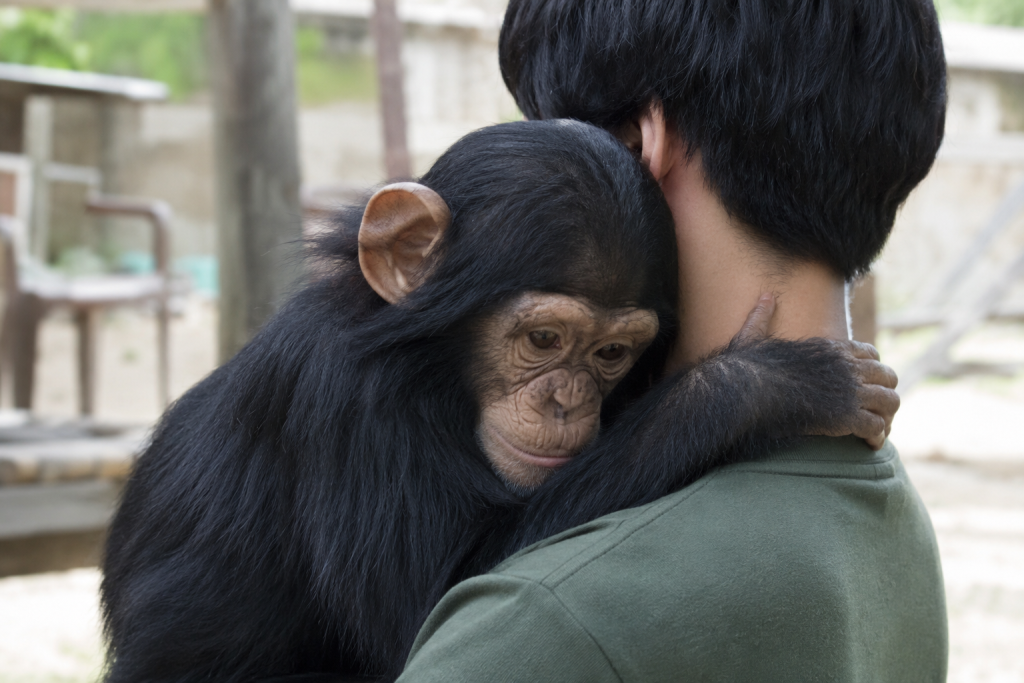
She walked over to a young volunteer, wrapped her arms around him, and gently pulled down her lower lip, silently showing him where she had been hurt.
That brief moment would stay with him for the rest of his life.
The volunteer was Louis Ng, a 20-year-old biology student in Singapore. At the time, he spent his free hours helping at the local zoo, assisting with public photography sessions that featured chimpanzees.
Among the animals he had grown especially close to was a playful young chimp named Ramba. She loved being tickled and would often grab Louis’s finger to keep the game going, making everyone around them laugh.
Then one ordinary day changed everything.
During one of the photography sessions, Ramba refused to follow instructions. The animal handler lost his temper and punched the young chimpanzee in the face.
What happened next left a lasting impression on Louis.
Rather than fleeing in fear, Ramba came straight to him, hugged him, and lowered her lip as if asking him to check whether she was bleeding.
Years later, Louis Ng would describe that encounter as one of the defining moments of his life.
From a university project to a national movement
For many people, witnessing an act of cruelty would have remained nothing more than a painful memory.
For Louis Ng, it became a turning point.
In 2001, while still studying Biology at the National University of Singapore, he founded the Animal Concerns Research and Education Society, better known as ACRES.
The organization started modestly, driven by volunteers and a simple mission: to protect animals that had no voice of their own.
Over time, ACRES grew into one of Singapore’s leading animal welfare organizations, becoming known for wildlife rescues, public education campaigns, and investigations into animal cruelty and the illegal wildlife trade.
Exposing the illegal exotic pet trade
One of ACRES’ most significant achievements came in 2005.
An undercover investigation revealed the scale of Singapore’s illegal exotic wildlife trade, exposing the trafficking of protected species. The findings prompted stronger enforcement efforts and contributed to amendments that introduced tougher penalties for wildlife trafficking offenses.
The investigation demonstrated that meaningful change often begins with evidence, persistence, and the willingness to confront uncomfortable truths.
Bringing advocacy into Parliament
In 2015, Louis Ng entered politics after being elected to Singapore’s Parliament.
Many wondered whether someone known for grassroots activism could continue championing the same causes from within the political system.
He did.
Throughout his parliamentary career, Louis remained one of the country’s strongest advocates for animal welfare. He also supported stronger protections against secondhand smoke, encouraged policies aimed at reducing single-use plastics, and campaigned to overturn long-standing restrictions that prevented residents from legally keeping cats in Singapore’s HDB public housing.
He was equally vocal about improving the safety of migrant workers, repeatedly calling for an end to the practice of transporting workers in the back of open trucks.
None of these were particularly glamorous political issues.
But they reflected a consistent belief: society should be judged by how it treats those with the least power.
A career shaped by a single unforgettable moment
After leading ACRES for two decades, Louis Ng stepped down as Chief Executive Officer in 2021 to dedicate himself fully to his parliamentary responsibilities.
In 2025, he announced his retirement from politics at the age of 46 before later joining the National University of Singapore.
Looking back, a clear pattern emerges.
Whether he was speaking for endangered wildlife, campaigning for safer working conditions, or advocating for pet owners, Louis Ng consistently focused on those who struggled to make their voices heard.
And perhaps it all began with one silent gesture.
Ramba could not explain that she was in pain.
She could not report what had happened.
All she could do was show someone she trusted where she had been hurt.
That was enough.
Sometimes history doesn’t begin with a speech, a protest, or a political campaign.
Sometimes it begins when one person witnesses an injustice—and chooses never to look away again.