
On the evening of November 12, 2004, Victoria Ruvolo was simply driving home after work. It was an ordinary trip along a Long Island road in New York, one she had taken countless times before. Within seconds, however, a reckless decision made by a teenager she had never met would leave her fighting for her life.
Traveling in the opposite direction was a car carrying five teenagers who had spent the evening shoplifting from a local grocery store. Among the stolen items was a frozen turkey weighing about 20 pounds (9 kilograms). What began as immature horseplay quickly turned into one of the most shocking criminal cases in recent American history.
As Victoria’s vehicle approached, 18-year-old Ryan Cushing hurled the frozen turkey out of the window.
At the combined speed of both vehicles, the heavy bird became the equivalent of a high-speed projectile.
It smashed through Victoria’s windshield and struck her directly in the face.
A Split Second That Changed Everything
The impact was catastrophic.
Emergency responders found Victoria critically injured inside her vehicle. Doctors soon discovered that nearly every major bone in her face had been shattered. Her jaw, nose, cheekbones, and eye sockets were severely fractured, and she had also suffered traumatic brain injuries.
Her condition was so critical that physicians placed her in a medically induced coma for nearly a month while they worked to save her life.
Surviving was only the beginning.
Over the following months, Victoria underwent a series of complex reconstructive surgeries. Surgeons used titanium plates and screws to rebuild much of her facial structure, and her recovery required tremendous physical and emotional strength.
Simple activities that most people take for granted—speaking, eating, and even looking in the mirror—became daily challenges.
A Reckless Act With Life-Changing Consequences
Ryan Cushing was arrested and charged with first-degree assault, a crime that carried the possibility of a prison sentence of up to 25 years.
Investigators determined that although he had not intended to kill anyone, the consequences of his actions were devastating. During the legal proceedings, Cushing admitted responsibility and expressed deep remorse for what he had done.
Public opinion largely expected a lengthy prison sentence.
Instead, the case would become famous for a very different reason.
The Courtroom Moment No One Expected
When it was Victoria Ruvolo’s turn to address the court, many assumed she would ask for the harshest punishment possible.
She did the opposite.
Victoria told the judge that sending the young man to prison for decades would not undo what had happened to her. She explained that holding on to anger would only allow the tragedy to continue controlling her life.
Looking directly at Ryan Cushing, she chose to forgive him.
The young man broke down in tears.
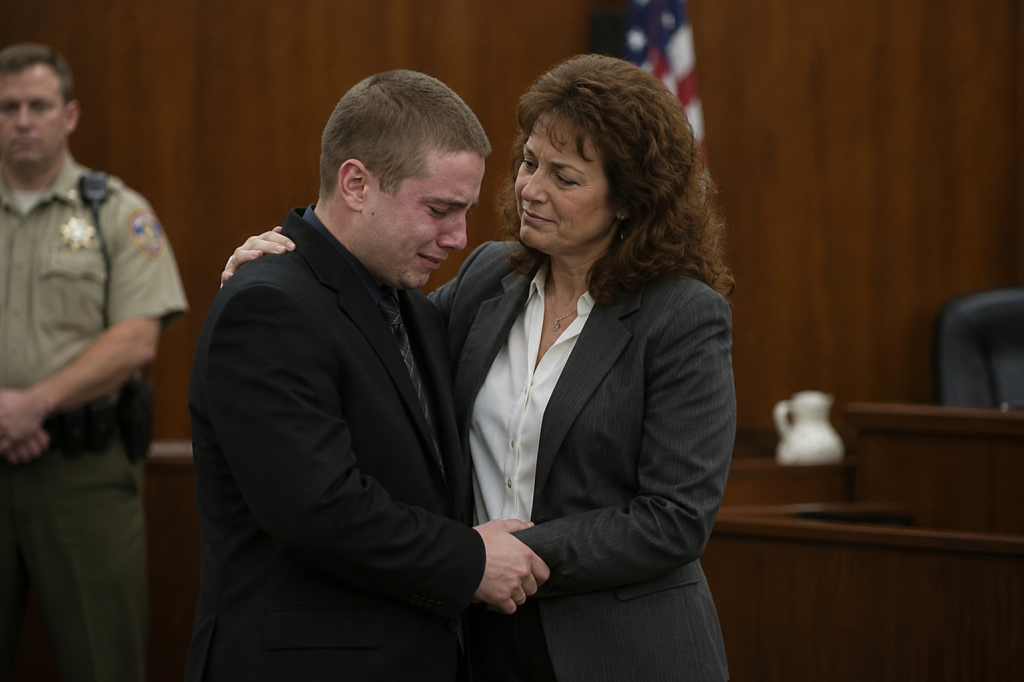
Moments later, victim and offender embraced in the courtroom, creating an unforgettable scene that was reported by media outlets around the world.
Taking Victoria’s wishes into account, the court approved a plea agreement that sentenced Cushing to six months in jail, five years of probation, community service, and restitution rather than the decades-long prison term he had originally faced.
“Forgiveness Was a Gift I Gave Myself”
In the years that followed, Victoria often explained that forgiveness did not mean excusing what had happened or pretending the attack had not changed her life.
Instead, she described forgiveness as a personal decision that allowed her to move forward instead of remaining emotionally trapped by the trauma.
As she later reflected, forgiveness was ultimately a gift she gave herself.
Her story became widely recognized as one of the most powerful examples of restorative justice in the United States. She spoke publicly about resilience, compassion, and the importance of refusing to let hatred define one’s future.
A Legacy That Lives On
Victoria Ruvolo continued sharing her remarkable story for years, inspiring audiences with her message that healing is not only physical but emotional as well.
She passed away on March 25, 2019, at the age of 59. Her family did not publicly disclose the cause of death, and there has never been evidence linking her passing to the injuries she sustained in the 2004 attack.
More than two decades after that November evening, the case is still remembered around the world. Not simply because a frozen turkey nearly claimed an innocent woman’s life, but because of what happened afterward.
In a courtroom where many expected anger and revenge, Victoria Ruvolo chose compassion instead.
Her decision transformed an extraordinary criminal case into one of the most compelling real-life stories about forgiveness, resilience, and the remarkable capacity of the human spirit to overcome even unimaginable tragedy.