
On September 22, 1989, what began as a routine Boy Scouts outing in Utah turned into one of the most remarkable child survival stories ever documented in the United States.
Ten-year-old Joshua Dennis disappeared inside an abandoned mine, becoming trapped in a maze of underground tunnels where he would remain alone for nearly five days. Without food, without a flashlight, and with no realistic way to find his own way back to the surface, his chances of survival appeared to diminish with every passing hour.
By the time rescuers finally found him, many had already begun to fear the worst.
More than three decades later, Joshua’s ordeal is still remembered as one of the most extraordinary mine rescue cases in American history, highlighting both the dangers of abandoned mines and the remarkable resilience that children can sometimes display under unimaginable circumstances.
A Weekend Adventure That Changed Everything
Joshua Dennis lived in Kearns, Utah, and in September 1989 he was allowed to join a Boy Scouts trip to Hidden Treasure Mine, an abandoned mining complex located in the Oquirrh Mountains near Stockton.
Although he was slightly younger than many of the other boys participating, he was excited to take part in what was supposed to be an educational adventure exploring one of Utah’s historic mining sites.
Like thousands of abandoned mines scattered across the western United States, Hidden Treasure Mine had long since ceased commercial operations. Yet its extensive network of tunnels continued to attract history enthusiasts, amateur explorers, and scouting groups interested in learning about the region’s mining heritage.
Beneath the mountain, however, lay an enormous underground labyrinth. The mine contained multiple levels connected by narrow passages, vertical shafts, extraction chambers, and countless branching tunnels stretching for roughly eight miles. Even experienced explorers considered it an exceptionally complex environment.
For a curious ten-year-old, it seemed fascinating.
For professional rescue teams, it represented one of the most challenging environments imaginable.
A Split-Second Decision
At one point during the exploration, one of the boys in the group became uncomfortable and wanted to leave the mine.
Joshua’s father, who was leading the outing, volunteered to escort the child back to the entrance. Before leaving, he asked Joshua if he wanted to come with them.
Joshua decided to stay behind and continue deeper into the mine, following two older Scouts who had already moved farther ahead.
What no one realized was that those boys had no idea Joshua was trying to catch up with them.
Within moments, his father’s flashlight disappeared in one direction while the lights carried by the other Scouts vanished around another bend. Joshua suddenly found himself completely alone.
He tried to follow the others.
Instead, he took a wrong turn.
Inside a mine where nearly every tunnel looks alike, a single mistake was enough to leave him hopelessly lost.
Why Abandoned Mines Are So Dangerous
Most people underestimate how quickly a person can lose all sense of direction underground.
Without natural light, the human brain loses the visual reference points it relies on for navigation. Research into spatial orientation has shown that people deprived of landmarks often begin drifting in circles without realizing it.
Underground mines make the problem even worse.
Echoes distort the direction of sound, intersecting tunnels appear nearly identical, and slight changes in elevation can easily go unnoticed. Many abandoned mines expanded gradually over decades as miners followed new veins of ore, creating complicated networks that were never intended to serve as navigable passageways.
Some tunnels end abruptly.
Others connect to multiple levels.
Hidden shafts, unstable rock, and collapsed passages create additional hazards.
Even modern mine rescue specialists rely on detailed maps, guide ropes, and specialized equipment to avoid becoming disoriented.
A ten-year-old child had virtually no chance of finding the exit alone.
A Massive Search Begins
When the group realized Joshua was missing, the situation changed almost instantly from a delayed return to a full-scale emergency.
The initial hope that he had simply wandered into another passage quickly faded.
As the hours passed without any sign of him, authorities launched an extensive search effort that continued day and night. Rescue personnel, trained mine specialists, law enforcement officers, volunteers, and search dogs were deployed to comb both the underground tunnels and the surrounding mountainsides.
Because no one knew exactly where Joshua had gone, investigators had to consider every possibility. Some believed he might still be somewhere inside the mine, while others feared he could have left the tunnels and become lost in the rugged terrain outside.
News of the disappearance spread rapidly across Utah.
Residents followed every update, community members offered support to Joshua’s family, and hundreds of volunteers joined the search in hopes of finding the missing boy alive.
Hidden in Plain Sight
What rescuers did not know was that Joshua had never left the mine.
In fact, he was far closer than anyone imagined.
After taking the wrong route, he eventually reached a small cavity created during earlier mining operations. The chamber was located roughly 2,000 feet from the mine entrance and about 150 feet above the main tunnel.
Its position made it extraordinarily difficult to detect.
Rescuers would later discover that search teams had passed nearby multiple times during the operation without realizing the child was only a short distance away.
From the main passage, Joshua’s location was almost completely concealed.
Nearly Five Days Underground
Joshua spent almost five days trapped beneath the mountain.
He had no food.
He had no flashlight.
He had only limited access to water.
While the human body can survive without food for several weeks under favorable conditions, dehydration becomes life-threatening much more quickly. Fortunately, the underground environment offered one important advantage: temperature.
Unlike the surface, where temperatures fluctuate dramatically, deep underground mines typically maintain relatively stable conditions throughout the day and night. That stability likely reduced Joshua’s risk of severe hypothermia.
Nevertheless, each passing day left him weaker.
He became increasingly dehydrated and exhausted as he waited in complete darkness, uncertain whether anyone would ever find him.
Medical examinations later confirmed that he had suffered dehydration, exhaustion, and frostbite affecting several of his toes, but remarkably few additional injuries considering the circumstances.
The Voice That Changed Everything
On September 27, 1989, after nearly five days of searching, three members of a rescue team entered the mine once again to continue their search.
At one point, one of the rescuers thought he heard something.
He asked everyone else to remain completely silent.
For several moments, nobody spoke.
Then they heard it.
A faint voice echoed through the darkness.
“Help.”
The rescuers immediately began calling back while trying to determine where the sound had originated. After carefully following the echoes through the maze of tunnels for roughly 45 minutes, they finally reached the hidden chamber where Joshua had been waiting.
Against all expectations, he was alive.
An Outcome Few Expected
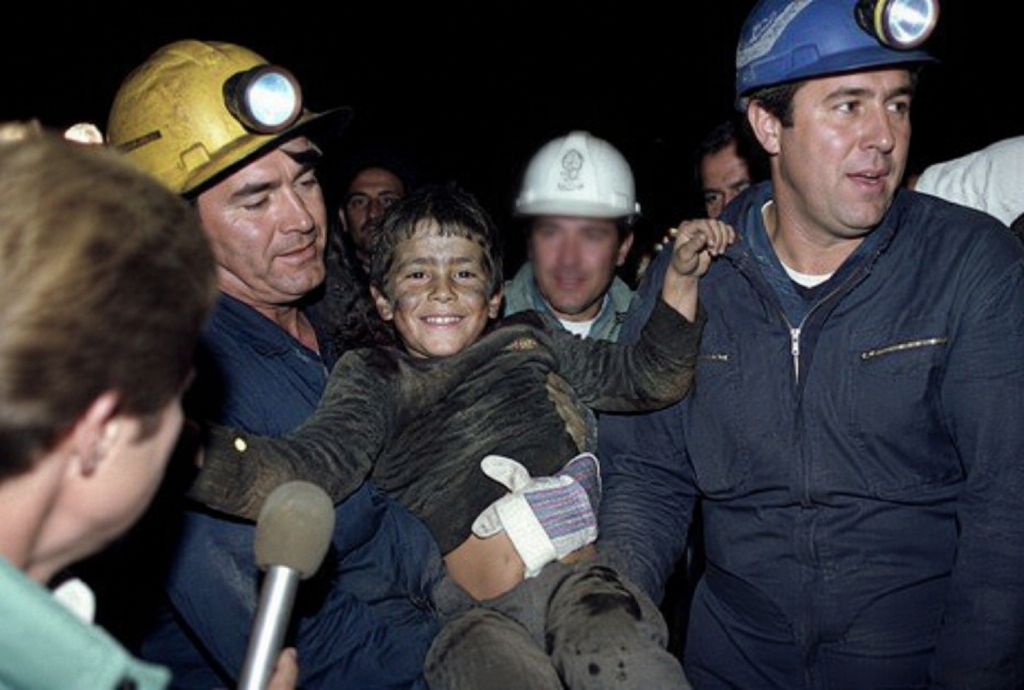
As Joshua emerged from the mine, the emotional response at the surface was immediate.
Rescuers, volunteers, family members, and onlookers broke into applause while many openly cried.
Several members of the rescue operation later admitted they had been preparing themselves for a recovery rather than a rescue. After nearly five days underground, the likelihood of finding a child alive seemed extraordinarily small.
Instead, Joshua survived.
Aside from dehydration, exhaustion, and limited frostbite, doctors found no major physical injuries.
For everyone involved, his condition was nothing short of astonishing.
What Helped Him Stay Alive?
Survival experts believe Joshua’s greatest advantage may have been a decision he made without realizing its importance.
Rather than continuing to wander endlessly through unfamiliar tunnels, he eventually stayed in one location.
People who become lost often make the situation worse by walking aimlessly in search of an exit, burning precious energy while increasing their chances of becoming even more disoriented.
By remaining relatively still, Joshua conserved both energy and body fluids.
Psychologists who study survival behavior also point to another critical factor: hope.
People who maintain the belief that rescue is still possible are often better able to make rational decisions, preserve their strength, and resist the overwhelming panic that isolation can produce.
A Story That Continues to Inspire
More than thirty years after the incident, Joshua Dennis’s experience continues to be remembered throughout Utah and within the search-and-rescue community.
His remarkable survival has inspired books, interviews, documentaries, and the 2024 feature film Faith of Angels, which introduced his story to a new generation.
Whether viewed through the lens of faith, resilience, or extraordinary determination, the facts remain remarkable.
A ten-year-old boy became lost inside an abandoned mine containing roughly eight miles of underground passages. He survived nearly five days in complete darkness and was eventually discovered in a hidden chamber that rescuers had unknowingly passed several times during their search.
For some, the story represents a miracle.
For others, it stands as a powerful reminder of human endurance under extreme conditions.
Either way, Joshua Dennis’s survival remains one of the most extraordinary documented child rescue stories in modern American history.