
For decades, one anthropological study has been repeatedly cited in discussions about parenting, emotional intelligence, and self-control. Short versions of the story have spread widely across social media, often claiming that Inuit parents “never yell at their children” or that they discovered the secret to raising calm, emotionally balanced adults.
The real story is both more nuanced and more compelling.
Behind these popular claims lies the work of American anthropologist Jean L. Briggs, whose groundbreaking field research in the Canadian Arctic remains one of the most influential studies of emotional expression across cultures. Rather than searching for parenting advice, Briggs set out to understand how a small Inuit community organized daily life in one of the harshest environments on Earth. What she found would reshape her understanding of anger, social relationships, and the way children learn emotional regulation.
An Anthropologist’s Journey Into the Canadian Arctic
In the early 1960s, Jean L. Briggs was a doctoral student in anthropology at Harvard University. At the time, long-term fieldwork was becoming the gold standard of anthropological research. Instead of relying on brief visits or interviews, researchers immersed themselves in the communities they studied, often living there for months or even years.
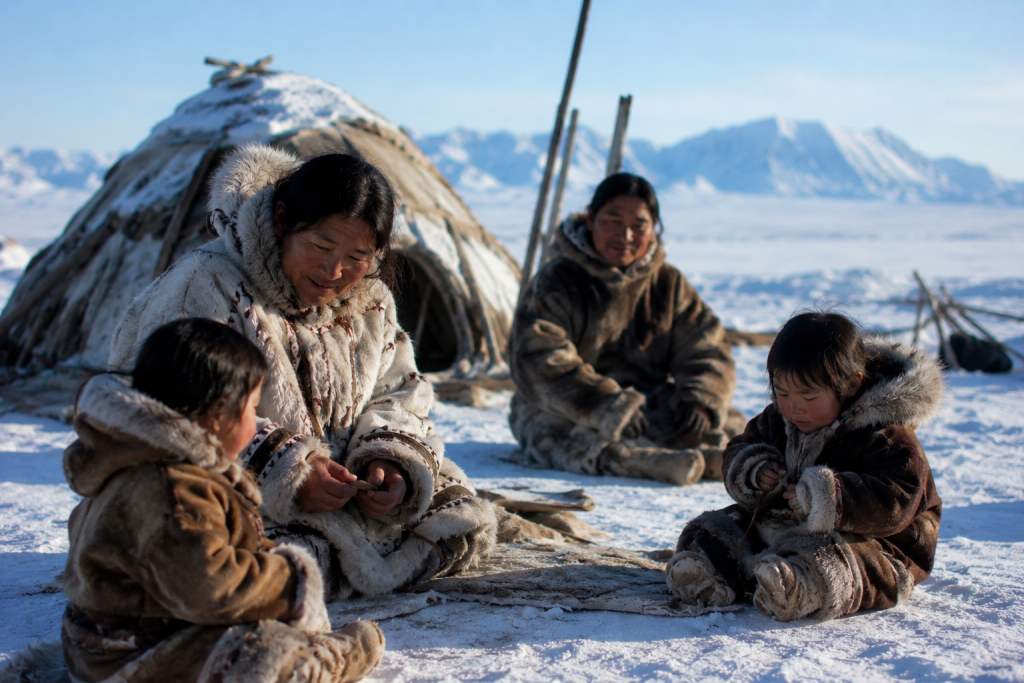
In 1963, Briggs traveled to the Canadian Arctic to live among the Utkuhiksalingmiut, an Inuit group whose traditional territory lay near the Back River in what is now Nunavut.
Life there demanded constant adaptation. Winter temperatures frequently dropped below –40°C (–40°F), daylight nearly disappeared for part of the year, and survival depended on careful cooperation within small family groups. Hunting and fishing provided most of the food, while weather conditions dictated nearly every aspect of daily life.
Rather than observing from a distance, Briggs became part of the community. She lived with an Inuit family for approximately seventeen months, learned their language, shared everyday responsibilities, and gradually earned the trust needed to witness aspects of life that outsiders rarely saw.
An Unexpected Discovery
Briggs did not travel north intending to study anger.
Her original research focused on social relationships and everyday interactions within the community. Yet as the months passed, she began noticing something that challenged many of her own assumptions.
Situations that might easily provoke frustration elsewhere rarely resulted in visible outbursts. Accidents happened. Valuable tools occasionally broke. Plans sometimes failed. Still, people generally responded with remarkable composure rather than shouting or assigning blame.
In her influential 1970 book Never in Anger: Portrait of an Eskimo Family, Briggs describes several moments in which expensive mistakes or unexpected setbacks were met with quiet acceptance instead of emotional confrontation.
Importantly, Briggs never suggested that the people she lived with were incapable of anger. Instead, she observed that openly displaying intense anger was socially discouraged and widely regarded as a sign of poor self-control.
That distinction is often lost in simplified retellings of her work.
When the Researcher Became Part of the Story
One reason Briggs’s research remains so highly regarded is her willingness to examine her own reactions.
Throughout her fieldwork, she openly acknowledged that she often found herself becoming impatient or irritated in situations where the Inuit families around her remained calm. At times, she realized that her own emotional responses seemed immature according to the cultural standards of the community.
Rather than pretending to be an objective observer untouched by experience, Briggs documented how deeply her own upbringing shaped the way she interpreted conflict, frustration, and emotional expression.
Today, anthropologists recognize this self-reflection as one of the strengths of her work. It demonstrated that researchers themselves are influenced by culture and cannot entirely separate their observations from their own backgrounds.
How Children Learned Emotional Self-Control
Curious about how adults developed such remarkable emotional restraint, Briggs turned her attention to the way children were raised.
She noticed that young children were rarely met with shouting or harsh punishment when they became upset. Instead, many parents waited until emotions had settled before addressing difficult behavior.
One of the most frequently discussed examples from Inuit parenting involves role-playing.
If a child had hit someone, the situation might later be recreated as a gentle game. The adult would invite the child to repeat the action, then dramatically act out the consequences by pretending to be hurt or sad. Rather than provoking fear or shame, the exercise encouraged the child to think about how their actions affected another person.
The goal was not immediate obedience. It was developing empathy, emotional awareness, and thoughtful decision-making.
Briggs viewed these interactions as opportunities for children to practice emotional control when they were calm instead of expecting them to learn during the height of an emotional outburst.
It is important to note that these observations describe practices documented within the specific Inuit communities studied by Briggs and later researchers. They should not be interpreted as universal customs shared by every Inuit population across Canada, Alaska, or Greenland.
Why Emotional Restraint Mattered
Understanding the Arctic environment helps explain why emotional self-control held such importance.
Families depended heavily on one another for survival. Successful hunting required cooperation, trust, and careful planning. During long winters, damaged relationships could have practical consequences far beyond hurt feelings.
Many anthropologists argue that in small, closely connected communities, maintaining social harmony became an essential survival strategy.
This does not mean disagreements never occurred. Like every human society, Inuit communities experienced conflict. The difference lay in the cultural expectations surrounding how conflict should be expressed and resolved.
Modern Science Offers Additional Perspective
When Briggs conducted her fieldwork, neuroscience was still in its infancy. Today, researchers understand far more about how children develop emotional regulation.
Brain imaging studies have shown that the prefrontal cortex—the region involved in planning, impulse control, and decision-making—continues developing well into early adulthood. Meanwhile, structures such as the amygdala, which plays a central role in emotional responses, become active much earlier in life.
This developmental imbalance helps explain why young children often experience powerful emotions before they possess the neurological capacity to manage them effectively.
Developmental psychologists now describe a process known as co-regulation, in which calm, consistent caregivers help children gradually build their own emotional regulation skills. Over time, repeated experiences of being guided through difficult emotions contribute to stronger self-control.
Although modern neuroscience does not validate every parenting practice observed by Briggs, many of her broader observations align with current understanding of how emotional regulation develops during childhood.
What Other Researchers Have Added
Like all influential research, Briggs’s work has also been examined critically.
Anthropologists emphasize that Never in Anger reflects one community during a particular historical period rather than the experiences of all Inuit peoples. Inuit cultures are diverse, and customs vary across regions.
Furthermore, Arctic communities have undergone profound social, political, and economic changes since the 1960s. Government policies, relocation programs, formal education, and increased contact with southern Canada have transformed many aspects of daily life.
For these reasons, Briggs’s observations should be understood within their original historical context rather than treated as universal descriptions of Inuit culture.
A Lesson That Extends Beyond the Arctic
More than half a century after its publication, Never in Anger continues to attract readers from fields as diverse as anthropology, psychology, education, and child development.
Its lasting influence comes not from offering a perfect parenting formula, but from raising a deeper question: how much of the way we express emotion is shaped by biology, and how much is learned from the people around us?
Modern research increasingly suggests that children develop emotional regulation not simply through instruction, but by repeatedly observing how trusted adults respond to stress, disappointment, and conflict.
Jean Briggs’s time in the Arctic reminds us that emotional habits are not fixed traits. They are shaped over years through everyday interactions, cultural expectations, and the examples children witness long before they fully understand the words adults speak.
Far from being a story about a society that never experienced anger, her work reveals something far more meaningful: every culture teaches emotional control differently, and those lessons often begin with the behavior adults model long before children are capable of managing their own emotions.