
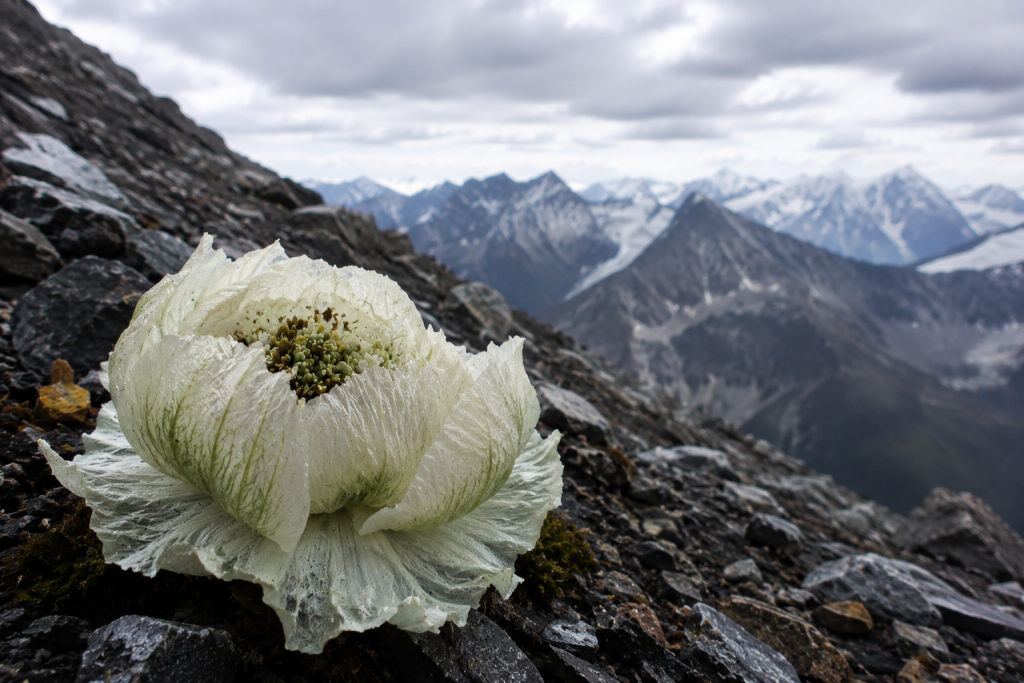
Far above the forests and valleys of Central Asia, where the air grows thin and icy winds sweep across barren cliffs, one remarkable plant has learned to thrive in conditions that seem almost impossible for life. Hidden among the rocky slopes of the Tian Shan Mountains, the snow lotus (Saussurea involucrata) has become one of the most extraordinary symbols of endurance in the botanical world.
Despite its common name, the snow lotus is not related to the aquatic lotus found on lakes and ponds. It belongs to the daisy family, yet its pale, woolly appearance and its ability to emerge from snow-covered mountains inspired generations of people to compare it with the elegant lotus flower.
A Life Measured in Years, Not Seasons
Most flowering plants complete their life cycle with remarkable speed, blooming every spring as temperatures rise. The snow lotus follows a completely different strategy.
For years, sometimes as long as five to eight depending on environmental conditions, it remains close to the ground as a compact cluster of leaves. During this long period, it stores energy while surviving relentless winds, freezing temperatures, nutrient-poor soil, and intense ultraviolet radiation that would damage many other species.
Only after reaching maturity does the plant produce its distinctive flower. The blooming period is surprisingly brief, often lasting only several days to around two weeks during the short alpine summer. In that narrow window, pollinating insects become active, allowing the plant to reproduce before harsh weather returns.
Built for One of Earth’s Harshest Environments
The Tian Shan Mountains create one of the most challenging habitats in Asia. At elevations exceeding 3,000 meters, oxygen levels decrease, temperatures can fluctuate dramatically within a single day, and ultraviolet radiation is significantly stronger than at sea level.
The snow lotus survives through a remarkable collection of adaptations. Fine white hairs covering its leaves and floral bracts help reflect sunlight, reduce water loss, and protect delicate tissues from harmful UV exposure. The overlapping bracts surrounding the flower also create a small insulating chamber, producing a slightly warmer microenvironment that supports successful flowering and seed development.
Its roots penetrate tiny cracks in exposed rock, capturing moisture released by melting snow. Rather than growing quickly, the plant invests years in conserving resources, a strategy that dramatically increases its chances of surviving in such an unforgiving landscape.
From Ancient Herbal Medicine to Modern Research
Long before scientists began studying its chemistry, the snow lotus held an important place in traditional Chinese and Tibetan medicine. Historical records describe its use for easing joint pain, reducing inflammation, supporting circulation, and relieving discomfort associated with cold mountain climates.
Because the plant grows only in remote alpine regions, gathering it required long and dangerous expeditions. Its rarity made it highly prized, and for centuries it was considered a valuable medicinal herb reserved for those who could afford it.
Modern laboratories have since identified numerous biologically active compounds within the plant, including flavonoids and other antioxidant molecules. Experimental studies have suggested that some of these compounds may possess anti-inflammatory and antioxidant properties, while early laboratory research has explored their potential effects on certain cancer cells.
However, researchers emphasize an important distinction: findings obtained in laboratory experiments do not automatically translate into proven medical treatments for humans. Further clinical research is still required before any therapeutic claims can be confirmed.
A Species Under Pressure
Ironically, the qualities that made the snow lotus famous also placed it at risk.
Decades of harvesting for traditional medicine significantly reduced many wild populations. Since each plant requires several years to reach maturity, natural recovery occurs very slowly, making overharvesting especially damaging.
Today, the species receives legal protection in parts of China, and scientists are developing cultivation techniques, including greenhouse production and plant tissue culture, to reduce pressure on wild populations. These conservation efforts aim not only to preserve a culturally important medicinal plant but also to protect the fragile alpine ecosystems where it plays a unique ecological role.
More Than Just a Rare Flower
The snow lotus has become more than a botanical curiosity. Across much of Asia, it represents resilience, patience, and the quiet strength required to survive difficult conditions.
Unlike flowers that bloom predictably every year, the snow lotus spends most of its existence preparing for a single, fleeting display. Its brief flowering period is not a sign of fragility but the result of a survival strategy refined over millions of years of evolution.
In a world that often celebrates speed and instant results, this remarkable alpine plant offers a different perspective. Sometimes nature’s greatest achievements are not measured by how quickly they appear, but by the extraordinary persistence required to make them possible.
For only a handful of days each summer, a pale flower emerges from cold mountain rock, reminding us that resilience is often built quietly, long before anyone notices it.