
On a warm July morning in 2012, what began as an ordinary kindergarten outing in the German countryside became a rescue that would capture the nation’s attention. There were no cameras recording the first moments, no dramatic soundtrack and no time to weigh the risks. There was only a frightened three-year-old child who had disappeared into the darkness of an abandoned mine shaft and a teacher who understood that every second mattered.
Her name was Ina Koenig. Until that day, she was known simply as a kindergarten teacher entrusted with caring for young children. Within minutes, she would perform an act of courage that many would later describe as heroic, although she herself never accepted that title.
More than a decade later, her decision remains one of the most remarkable civilian rescue stories in modern Germany—not because it involved extraordinary physical strength, but because it demonstrated what can happen when compassion overcomes fear.
A Region Shaped by Coal Mining
The accident occurred near Barsinghausen, in the German state of Lower Saxony. Today, the area is quiet and green, but beneath its forests and fields lies the legacy of more than a century of coal mining.
For decades, mines in the region supplied fuel that helped power homes, factories and railways throughout Germany. As the industry declined during the twentieth century, many mines were closed and their entrances sealed. However, the underground network of shafts and tunnels remained.
Across Germany, thousands of former mining structures still exist. Most are secured and carefully monitored, but abandoned industrial sites can continue to present hidden dangers. Natural erosion, changing groundwater levels and the gradual deterioration of old infrastructure occasionally expose forgotten openings that are almost impossible to notice until someone is dangerously close.
The children visiting the countryside that day had no way of knowing that beneath their feet lay one of those remnants of Germany’s industrial past.
A Child Vanishes Into the Ground
During the excursion, the group was exploring the area under adult supervision when the unimaginable happened.
A three-year-old boy stepped onto unstable ground near the opening of an abandoned vertical mine shaft. In an instant, the earth beneath him gave way and he plunged into the darkness.
Witnesses later estimated that the shaft was approximately 23 to 25 meters (75 to 82 feet) deep.
At the bottom was icy water.
The child disappeared from sight almost immediately.
For several terrifying moments, nobody knew whether he had survived the fall.
Adults rushed toward the opening, desperately trying to understand what had happened. Looking down into the shaft revealed little more than darkness.
Emergency services were called immediately, but everyone present understood one frightening reality: rescue teams would need time to arrive, assess the situation and organize a safe operation.
A small child immersed in freezing water might not have that much time.
A Decision Made Without Hesitation
Most people spend their entire lives believing they know how they would react during an emergency.
Psychologists have long observed that reality is often very different.
Faced with sudden danger, many people experience the automatic “fight, flight or freeze” response. Even highly intelligent individuals can become temporarily unable to move because the brain is overwhelmed by the unexpected event.
Ina Koenig reacted differently.
Without waiting for instructions or guarantees of her own safety, she decided to go after the boy herself.
It was an extraordinary decision because abandoned mine shafts are among the most hazardous environments rescuers encounter.
The walls may be unstable. Loose rocks can collapse without warning. Oxygen levels may be dangerously low. Flooded sections can conceal debris, deep mud or submerged obstacles. Nobody knew exactly what conditions existed below.
Yet she climbed down anyway.
Reaching the Child
After descending into the shaft, Ina reached the little boy.
He had survived the fall but was trapped in freezing water, frightened and unable to escape.
There was no possibility of climbing back to the surface while carrying him.
Instead, she focused on the only objective that mattered: keeping him alive until professional rescuers arrived.
Supporting herself against the confined walls of the shaft, she held the child so that his head remained above the water.
It sounds simple.
In reality, it required constant physical effort.
Every minute placed increasing strain on her muscles while the cold steadily drained her body’s heat and energy.
There was no opportunity to rest.
There was no way to know how long they would remain trapped below ground.
The Silent Enemy: Cold Water
Many people underestimate how dangerous cold water can be.
Unlike exposure to cold air, immersion in cold water removes body heat up to twenty-five times faster. As soon as the body enters very cold water, blood vessels constrict in an attempt to preserve heat around vital organs. Breathing becomes rapid and involuntary, heart rate changes suddenly and muscles gradually lose strength.
For small children, the danger is even greater.
Because children have less body mass and lose heat more quickly than adults, hypothermia can develop much faster. As body temperature falls, coordination deteriorates, thinking becomes impaired and eventually consciousness may be lost.
Keeping the boy’s mouth and nose above the surface was therefore not merely comforting—it was lifesaving.
Every additional minute increased the importance of what Ina Koenig was doing.
A Race Against Time Above Ground
While Ina remained trapped below with the child, firefighters, rescue specialists and emergency medical personnel converged on the scene.
The rescue proved exceptionally complex.
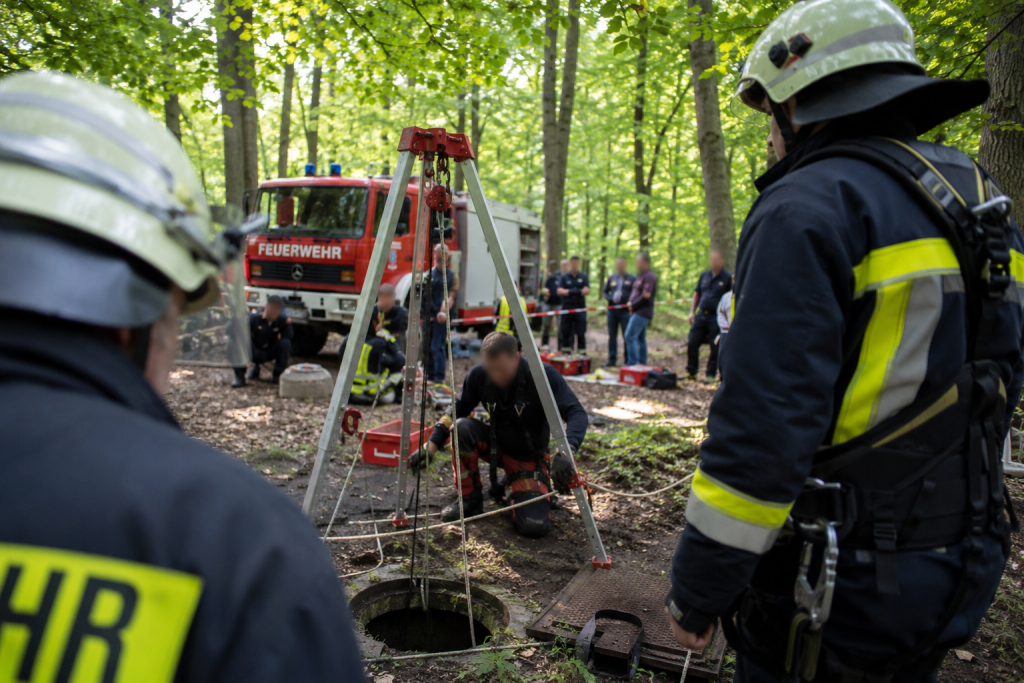
Unlike lifting someone from a well or a swimming pool, recovering victims from a flooded vertical mine shaft requires specialized equipment and meticulous planning. Rescuers must consider the stability of the shaft, the safety of ropes and lifting systems, communication with those below and the possibility of further collapse.
Any mistake could endanger not only the victims but also the rescuers themselves.
Above ground, valuable minutes slipped away.
Below ground, Ina continued holding the child above the freezing water.
Reports published after the rescue indicate that she remained with him for well over an hour, with some contemporary accounts describing the ordeal as lasting nearly two hours before both could finally be brought back to the surface.
Finally Back in the Light
When rescuers eventually succeeded in lifting both of them out of the abandoned mine, relief swept through everyone gathered at the scene.
The child was alive.
So was the woman who had refused to abandon him.
Both received immediate medical attention. Ina Koenig suffered exhaustion and the effects of prolonged exposure to the cold water, but considering the circumstances, her injuries were remarkably limited.
Medical professionals later acknowledged that her rapid intervention had almost certainly played a decisive role in the boy’s survival.
Without someone keeping him above the freezing water during those critical first moments, the outcome could have been tragically different.
Germany Hears Her Story
The rescue quickly became national news.
German newspapers described the remarkable bravery shown by the kindergarten teacher who had entered an abandoned mine without hesitation to save one of the children in her care.
Public admiration spread rapidly.
Among those who recognized her courage was German Chancellor Angela Merkel, who personally congratulated Ina Koenig for her actions.
Such recognition reflected how profoundly the story resonated across the country. Parents, teachers and emergency responders all understood the extraordinary responsibility involved in caring for young children, and many wondered whether they themselves would have possessed the same courage.
“I Only Did What Had to Be Done”
Despite widespread praise, Ina Koenig consistently rejected the image of herself as a hero.
In interviews following the rescue, she explained that she had simply done what she believed anyone responsible for a child’s safety should do.
Her modesty became almost as memorable as the rescue itself.
True heroism often shares that characteristic.
People who perform extraordinary acts frequently insist they merely reacted to circumstances rather than making a conscious choice to become heroes.
For Ina, the focus was never on recognition.
It was on the child.
Why This Story Still Matters
Stories like this continue to resonate because they reveal something fundamental about human nature.
In everyday life, courage is often imagined as something reserved for firefighters, soldiers or professional rescuers.
Yet history repeatedly shows that ordinary citizens sometimes become the first—and most important—link in the chain of survival.
Psychologists who study altruism describe these moments as instances of high-cost helping, situations in which an individual knowingly accepts significant personal risk to protect another person.
Such decisions cannot be fully explained by training or instinct alone. They also involve empathy, moral responsibility and an almost immediate commitment to another person’s well-being.
Ina Koenig never expected to become an example in psychology textbooks or emergency response discussions.
She simply refused to let a child face death alone.
An Ordinary Teacher Who Did an Extraordinary Thing
The abandoned mine near Barsinghausen has long since returned to silence.
The emergency vehicles are gone. The crowds dispersed years ago. The headlines have faded into newspaper archives.
But the significance of what happened there has not diminished.
A little boy who entered that shaft at the age of three was able to continue his life because one person decided that fear would not dictate her actions.
Ina Koenig did not possess superhuman strength, specialized rescue equipment or certainty that she would survive.
She possessed something rarer.
The willingness to place another human life ahead of her own safety.
Perhaps that is why her story continues to inspire people around the world. It reminds us that genuine courage is rarely loud or theatrical. More often, it appears unexpectedly, in ordinary people confronted by extraordinary circumstances.
On that July day in 2012, deep beneath the surface of the earth, one kindergarten teacher proved that heroism is not defined by titles or fame. Sometimes, it is defined by the simple refusal to let go.