
Some photographs fade with time. Others become impossible to forget.
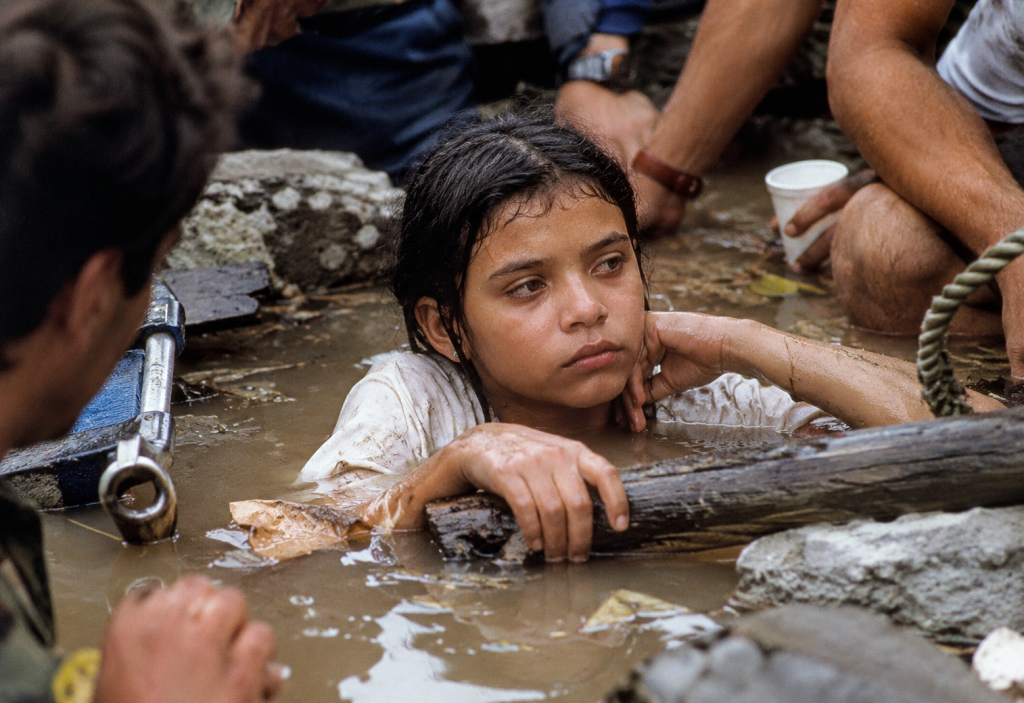
One image, taken in November 1985, shows a 13-year-old girl surrounded by muddy water, looking calmly toward the people standing around her. There is no panic on her face, no dramatic gesture, only exhaustion, hope, and the quiet determination to keep holding on.
Her name was Omayra Sánchez.
For nearly 60 hours, rescuers fought to free her from the wreckage of her home after one of the deadliest volcanic disasters of the twentieth century. They never stopped trying. Yet despite their determination, they simply did not have the equipment needed to save her.
Today, Omayra’s story is remembered not only because of the heartbreaking photograph that captured her final hours, but because it became a powerful reminder of what can happen when nature strikes and preparation falls tragically short.
A Disaster That Destroyed an Entire City
On the evening of November 13, 1985, Colombia’s Nevado del Ruiz volcano erupted after decades of relative quiet.
The eruption itself was only part of the disaster. Heat from the volcano rapidly melted the glacier covering its summit, releasing enormous flows of water mixed with volcanic ash, rocks, and debris. These fast-moving mudflows, known as lahars, rushed down the mountain and overwhelmed everything in their path.
The town of Armero stood directly in their way.
Within minutes, entire neighborhoods disappeared beneath layers of mud and rubble. Homes collapsed, roads vanished, and thousands of families had no chance to escape.
Nearly 23,000 people lost their lives, making the Armero disaster one of the deadliest volcanic catastrophes in modern history.
The Rescue That Slowly Turned Into a Race Against Time
When emergency crews found Omayra, there was still reason to believe she could survive.
She was conscious, speaking clearly, and responding to everyone around her. From the surface, her injuries did not appear severe.
What no one could immediately see was the destruction beneath the muddy water.
Large concrete slabs, broken beams, and the remains of her family’s house had trapped her lower body. Every attempt to pull her free risked causing catastrophic internal injuries.
Rescuers worked continuously, trying different methods to release her. They dug by hand, used ropes, and searched desperately for any solution that might work.
Nothing did.
As the hours passed, hope slowly gave way to reality.
Why Couldn’t Doctors Save Her?
One question has followed Omayra’s story for decades.
Why didn’t doctors amputate her legs?
Medical experts later explained that such an operation would have been almost impossible under those conditions.
There was no operating room, no surgical team, no blood supply for transfusions, and no way to control massive bleeding in the middle of a disaster zone. Even if an amputation had somehow been performed, her chances of surviving the procedure without immediate advanced medical care were extremely small.
The only realistic option was to remove the heavy debris and pump away the water surrounding her.
Unfortunately, the necessary machinery never arrived in time.
Remarkable Courage Until the Very End
Perhaps the most extraordinary part of Omayra’s story was not the disaster itself but the courage she showed throughout those final hours.
Witnesses remembered her remaining astonishingly composed despite everything she was enduring.
She spoke with rescuers, answered journalists’ questions, and even worried about missing school exams. Those around her later said it was difficult to believe they were speaking with a frightened thirteen-year-old child.
As exhaustion, cold, dehydration, and her injuries took their toll, her condition gradually worsened.
Still, she continued waiting for the rescue everyone hoped would come.
The Photograph That Changed the World
French photojournalist Frank Fournier arrived in Armero while rescue efforts were still underway.
When he encountered Omayra, he captured an image that would later become one of the most influential photographs ever published.
Some people questioned why he chose to take photographs instead of helping.
Fournier later explained that dozens of rescuers were already doing everything physically possible. There was nothing a photographer could do to free her. What he could do was document the reality unfolding before him, ensuring the world would witness both the human tragedy and the devastating lack of resources available during the rescue effort.
His photograph received the World Press Photo of the Year award and remains one of the defining images of modern photojournalism.
A Tragedy That Sparked Difficult Questions
In the years following the disaster, investigations revealed that scientists had warned authorities about the volcano’s potential danger.
Hazard maps existed, and experts had identified Armero as being directly in the path of possible lahars.
Despite those warnings, a large-scale evacuation was never carried out before the eruption.
As a result, Omayra Sánchez became more than a victim of a natural disaster. She became a symbol of the devastating consequences that can follow when known risks are underestimated and emergency preparations fall short.
A Face the World Has Never Forgotten
More than four decades have passed since the tragedy at Armero.
The town was never rebuilt on its original site, but Omayra’s story continues to appear in museums, history books, documentaries, and journalism courses around the world.
People do not remember her simply because she became the subject of an iconic photograph.
They remember her because she represents something universal: hope in the face of overwhelming circumstances, the courage of a child surrounded by unimaginable loss, and the painful reminder that sometimes the greatest tragedy is not that people refused to help—but that they simply lacked the means to do so.
Even today, one look into Omayra Sánchez’s eyes is enough to remind us how fragile life can be, how important disaster preparedness truly is, and how a single photograph can preserve a moment that history should never allow us to forget.