
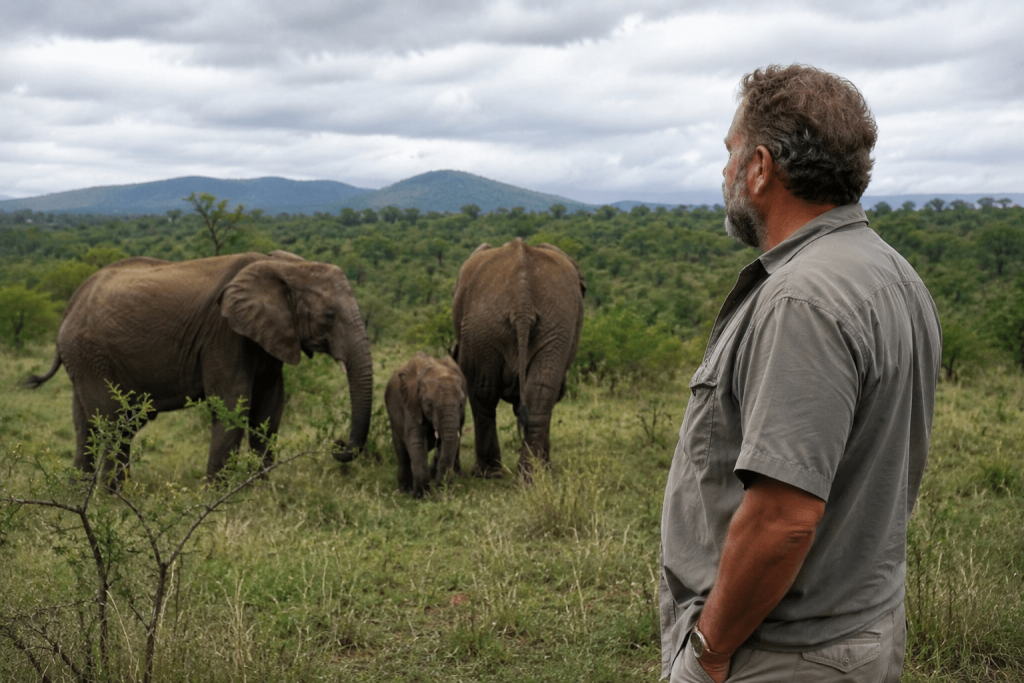
The morning after Lawrence Anthony passed away, an extraordinary scene unfolded at Thula Thula Private Game Reserve in South Africa’s KwaZulu-Natal province. Out of the surrounding bush emerged two herds of wild elephants, walking with quiet determination toward the home of the man who had once saved their lives. They remained there for nearly two days before silently disappearing back into the wilderness.
No one had summoned them. No one had guided their path. The elephants had not visited that part of the reserve for many months, making their appearance all the more remarkable. Over the years, the story has spread across the world as one of the most touching accounts of the bond that can exist between humans and wildlife. Yet behind the emotion lies a well-documented story of a conservationist whose life’s work changed the fate of countless animals.
The Man Who Refused to Give Up on a Doomed Herd
Lawrence Anthony was born in South Africa in 1950 and went on to become one of Africa’s most respected conservationists. Rather than viewing wild animals as problems to be controlled, he believed they could only be protected by understanding their behavior and respecting their natural instincts.
In the late 1990s, a herd of elephants had gained a reputation for being dangerously aggressive. Having endured traumatic experiences with humans, the animals repeatedly broke through fences, threatened nearby communities, and resisted every attempt at relocation. Authorities concluded that euthanasia might be the only remaining option.
Anthony refused to accept that outcome.
He offered to take the herd into his own reserve, Thula Thula, despite widespread warnings that the decision could cost him his life.
Winning Trust Instead of Using Force
The arrival of the elephants marked the beginning of a long and difficult process.
The herd was led by a powerful matriarch who trusted no one. Night after night she tested the reserve’s fences, searching for a way to lead her family back to freedom. The rest of the elephants followed her every move, remaining tense and defensive.
Rather than responding with aggression, Anthony chose patience.
He spent hours standing near the fences, speaking softly to the animals and allowing them to become familiar with his presence. He believed that forcing obedience would only deepen their fear. Instead, he hoped that consistency and calm would eventually replace suspicion with trust.
Progress came slowly.
Over the following months, the matriarch’s behavior began to change. Escape attempts became less frequent, and the elephants gradually accepted the man who had once been just another human in their eyes.
Anthony later described this remarkable journey in his bestselling book The Elephant Whisperer, where he shared firsthand experiences of building a relationship with one of the most intelligent and emotionally complex species on Earth.
A Conservationist Whose Work Reached Beyond South Africa
Lawrence Anthony’s dedication to wildlife extended far beyond Thula Thula.
In 2003, during the Iraq War, he traveled to Baghdad despite serious security risks to help rescue animals trapped inside the city’s devastated zoo. Many had been abandoned without food or water, while others had been injured during the conflict. His efforts attracted international attention and highlighted his unwavering commitment to protecting wildlife wherever it was threatened.
Throughout his career, Anthony promoted the idea that conservation is not simply about saving individual animals but about preserving the delicate relationship between people and the natural world.
The Day the Elephants Came Back
Lawrence Anthony died of a heart attack on March 2, 2012, at the age of 61.
Shortly afterward, something unexpected happened.
According to his wife, Françoise Malby-Anthony, and staff members at Thula Thula, two separate elephant herds made their way toward Anthony’s home. The animals reportedly remained nearby for almost forty-eight hours before quietly returning to the bush.
The account quickly spread through international media and has since become one of the most widely shared wildlife stories of the past decade.
However, it is important to separate documented events from interpretation. While multiple eyewitnesses reported the elephants’ visit, there is no scientific evidence proving that the animals somehow knew Anthony had died or intentionally gathered to mourn him. Those conclusions remain personal interpretations rather than established facts.
What Science Tells Us About Elephant Intelligence
Although the reason behind the elephants’ visit remains unknown, decades of scientific research have revealed just how extraordinary these animals truly are.
Elephants possess the largest brains of any land mammal, with highly developed regions associated with memory, learning, and emotional processing. They can recognize hundreds of individual elephants, remember migration routes and water sources for decades, and communicate through low-frequency sounds that travel several kilometers beyond the range of human hearing.
Researchers have also documented behaviors that suggest deep social bonds. Elephants often investigate the bones of deceased elephants, gently touching skulls and tusks with their trunks. Herd members may linger near the bodies of companions or revisit places where deaths occurred long after the event itself.
While scientists remain cautious about describing these behaviors as human-like grief, they agree that elephants display an exceptional level of social awareness and emotional complexity.
A Legacy That Lives Beyond the Legend
Today, Lawrence Anthony is remembered for far more than the mysterious story that followed his death.
His greatest achievement was proving that animals labeled as hopeless or dangerous could be given another chance through patience, respect, and understanding rather than fear or violence. His work transformed public perceptions of elephant behavior and inspired conservation efforts around the world.
Whether the elephants visited his home because they sensed his absence or for reasons science has yet to explain may never be known.
What is certain is that Lawrence Anthony left behind more than a remarkable story. He left a lasting legacy of compassion, courage, and conservation that continues to inspire people across the globe, reminding us that the strongest connections with nature are often built not through control, but through trust.