
Modern air travel comes with long security lines, baggage scanners, and strict screening procedures that many travelers find frustrating. Yet few stop to wonder why those measures exist in the first place.
Decades ago, flying was a very different experience.
Passengers walked through airport terminals with little security, luggage was loaded without the technology we now consider essential, and travel insurance could even be purchased from vending machines just minutes before boarding.
That world changed forever after one of the most shocking crimes in American aviation history.
A Farewell No One Questioned
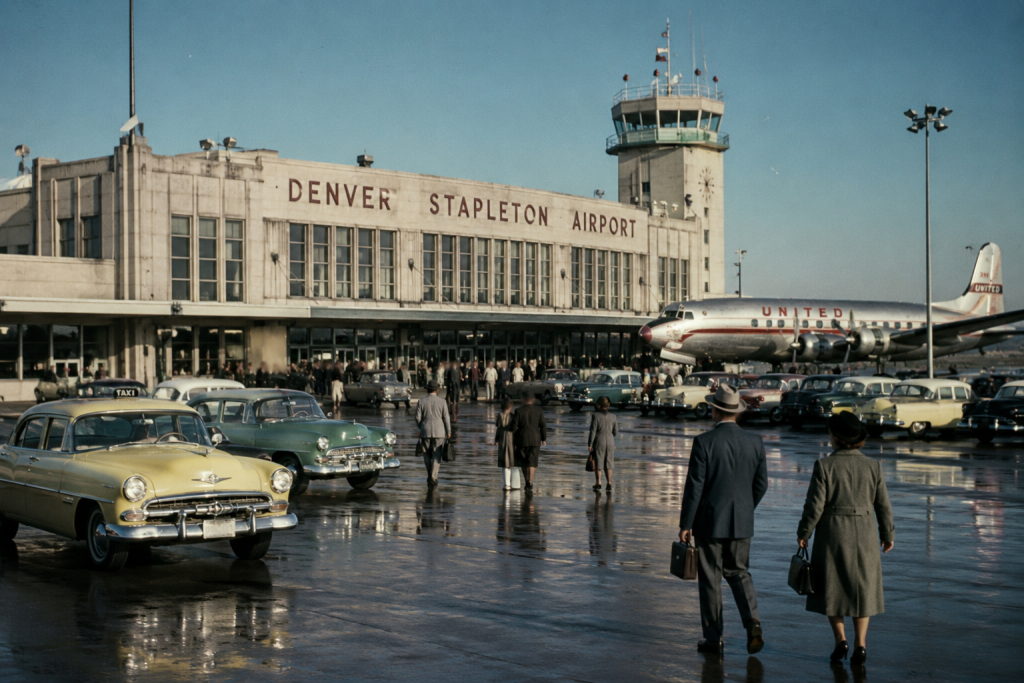
On the evening of November 1, 1955, Daisie King arrived at Denver’s Stapleton Airport for a trip to visit relatives in Alaska.
Her son, John Gilbert “Jack” Graham, drove her to the airport, helped with her luggage, and stayed by her side until it was time to board.
Before saying goodbye, he asked if he could place an early Christmas present inside one of her suitcases.
She agreed without hesitation.
Moments later, they embraced one last time.
Neither the airport staff nor the passengers around them had any reason to suspect that the package hidden inside her luggage was not a gift at all, but a carefully constructed explosive device.
A Childhood That Left Lasting Scars
John Gilbert Graham had experienced a troubled upbringing. After his father died, his mother struggled financially and placed him in an orphanage for a period of his childhood.
Historians believe that experience deeply affected him, although no one can say with certainty how much it shaped the decisions he later made.
As he grew older, Graham repeatedly found himself in trouble with the law. He committed theft, forged checks, and accumulated a criminal record. More than once, his mother stepped in to help him avoid harsher consequences, paying debts and trying to give him another chance.
From the outside, it appeared she had never stopped supporting her son.
Behind the scenes, however, resentment had continued to grow.
Eleven Minutes Into the Flight
United Airlines Flight 629 departed Denver at 6:52 p.m.
The Douglas DC-6B carried 39 passengers and five crew members. Some were traveling for business, others were heading home or visiting family. For everyone on board, it seemed like an ordinary evening flight.
About eleven minutes after takeoff, a powerful explosion ripped through the aircraft’s baggage compartment.
The blast destroyed the rear section of the airplane, causing it to break apart in midair before crashing across farmland near Longmont, Colorado.
Witnesses on the ground described hearing a loud explosion before watching burning wreckage fall from the sky.
None of the 44 people aboard survived.
Rebuilding an Airplane to Find the Truth
Investigators faced an enormous challenge.
Thousands of pieces of twisted aluminum, wiring, and aircraft components were recovered from the crash site and transported to a hangar, where specialists painstakingly reconstructed sections of the airplane.
The damage pattern eventually revealed something crucial.
The explosion had originated inside the baggage compartment.
From there, investigators narrowed their search to a single suitcase.
It belonged to Daisie King.
The Mistake That Exposed the Killer
As detectives examined Graham’s recent activities, they uncovered a critical clue.
Just before the flight departed, he had purchased several travel life insurance policies covering his mother, worth a total of $37,500.
At the time, airport vending machines commonly sold these policies within minutes.
The insurance purchases alone raised suspicion, but they were only part of the evidence.
Authorities traced the dynamite used in the bomb to Graham, discovered components matching the explosive device, and eventually obtained a confession detailing how he had built and hidden the bomb.
Although he later claimed his confession had been forced, the physical evidence left little room for doubt.
A Crime That Changed More Than One Family
John Gilbert Graham was convicted of first-degree murder in 1956 and executed in Colorado’s gas chamber the following year at just 24 years old.
The tragedy exposed significant weaknesses in aviation security and highlighted gaps in U.S. law regarding attacks against commercial aircraft.
While today’s airport screening procedures did not appear overnight—and many were introduced years later following additional hijackings and terrorist incidents—the Flight 629 bombing became one of the earliest events to demonstrate how devastating unchecked aviation sabotage could be.
It also helped drive legislative changes that strengthened federal authority over crimes involving commercial aircraft.
Why This Story Still Matters
The victims aboard Flight 629 were not involved in a family dispute.
They were ordinary people who expected nothing more than a routine flight.
They never knew the danger had been packed into the luggage compartment before takeoff.
Today, every security checkpoint, baggage inspection, and screening procedure serves as a reminder that many aviation safety rules were written only after terrible lessons had already been learned.
The story of Flight 629 is not simply about one of America’s most disturbing crimes.
It is a reminder that behind many of the safety measures travelers take for granted are real people whose lives were lost long before those protections existed.