
On the morning of May 19, 1536, silence hung over the Tower of London as Anne Boleyn walked toward the scaffold. Once the most influential woman in England, she had inspired King Henry VIII to break with Rome and alter the course of English history. Now she was condemned to die on charges that many historians believe were politically motivated.
Left behind was a three-year-old daughter.
For centuries, one question has continued to intrigue historians and history lovers alike: if Henry VIII wanted to erase Anne Boleyn from his life, why didn’t he eliminate their daughter as well?
The answer reveals far more than the personality of one king. It offers a fascinating glimpse into power, politics, and the fragile nature of royal succession in Tudor England.
A King’s Daughter Was Not So Easily Discarded
Henry VIII desperately wanted a son. His obsession with producing a male heir shaped nearly every major decision of his reign, from his six marriages to England’s break with the Catholic Church.
Elizabeth was not the child he had hoped for.
Yet she remained his own daughter.
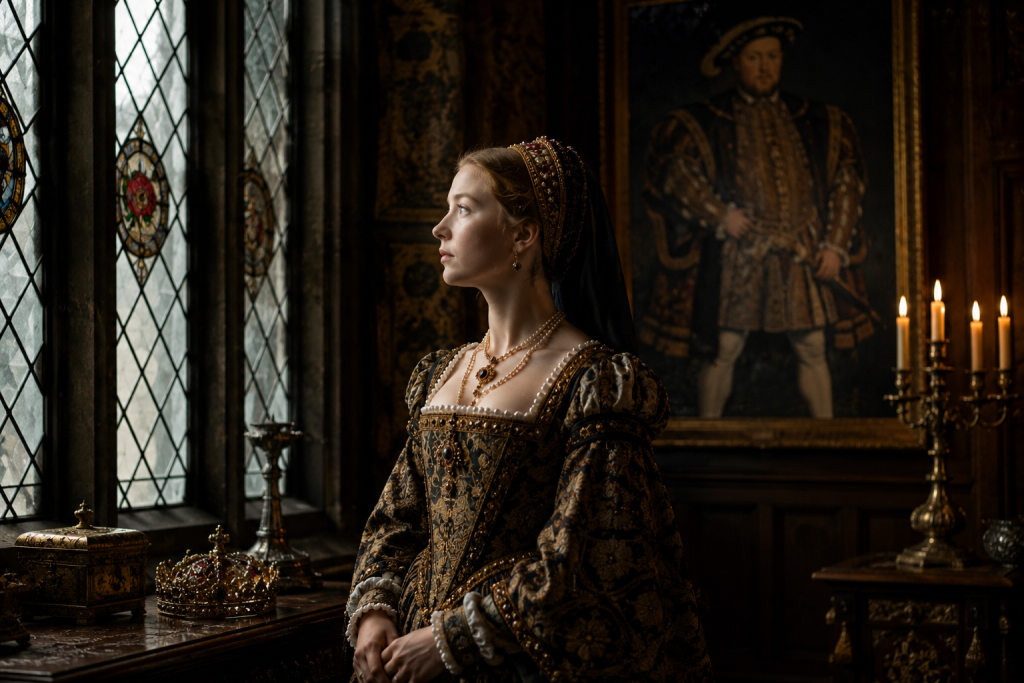
In sixteenth-century Europe, royal blood carried enormous significance. Executing an innocent child of the king would have been viewed as an act of shocking brutality, risking outrage among European rulers, damaging Henry’s legitimacy, and undermining the very dynasty he was trying to protect.
Even Henry, despite his ruthless reputation, understood that such a step would have carried consequences far beyond England.
Keeping Elizabeth Alive Was Politically Useful
Royal daughters were valuable diplomatic assets.
A carefully arranged marriage could strengthen alliances, prevent conflicts, or improve relations with powerful neighboring kingdoms. Even if Elizabeth was no longer Henry’s preferred heir, she still represented an opportunity that could prove useful in the future.
A living princess was often worth far more than a dead one.
Henry Chose a Different Solution
Rather than removing Elizabeth physically, Henry erased her position in law.
Shortly before Anne Boleyn’s execution, his marriage to her was declared invalid. As a result, Elizabeth was officially declared illegitimate.
Overnight, she lost her title of Princess and became known simply as “Lady Elizabeth.” More importantly, she was removed from the line of succession, clearing the way for any future children Henry hoped to have with his next wife, Jane Seymour.
For the king, this solved the immediate problem without creating a political scandal.
The Forgotten Child Who Received an Extraordinary Education
Although stripped of her royal status, Elizabeth was never abandoned.
She continued to live in royal households and received an education that few women—and even fewer men—could match. She mastered Latin, Greek, French, and Italian while studying philosophy, history, theology, and classical literature.
Foreign ambassadors frequently commented on her remarkable intelligence, long before anyone imagined she might one day wear the crown herself.
Later in Henry’s reign, his sixth wife, Catherine Parr, helped improve Elizabeth’s relationship with her father. In 1543, the Third Succession Act restored both Elizabeth and her half-sister Mary to the order of succession, although questions surrounding their legitimacy technically remained.
Her Mother’s Fate Never Stopped Following Her
Henry’s death did not end Elizabeth’s struggles.
After the brief reign of her half-brother Edward VI, the throne passed to Mary I, a committed Catholic who viewed Protestant supporters with deep suspicion.
In 1554, Elizabeth was arrested and imprisoned in the Tower of London.
History seemed ready to repeat itself.
She entered the same fortress where her mother had spent her final days before execution nearly two decades earlier. Elizabeth knew exactly what that place represented. Many prisoners who entered its gates never walked out again.
Only the lack of convincing evidence against her—and Mary’s reluctance to act without it—saved her life.
The Daughter Henry Never Wanted Became England’s Greatest Queen
When Mary I died childless in 1558, Elizabeth inherited the crown.
Few people could have predicted what happened next.
Her reign lasted 44 years and became known as the Elizabethan Age, one of the most celebrated periods in English history. Literature flourished, overseas exploration expanded, trade grew rapidly, and England emerged as one of Europe’s leading powers.
In 1588, the defeat of the Spanish Armada transformed England’s international reputation and secured Elizabeth’s place among history’s most successful rulers.
The irony could hardly have been greater.
The little girl once declared illegitimate had become the monarch who defined an entire era.
Why She Never Married
Elizabeth received marriage proposals from some of Europe’s most powerful royal families, yet she accepted none of them.
Historians continue to debate her reasons. Some believe witnessing her father’s marriages and her mother’s execution left her deeply distrustful of marriage itself. Others argue that remaining unmarried allowed her to retain complete political authority and use the possibility of marriage as a diplomatic advantage.
Whatever the explanation, history remembers her as the Virgin Queen.
She never married.
She never had children.
The End of the Tudor Dynasty
When Elizabeth died in 1603, she left no direct heir.
The Tudor dynasty came to an end, and the English crown passed to James VI of Scotland, who became James I of England. As the great-grandson of Margaret Tudor—Henry VIII’s elder sister—he inherited the throne through the wider Tudor family, beginning the Stuart dynasty.
The Greatest Irony of Henry VIII’s Life
Henry VIII spent decades trying to secure the future of his dynasty through a son.
He divorced queens, married six times, transformed England’s religious landscape, and reshaped the monarchy in pursuit of that single goal.
He eventually had the son he longed for, Edward VI.
But Edward died at just fifteen years old without leaving descendants.
Meanwhile, the daughter Henry had declared illegitimate, removed from the succession, and once regarded as a disappointment ruled England longer than any of her siblings and became one of the most admired monarchs in British history.
History often unfolds in unexpected ways.
For Henry VIII, the legacy he fought hardest to secure did not come through the son he desperately wanted. It came through the daughter he had once pushed aside—a woman whose reign would shape England for generations and whose name would eclipse his own ambitions.