
In the early 1800s, people across Europe weren’t buying tickets to Niccolò Paganini’s concerts for the music alone. Many came because they wanted to see the man behind the rumors.
Some believed his fingers moved in ways no human hands should. Others insisted no ordinary musician could play with such speed, precision, and control. Before long, stories spread that his astonishing talent had come at a terrible price—that he had traded his soul to the Devil.
Today those tales sound like folklore, but they reveal just how extraordinary Paganini appeared to audiences of his time.
A Musician Unlike Anyone Else
Born in Genoa in 1782, Paganini showed remarkable musical ability from a young age. Encouraged—some would say relentlessly pushed—by his father, he spent countless hours practicing the violin until his technique surpassed anything most listeners had ever witnessed.
As his reputation grew, concert halls filled with people eager to hear the performer everyone was talking about.
His performances seemed almost impossible. He introduced techniques that few violinists could imitate, combining breathtaking speed with flawless precision. Even when a string snapped during a performance, he was known to continue playing, turning an accident into another unforgettable display of mastery.
For audiences who had never seen anything like it, the experience bordered on the unbelievable.
When Talent Became a Legend
Paganini’s appearance only fueled the mystery.
He was exceptionally thin, with a pale face, long fingers, and dark clothing that made him stand out wherever he performed. On stage, he appeared completely absorbed in the music, rarely displaying the theatrical charm expected from many performers of the era.
Combined with his extraordinary abilities, his unusual appearance sparked endless speculation.
Modern researchers have suggested that he may have had a connective tissue disorder such as Marfan syndrome or Ehlers-Danlos syndrome, conditions that can increase flexibility. However, no medical diagnosis was ever confirmed, so these remain educated theories rather than established facts.
At the time, people had no such explanations. In an age when superstition still shaped public opinion, many found it easier to believe supernatural stories than to accept that someone could reach such an extraordinary level through talent, discipline, and relentless practice.
Before long, newspapers and word of mouth had transformed Paganini into “The Devil’s Violinist.”
The Man Behind the Myth
Despite the legends, Paganini’s achievements were built on remarkable dedication.
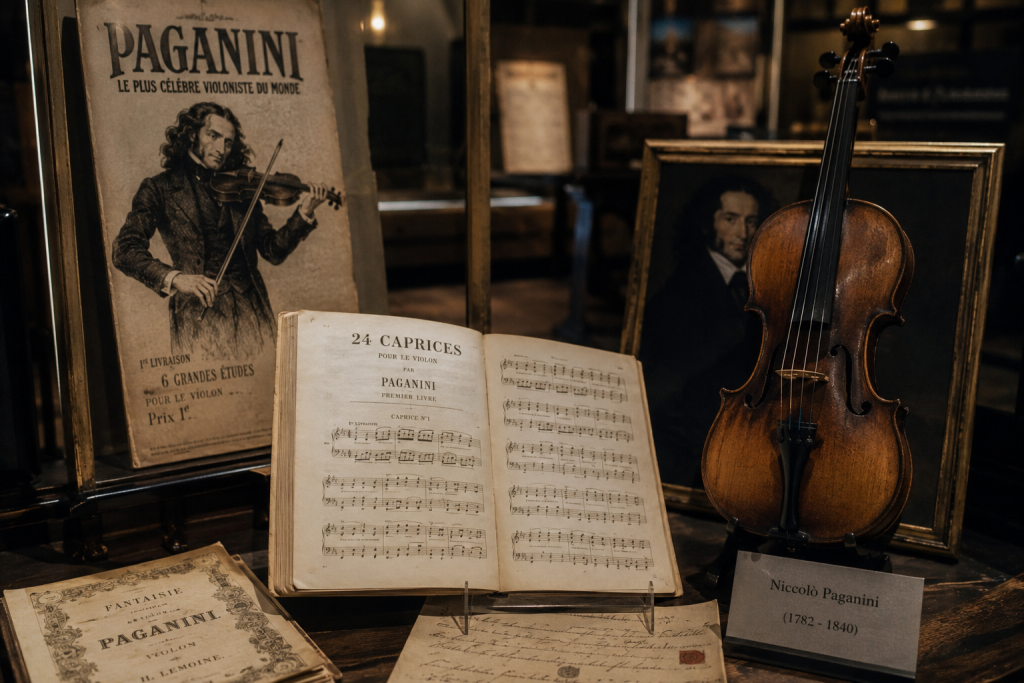
He constantly experimented with new techniques and expanded the possibilities of the violin. His famous 24 Caprices remain among the most technically demanding works ever written for the instrument, challenging even today’s finest performers.
His influence extended far beyond his own lifetime. Many violinists still regard his compositions as milestones in the evolution of violin performance.
A Controversial Farewell
The final chapter of Paganini’s life proved almost as dramatic as the rumors that surrounded him.
By 1840, serious illness had left him unable to speak properly. According to historical accounts, a priest visited to administer the last rites, but Paganini declined, believing death was not yet imminent.
He died shortly afterward.
That decision had lasting consequences.
Because he had died without receiving the final sacraments—and because of the dark reputation that had followed him for years—his burial became the subject of prolonged disputes with Church authorities.
A Coffin Without a Resting Place
After his death, Paganini’s remains did not immediately find a permanent resting place.
His son, Achille, spent decades seeking permission for a proper Catholic burial while the coffin was moved several times as different authorities refused to authorize the interment.
Each delay gave fresh life to the old rumors. To believers in the legend, it seemed as though the famous violinist had found no peace even after death.
The truth was far less mysterious. The delays were the result of religious and administrative decisions rather than anything supernatural.
Finally, in 1876—thirty-six years after his death—Niccolò Paganini was laid to rest in Parma, bringing a long and unusual chapter of music history to an end.
Why His Story Still Fascinates Us
Many historical figures become surrounded by myths, but few have inspired stories as enduring as Paganini’s.
The legend of a musician who bargained with the Devil continues to appear in books, documentaries, and popular culture. Yet there has never been any evidence to support those claims.
What history does confirm is arguably even more remarkable.
A boy from Genoa transformed violin playing forever through exceptional ability, relentless practice, and relentless creativity. His music continues to challenge performers more than two centuries later, and his name remains synonymous with virtuosity.
Perhaps that is why the legend has never completely disappeared. Sometimes extraordinary talent seems so difficult to explain that people prefer a supernatural story over a very human truth.