
I almost did.
A sweet potato had been sitting untouched for weeks. By the time I picked it up again, it looked nothing like the one I had brought home from the store. Long purple stems stretched in every direction, fresh green leaves had appeared, and tiny roots were beginning to form.
It no longer looked like dinner.
It looked alive.
Like many people, my first reaction was simple: “There’s no way this is still safe to eat.”
But the more I looked into it, the more I realized that a sprouted sweet potato tells a very different story from a sprouted regular potato. In most cases, what you’re seeing isn’t spoilage at all—it’s nature doing exactly what it was designed to do.
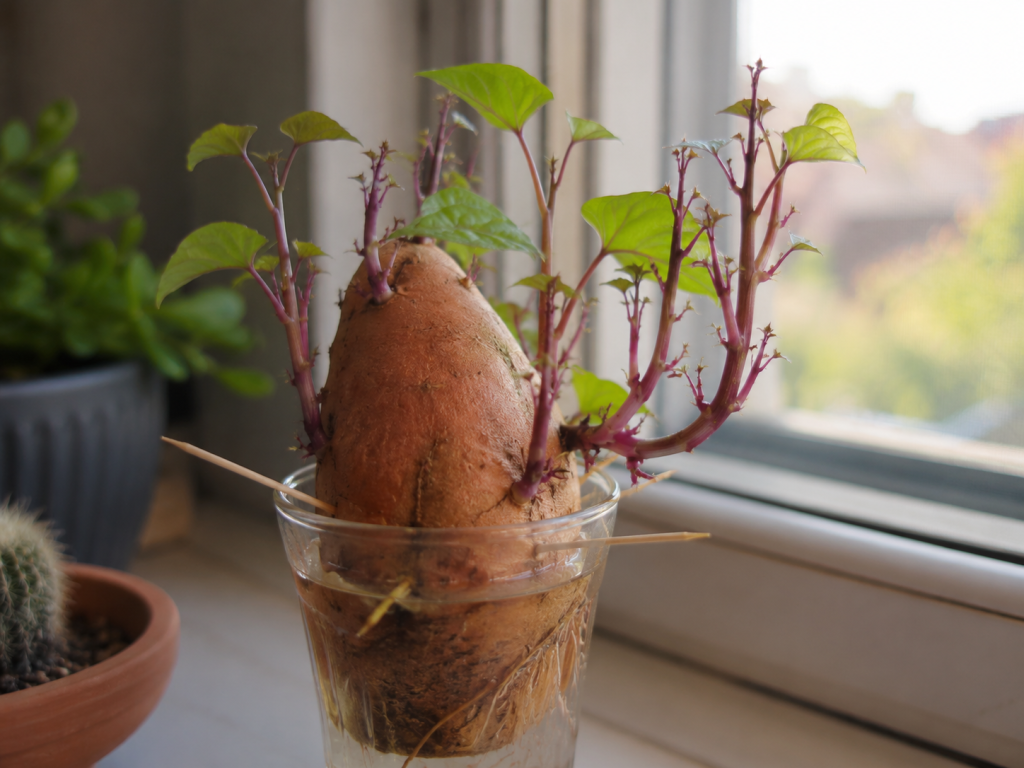
It’s not dying—it’s trying to grow
A sweet potato isn’t just food. For the plant, it’s an energy reserve.
Hidden inside the tuber are starches and nutrients that remain dormant until the right conditions arrive. Warm temperatures, light, and time signal that it’s safe to begin growing again.
That’s when tiny buds wake up.
Soon they become shoots, then vines, leaves, and roots. Everything the new plant needs comes from the energy stored inside the sweet potato itself.
From our perspective, it may look old.
From the plant’s perspective, it’s just getting started.
Why do so many people think it’s dangerous?
The answer is surprisingly simple.
Most of us assume sweet potatoes behave like ordinary potatoes because they share the same name.
In reality, they’re only distant botanical cousins.
The common potato (Solanum tuberosum) belongs to the nightshade family, alongside tomatoes, peppers, and eggplants. Sweet potatoes (Ipomoea batatas), however, belong to the morning glory family—a completely different group of plants.
The name “sweet potato” comes from the fact that both produce edible underground storage organs and are prepared in similar ways. Beyond that, they have very different biology.
That difference matters far more than most people realize.
Why the rules aren’t the same
Regular potatoes can accumulate higher levels of natural compounds called glycoalkaloids, particularly solanine, when they’re exposed to light and begin turning green. In large amounts, these compounds can be harmful, which is why heavily green or badly sprouted potatoes are often discarded.
Sweet potatoes don’t follow the same pattern.
Simply producing shoots does not mean they’ve become toxic.
That’s one of the biggest misconceptions surrounding them.
Does sprouting change the potato?
Yes—but not in the way many people expect.
As the vines continue to grow, the sweet potato gradually uses up the starches and sugars it stored for months. Those nutrients are converted into energy for the developing plant.
As a result, the tuber may lose some sweetness, become lighter, slightly wrinkled, or develop a firmer, more fibrous texture.
These are quality changes rather than safety concerns.
The sweet potato isn’t becoming poisonous.
It’s simply spending the energy it had saved.
So when should you throw it away?
The sprouts themselves usually aren’t the deciding factor.
Instead, look for the classic signs of spoilage.
If the sweet potato has mold, a sour or fermented smell, large soft spots, leaking liquid, or extensive internal rot, it’s time to discard it.
If it still feels firm, smells normal, and looks healthy when cut open, removing the sprouts and cooking the potato is generally considered perfectly reasonable.
In other words, spoilage matters far more than sprouting.
One fascinating fact most people never hear
Commercial growers don’t see those shoots as a problem.
They actually rely on them.
The young shoots, called slips, are removed from the parent sweet potato and planted in soil, where they develop roots and eventually produce entirely new sweet potatoes.
A single healthy tuber can generate dozens of slips, making it the starting point for an entire harvest.
Even more surprising, the young leaves of sweet potato plants are commonly eaten in many parts of Asia, Africa, and South America. They’re rich in vitamins, antioxidants, and fiber, and are often cooked much like spinach.
That’s another reminder that sprouting doesn’t automatically mean something has gone bad.
The best way to store sweet potatoes
If you’d like them to last longer before sprouting, keep them somewhere cool, dry, and well ventilated, away from direct sunlight.
Unlike many vegetables, the refrigerator isn’t the ideal place. Temperatures that are too cold can damage the flesh, affecting both flavor and texture once cooked.
Commercial producers often use a process known as curing, holding freshly harvested sweet potatoes under carefully controlled warmth and humidity. This allows tiny wounds in the skin to heal naturally, helping the potatoes stay fresh for much longer.
Final thoughts
The next time you discover a sweet potato covered in vines and leaves, take a second look before throwing it away.
What appears to be a ruined vegetable is often something entirely different—a living plant using every bit of stored energy to begin another life.
The important question isn’t whether it has sprouted.
It’s whether it has spoiled.
Sometimes nature looks messy. Sometimes it even looks alarming.
But every now and then, what seems like the end of a vegetable is actually the beginning of something new.