
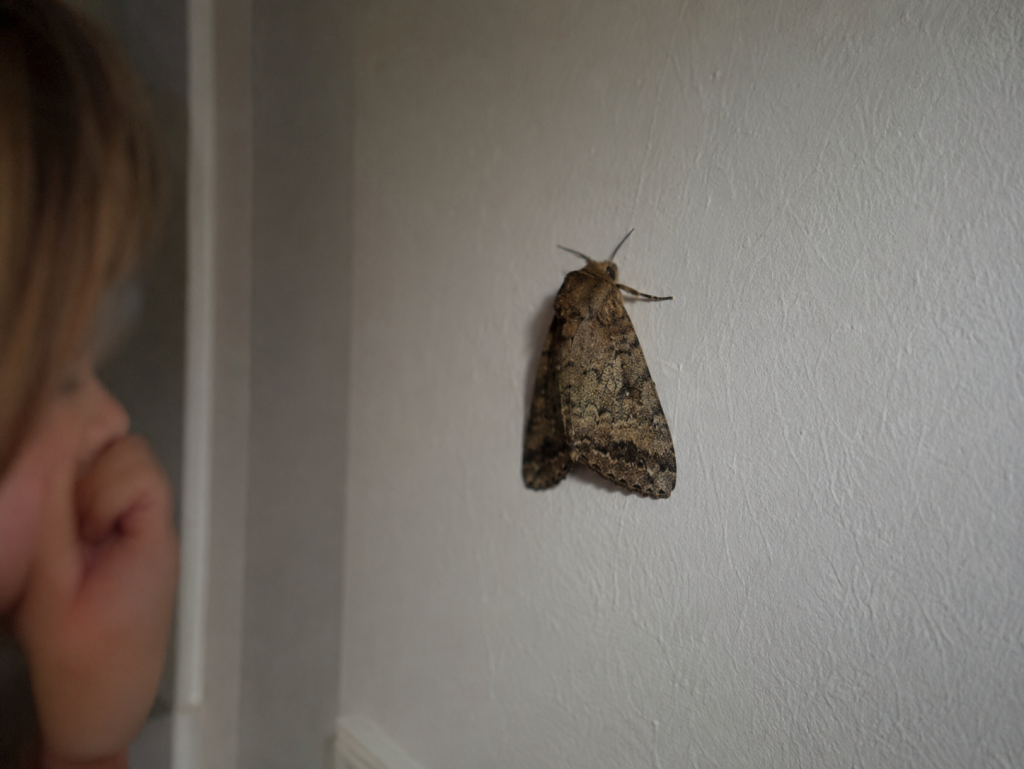
One evening, just as bedtime was approaching, my daughter called for me in a panic. When I stepped into her room, she was frozen, staring at the wall.
There it was.
A large moth.
It wasn’t moving. It wasn’t flying toward her. It wasn’t doing anything at all. Yet in the eyes of a frightened child, it looked enormous.
“Can it bite me?”
“Is it poisonous?”
“What if it lands on me?”
The truth is, these are questions many adults quietly wonder about as well. Moths have always carried an air of mystery. They appear after dark, seem to fly unpredictably, and often look far more intimidating than the colorful butterflies we enjoy during the day.
That moment made me realize something surprising: most of us know very little about these nighttime visitors.
So I started digging into the facts.
What I found completely changed the way I look at them.
Moths have been misunderstood for centuries
Mention the word butterfly, and most people picture bright colors, flowers, and warm summer afternoons.
Mention the word moth, and the image changes instantly. People imagine a dusty insect darting around a light bulb or hiding in a closet, ready to ruin their favorite sweater.
Yet butterflies and moths belong to the very same order of insects: Lepidoptera.
In fact, butterflies are actually the minority. Scientists have described roughly 160,000 moth species, compared with around 17,000–18,000 butterfly species worldwide.
The night belongs to moths far more than the day belongs to butterflies.
Why do moths seem to fly straight at people?
If you’ve ever had one circling your living room, you’ve probably thought it was coming after you.
It wasn’t.
For countless generations, moths have navigated using the Moon as a fixed point in the night sky. Because the Moon is so distant, maintaining a steady angle to its light allows them to travel in a straight line.
Artificial lighting changes everything.
A nearby porch light, lamp, or ceiling bulb confuses that ancient navigation system. Instead of flying normally, the moth begins looping, spiraling, and changing direction unexpectedly.
To us, it looks aggressive.
To the moth, it’s simply disorienting.
Can a moth actually harm a child?
This is probably the question every parent asks first.
Fortunately, the answer is reassuring.
The vast majority of moths commonly found in homes across Europe are harmless.
They don’t bite.
They don’t sting.
They don’t inject venom.
They don’t spread diseases simply by landing on someone’s skin.
If one lands on your hand, it’s usually because it’s exhausted or confused—not because it has any interest in people.
Is the powder on their wings dangerous?
Many of us grew up hearing that touching a moth would expose us to something harmful.
That isn’t true.
The dusty coating isn’t dust at all. It’s made of countless microscopic scales that give moths their colors, patterns, and even help improve their flight.
The scientific name Lepidoptera literally means “scale-winged.”
These scales aren’t poisonous. If they get into your eyes, they may cause minor irritation, just as any tiny particle might, but they pose no toxic risk.
For the moth, however, those scales are valuable, which is why it’s best not to handle these insects unless necessary.
What about clothes moths? Are they the same thing?
At this point, many people ask the obvious question.
“If moths are harmless, what about the ones that destroy wool sweaters?”
The answer is both yes and no.
They are relatives, and we commonly call them all moths, but they live very different lives.
The larger moths that occasionally wander into our homes have no interest in clothing. Their caterpillars usually feed on leaves, while many adults survive on flower nectar. Some species don’t eat at all once they become adults, living only long enough to reproduce.
Clothes moths are a completely different story.
The adult insect isn’t what damages fabrics. Instead, females lay eggs in dark, undisturbed places, and the tiny caterpillars that hatch feed on natural fibers rich in keratin, including wool, cashmere, fur, feathers, and similar materials.
Although they share a family tree, comparing a large garden moth to a clothes moth is a bit like comparing an eagle to a canary simply because they’re both birds.
A hidden battle takes place every night
While most of us sleep peacefully, one of nature’s oldest survival contests unfolds above our heads.
Bats hunt using echolocation, sending out ultrasonic calls that reveal insects flying through the darkness.
Many moth species have evolved sensitive hearing organs capable of detecting those sounds.
The instant they “hear” a bat approaching, they may suddenly dive, tumble, or veer away at astonishing speed.
Some species go even further. Researchers have discovered that certain moths produce ultrasonic clicks of their own, potentially interfering with a bat’s echolocation or signaling that they wouldn’t make an appealing meal.
It’s a silent arms race that has been evolving for millions of years—one we rarely notice.
The overlooked pollinators of the night
Butterflies often receive the spotlight, but many plants depend just as much on moths.
Some flowers don’t fully open until after sunset, releasing powerful fragrances specifically to attract nocturnal pollinators.
Without moths, many of these plants would struggle to reproduce successfully.
Moths also serve as an important food source for birds, bats, amphibians, and countless other animals, making them an essential part of healthy ecosystems.
Why do we fear them so much?
The answer may have more to do with human psychology than with insects.
Our brains are naturally alert to fast, unpredictable movement, especially when it happens close to our faces.
That instinct once helped our ancestors avoid genuine threats.
Today, the same response can make a completely harmless moth seem frightening.
The fear feels real.
The danger usually isn’t.
The easiest way to help a moth leave
If a moth enters your home, there’s rarely any need to kill it.
Turning off the lights in the room and opening a nearby window is often enough. If it doesn’t find its way out, gently catching it with a glass and a piece of paper allows you to release it safely outside.
It’s a simple act that protects both the insect and your home.
Sometimes understanding changes everything
That evening, we carefully carried the moth back outside.
My daughter watched as it disappeared into the darkness.
Just minutes earlier, she had seen a frightening creature.
Now she saw a lost traveler, drawn off course by a light in a window.
Perhaps that’s the greatest lesson moths can teach us.
Not everything that appears mysterious is dangerous. Quite often, fear grows where knowledge is missing.
The next time a moth quietly lands on your wall, pause for a moment before reaching for a shoe.
You may not be looking at a pest at all.
You may be looking at one of nature’s most remarkable night flyers—a tiny survivor whose ancestors have been navigating the darkness for millions of years, only to become lost for a few moments in our brightly lit world.