
Most people never question whether the family they grew up with is also the family they were born into. It is simply one of life’s unquestioned truths.
For Jeremy Morrison and Kyle Bylin, that certainty disappeared almost four decades after they entered the world.
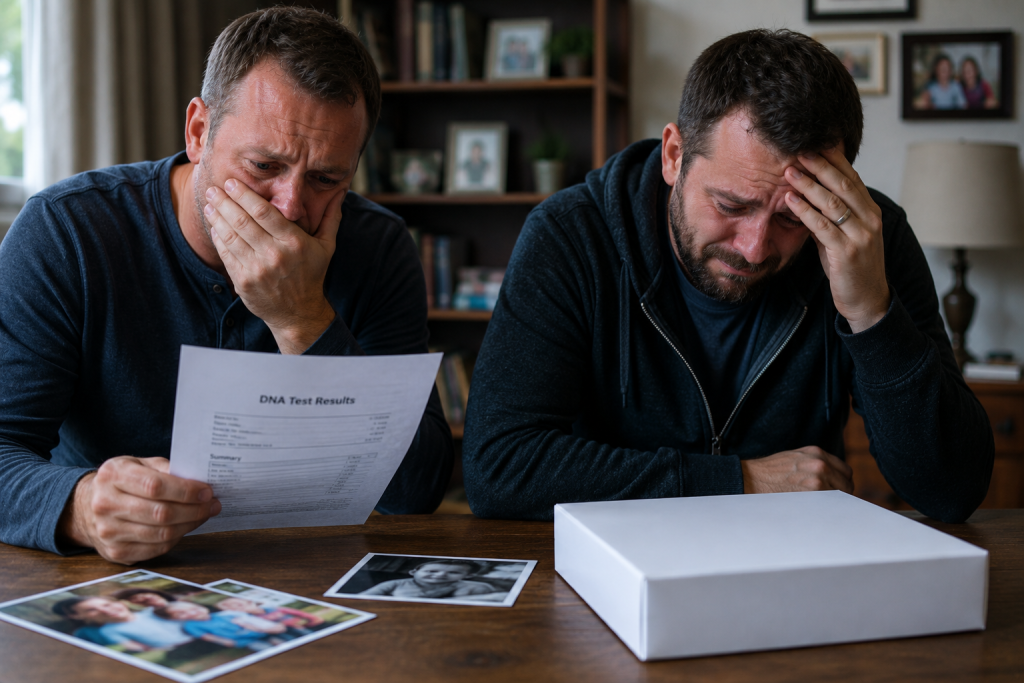
A routine DNA test revealed something almost impossible to imagine: the parents who had raised them with love were not their biological parents. Instead, the two men had been accidentally switched shortly after birth, leaving each family to raise the other’s son for 36 years.
Their story is a powerful reminder that a single mistake made in a hospital can echo across generations.
A Mistake No One Realized Had Happened
On January 26, 1988, two baby boys were born at Unity Medical Center in Grafton, North Dakota.
According to court filings, Jeremy Morrison and Kyle Bylin were the only infants born at the hospital that day.
Somewhere during those first hours after delivery, something went terribly wrong.
The newborns were allegedly placed with the wrong parents, and both families left the hospital believing they were taking home their own child.
No one noticed the error.
The boys grew up in different households, surrounded by parents who loved them deeply and believed they were raising their biological sons.
Nearly Four Decades of Lives Built on the Wrong Beginning
As the years passed, both men created lives that seemed completely ordinary.
They attended school, made lifelong friends, chose careers, married, and started families of their own.
Nothing suggested that their identities had been shaped by a mistake made before they were even old enough to open their eyes.
Every family photograph, birthday celebration, and childhood memory was genuine.
The only thing that wasn’t was the biological connection everyone assumed existed.
A DNA Test Changed Everything
Jeremy Morrison eventually decided to take a consumer DNA test, much like millions of people who are curious about their ancestry.
He wasn’t investigating a family mystery.
He simply wanted to learn more about his roots.
Instead, the results raised a question that seemed impossible to answer.
The people he had always believed were his biological parents shared no genetic relationship with him.
At first, the findings appeared too extraordinary to be true.
Further testing and additional research, however, confirmed the same conclusion.
The explanation was far more shocking than a laboratory error.
Finding the Other Child
As genetic records were examined more closely, investigators identified Kyle Bylin.
DNA evidence showed that the two men had been switched shortly after birth.
For both families, the discovery turned decades of certainty into uncertainty.
Parents met the sons they had unknowingly lost.
Siblings discovered biological brothers they had never known existed.
Jeremy and Kyle suddenly found themselves connected to families that had always been theirs by blood, yet completely unfamiliar by experience.
Can Biology Replace a Lifetime of Memories?
Cases like this raise difficult questions that have no simple answers.
Biology matters.
So does the life shared with the people who raise a child.
Parenthood is shaped not only by genetics but by thousands of ordinary moments—comforting a sick child, celebrating milestones, offering guidance, and being present through life’s challenges.
Those memories cannot be erased by a DNA report.
At the same time, neither man can recover the childhood he might have experienced with his biological family.
Both realities exist together, making stories like this emotionally complex rather than simply tragic.
“My Life Would Have Been Completely Different”
Jeremy Morrison has spoken publicly about how differently his life might have unfolded.
He believes he likely would have remained in North Dakota, working on his biological family’s farm alongside the brother he never knew he had.
Instead, his life took him to Colorado, where he built an entirely different future.
His reflection highlights how one administrative mistake can influence far more than a birth certificate.
It can alter where someone grows up, the people they meet, the opportunities they receive, and ultimately the person they become.
The Lawsuit Against the Hospital
Following the DNA confirmation, Jeremy Morrison and Kyle Bylin filed a lawsuit against Unity Medical Center.
They argue that the hospital’s alleged mistake permanently altered the course of their lives and caused significant emotional harm.
The lawsuit seeks financial damages and a jury trial.
Hospital representatives have acknowledged that the two men were raised by the wrong families but maintain that, nearly four decades later, there is insufficient evidence to determine exactly how the mix-up occurred or who was responsible.
The legal case is ongoing.
Why Stories Like This Are Emerging Today
Until recently, many birth mix-ups might never have been discovered.
The widespread availability of direct-to-consumer DNA testing has changed that.
Originally marketed as a way to explore ancestry, these tests have unexpectedly uncovered hidden adoptions, unknown siblings, donor-conceived children, and, in rare cases, babies switched at birth.
Advances in genetic technology are revealing family secrets that once seemed destined to remain hidden forever.
Could This Happen Today?
Modern maternity wards operate very differently than they did decades ago.
Hospitals now rely on multiple identification systems, including matching wristbands, electronic verification, barcode tracking, and strict newborn identification protocols.
While no safety system can eliminate every possibility of human error, incidents like this have become significantly less likely than they were in the past.
Many of today’s procedures were introduced precisely because of cases that exposed weaknesses in older hospital practices.
A Story About More Than DNA
Jeremy Morrison and Kyle Bylin eventually learned the truth about their biological origins.
What they did not lose were the relationships built over decades with the parents who loved and raised them.
Their story is not simply about genetics.
It is about identity, belonging, and the complicated reality that a family can be defined both by blood and by the life shared together.
For nearly 36 years, two families celebrated birthdays, holidays, graduations, and countless ordinary moments without realizing that somewhere else, their biological son was living an entirely different life.
No court ruling can restore those lost years.
But their story has become a powerful reminder of why accuracy, accountability, and modern safeguards in maternity care matter—and how one unexpected DNA test can rewrite an entire family’s history.