
For decades, climbers attempting to reach the summit of Mount Everest passed the same silent figure lying inside a small rocky alcove high above the clouds. Frozen in place by temperatures that rarely rise above freezing, the body became one of the mountain’s most recognizable landmarks.
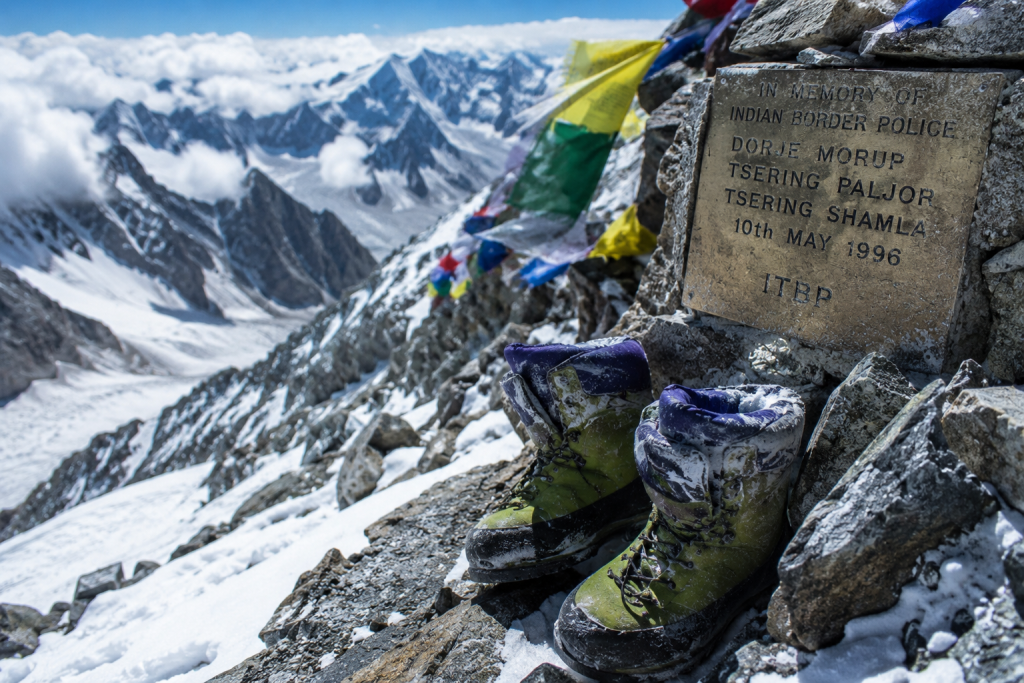
Most people knew the climber only by the nickname “Green Boots,” a reference to the bright green mountaineering boots he was wearing. Books, documentaries, expedition journals, and countless online discussions repeated the same story: the body belonged to Indian climber Tsewang Paljor, who died during the infamous 1996 Everest disaster.
That story endured for nearly three decades.
Then modern DNA analysis revealed that one of Everest’s best-known legends was built on a mistaken identity.
A landmark no climber ever wanted to see
Mount Everest is unlike any other mountain on Earth. Above approximately 8,000 meters (26,247 feet), climbers enter what mountaineers call the “Death Zone.” At this altitude, the human body slowly begins to shut down because there is simply not enough oxygen to sustain normal function.
Every movement requires enormous effort. Judgment becomes impaired, reaction times slow, and even experienced climbers can become confused.
It was in this unforgiving environment, at roughly 8,500 meters (27,900 feet) on Everest’s North Route, that the frozen climber remained for years inside a shallow cave.
Because his bright green boots stood out against the rock and snow, mountaineers began referring to him simply as Green Boots.
The nickname eventually became more famous than the man himself.
For thousands of climbers, passing the cave became an emotional milestone. Some deliberately avoided looking inside, while others later described the experience as a sobering reminder that the world’s highest mountain offers little forgiveness for mistakes.
The storm that changed Everest forever
The mystery surrounding Green Boots traces back to one of the darkest chapters in Everest’s history.
In May 1996, commercial expeditions were becoming increasingly popular. Favorable weather windows were brief, meaning dozens of climbers often attempted the summit on the same day.
On May 10, 1996, conditions initially appeared promising.
Then everything changed.
A violent storm swept across the mountain, bringing hurricane-force winds, plunging temperatures, and near-zero visibility. Climbers who had successfully reached the summit suddenly found themselves struggling to navigate back to camp.
Some ran out of supplemental oxygen.
Others became separated from their teams.
By the time the storm subsided, eight climbers had lost their lives, making it one of the deadliest single days in Everest’s climbing history. The disaster later became internationally known through Jon Krakauer’s bestselling book Into Thin Air.
Three climbers never returned
Among those caught in the storm was a team from the Indo-Tibetan Border Police (ITBP).
The expedition included experienced climbers Dorje Morup, Tsewang Paljor, and Tsewang Smanla.
All three disappeared during the descent after reaching extreme altitude.
Recovering bodies in the Death Zone was almost impossible. The harsh conditions placed rescuers at enormous risk, and confirming exactly where each climber had died proved equally difficult.
In the years that followed, many assumed the body inside the cave belonged to Tsewang Paljor.
The explanation seemed reasonable.
Paljor had reportedly been wearing green climbing boots, and available accounts appeared to place him near the location where the body was eventually found.
Without physical evidence to prove otherwise, the assumption gradually became accepted as fact.
When assumptions become history
One of the fascinating aspects of the Green Boots story is how quickly an unverified conclusion became part of mountaineering history.
Travel articles, television documentaries, books, and online discussions repeated the same identification year after year. Eventually, few people questioned whether the body had ever been officially identified.
In reality, it had not.
Because the remains stayed on the mountain, there was no opportunity for immediate forensic confirmation.
For almost thirty years, the world’s most famous unidentified climber was known by a name that turned out to be incorrect.
Why Everest still holds so many bodies
Many people wonder why victims are not simply brought down from the mountain.
The answer lies in the extraordinary dangers of high-altitude recovery.
Above 8,000 meters, oxygen levels are so low that even walking a few steps can leave climbers exhausted. Every additional kilogram dramatically increases physical effort.
Recovering a single body may require a large team of experienced Sherpas and mountaineers working together under life-threatening conditions. Such missions are technically complex, physically demanding, and can cost tens of thousands of dollars.
History has shown that rescuers themselves can become victims during recovery attempts.
For that reason, many families ultimately decide that leaving loved ones on the mountain is safer than risking additional lives.
DNA testing rewrote one of Everest’s most famous stories
Nearly thirty years after the tragedy, advances in forensic science finally provided an answer.
Indian authorities compared DNA collected from the climber’s remains with genetic samples provided by relatives of the missing expedition members.
The results surprised both the climbing community and the public.
The body known worldwide as Green Boots was not Tsewang Paljor.
Instead, DNA confirmed that the climber was Dorje Morup, another member of the same 1996 expedition.
With a single scientific finding, one of Everest’s longest-standing mysteries was finally resolved.
It also highlighted how even widely accepted historical narratives can be corrected when new evidence emerges.
More than a famous nickname
To the climbing community, Green Boots became an enduring symbol of Everest’s dangers.
To Dorje Morup’s family, however, he was never simply a landmark or a story repeated in documentaries.
He was a son, a colleague, and a man whose final moments remained uncertain for nearly three decades.
The DNA confirmation cannot undo the tragedy of 1996, but it restores something deeply important: identity.
After years of speculation, one of the mountain’s most recognizable figures is no longer remembered only by a nickname.
A reminder that Everest still keeps its secrets
Every climbing season, hundreds of people attempt to stand on the highest point on Earth. Most return home safely. Some do not.
The extreme cold preserves equipment, footprints, and, in many cases, those who never made it back down.
Green Boots became one of Everest’s most recognizable symbols not because of extraordinary achievement, but because his story represented both the ambition and the unforgiving reality of climbing at the limits of human endurance.
For nearly thirty years, the world believed it knew who he was.
Science proved otherwise.
Today, the mystery that captivated climbers for a generation has finally been solved, reminding us that even on the world’s most explored mountain, history can still change when evidence replaces assumption.