
Before the first tourist boats arrive each morning, park rangers begin patrolling the trails of Indonesia’s Komodo National Park. Their job isn’t simply to guide visitors through breathtaking landscapes. They are also watching for one of the planet’s most extraordinary predators—a reptile that can grow longer than three meters and is powerful enough to bring down deer and even water buffalo.
Not far from these protected areas, small villages come to life. Fishermen prepare their boats before sunrise, children head to school, and families begin another ordinary day. Yet life here includes an unusual reality: at almost any moment, a Komodo dragon could wander close to the edge of the village.
For the people who call these islands home, the world’s largest lizard isn’t a mythical creature from a nature documentary. It’s a wild neighbor that has shared the same landscape with humans for generations.
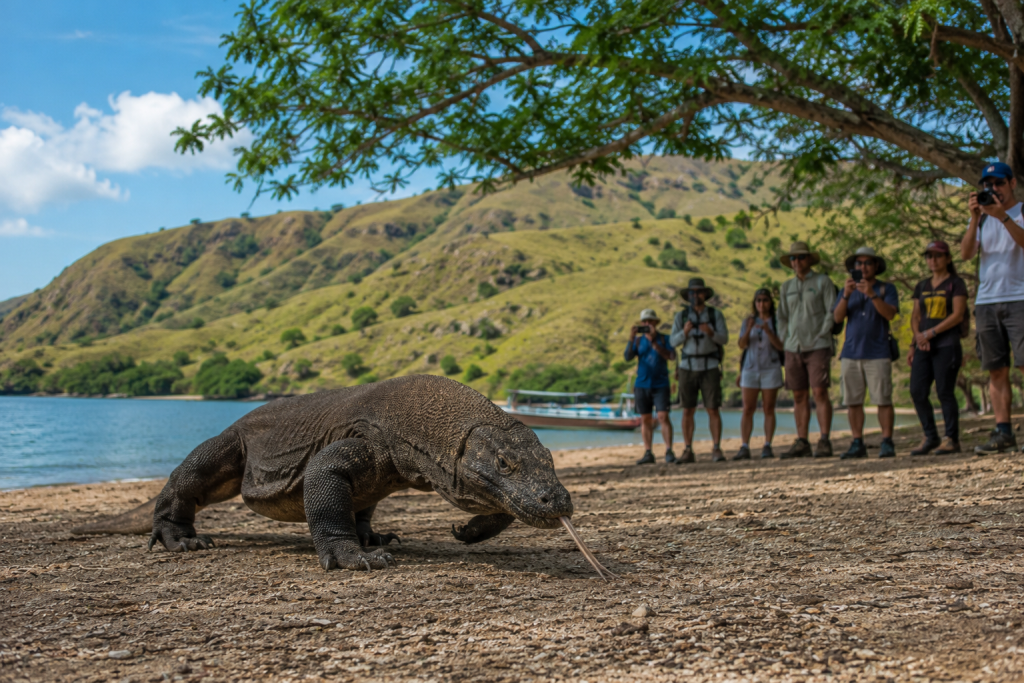
A Survivor From an Ancient World
The Komodo dragon (Varanus komodoensis) is found naturally in only a handful of Indonesian islands, including Komodo, Rinca, Flores, and several smaller neighboring islands.
Its ancestors evolved millions of years ago, and geographic isolation allowed this remarkable reptile to become the dominant land predator in its environment. With few large carnivorous mammals competing for food, the Komodo dragon developed into the undisputed apex predator of its ecosystem.
Adult males commonly reach between 2.5 and 3 meters (8–10 feet) in length and often weigh more than 70 kilograms (155 pounds). Some exceptional individuals grow even larger.
A Hunter Built for Patience
At first glance, a Komodo dragon may seem surprisingly sluggish. During the hottest hours of the day, it often lies motionless, conserving energy under the tropical sun.
That calm appearance can be misleading.
When an opportunity presents itself, the animal is capable of short bursts of speed approaching 20 kilometers per hour (12 mph). It relies on ambush rather than long pursuits, using explosive acceleration to overwhelm prey before delivering a devastating bite.
For decades, scientists believed dangerous bacteria in the dragon’s mouth were primarily responsible for killing its victims. Modern research has changed that understanding. Komodo dragons possess venom glands that release compounds capable of lowering blood pressure, preventing normal blood clotting, and accelerating blood loss, making it much harder for injured prey to escape.
A Sense of Smell Unlike Almost Any Other
One of the Komodo dragon’s greatest advantages is not its size but its extraordinary ability to detect scent.
Its constantly flicking forked tongue collects microscopic particles from the air and delivers them to the Jacobson’s organ inside the roof of the mouth. This highly specialized sensory system allows the animal to locate carrion or injured prey from several kilometers away, depending on wind conditions.
That is why dragons are naturally attracted to animal carcasses, food scraps, and strong organic odors.
How People Have Learned to Live With Them
Residents of Komodo and Rinca Islands have spent generations adapting to life alongside these reptiles.
Food waste is carefully managed, livestock is watched closely, and children are taught from an early age never to approach a dragon. Awareness is simply part of everyday life.
Local traditions have also helped shape this relationship. Some stories passed down through generations describe a symbolic connection between people and Komodo dragons, encouraging respect rather than fear. Whether viewed as folklore or cultural heritage, these beliefs have contributed to the long coexistence between humans and one of nature’s most formidable reptiles.
When Dragons Enter Villages
Most Komodo dragons avoid human settlements, but they occasionally wander into villages in search of food.
Fish remains, domestic animals, or other strong scents can attract them closer to homes. When this happens, trained park staff monitor the situation and, if necessary, safely drive the animal away or relocate it.
These interventions are designed to protect both people and dragons, as the species is legally protected and plays a vital role in the local ecosystem.
Rare Encounters That Turn Dangerous
Despite their fearsome reputation, attacks on people are uncommon.
One of the most widely reported tragedies occurred in 2007, when an eight-year-old boy from Komodo Island was fatally attacked near his village. The incident shocked the local community and led to increased efforts to reduce the likelihood of similar encounters.
There have also been isolated cases involving tourists who ignored safety instructions or ventured too close while trying to photograph the animals. In many of these situations, the quick response of park rangers prevented far more serious outcomes.
Considering the large number of visitors who explore Komodo National Park each year, serious incidents remain exceptionally rare.
Why Visitors Never Explore Alone
Unlike many wildlife destinations around the world, Komodo National Park requires visitors to travel with trained guides.
Rangers understand the subtle body language of these reptiles. They recognize changes in posture, movement, and behavior that most visitors would never notice until it was too late.
Guests are instructed to keep a safe distance, avoid running, never feed the animals, and stay well away from dragons that are eating or guarding territory.
These precautions have been refined through decades of experience and are one of the main reasons that millions of visits have taken place safely.
A Surprisingly Dangerous Childhood
One of the least-known facts about Komodo dragons is that their greatest threat often comes from their own species.
Adult dragons sometimes prey on juveniles, making cannibalism a natural part of their ecology. To survive, young dragons spend much of their early lives high in trees, where larger adults cannot easily reach them.
Only after they have grown large enough to defend themselves do they begin living primarily on the ground.
An Apex Predator Facing an Uncertain Future
Although Komodo dragons dominate their environment, they are not immune to modern threats.
The species is listed as endangered, with climate change representing one of its greatest long-term challenges. Rising sea levels threaten the small islands where the dragons live, while environmental changes may also affect populations of deer and other prey species that sustain them.
Protecting Komodo dragons therefore means protecting an entire island ecosystem rather than a single animal.
More Than a Legendary Predator
Images of Komodo dragons overpowering large prey have made them famous around the world, but those dramatic moments tell only part of the story.
These reptiles spend much of their lives conserving energy and avoiding unnecessary conflict. They are not relentless hunters of humans, nor do they roam the islands searching for people. Most dangerous encounters occur when food is involved, when safety rules are ignored, or when a dragon feels threatened.
Their story is ultimately one of balance. For centuries, isolated Indonesian communities have shared their homeland with one of Earth’s most remarkable reptiles, proving that even a powerful predator can coexist with people when respect, knowledge, and careful management come together.
The Komodo dragon is more than the world’s largest lizard. It is a living reminder that some of nature’s oldest survivors continue to thrive in places where humans have learned not to dominate wildlife, but to live alongside it.