
For generations, the Sea of Galilee was seen as one of Israel’s greatest natural treasures. It supplied drinking water to millions, supported agriculture in a dry region, and held immense historical and religious significance. Yet only a few years ago, experts feared that the country’s most famous freshwater lake was approaching a dangerous tipping point.
Years of below-average rainfall, rising temperatures, and growing demand for water had pushed the lake’s level closer to critical thresholds. If the decline continued, the consequences could extend far beyond water shortages, threatening the delicate ecosystem that had existed there for thousands of years.
What happened next surprised much of the world.
Instead of relying solely on rainfall to replenish the lake, Israel began using water that had originally come from the Mediterranean Sea. It sounds almost impossible at first glance, but behind this achievement lies one of the world’s most advanced water management systems.
A Lake That Shaped a Nation
Known internationally as the Sea of Galilee and locally as Lake Kinneret, this freshwater lake occupies a unique place both geographically and culturally. Located more than 200 meters below sea level, it is one of the lowest freshwater lakes on Earth.
Its importance extends far beyond geography.
For Christians, it is one of the most recognizable locations mentioned in the New Testament. According to biblical accounts, Jesus called His first disciples here, taught large crowds along its shores, calmed a storm, and performed several well-known miracles on and around the lake.
For modern Israel, however, the Sea of Galilee has also been a strategic national resource.
For decades, it served as the country’s largest natural freshwater reservoir, supplying homes, farms, and industries across large parts of the nation.
A Water System Built for a Different Era
During the 1960s, Israel completed the National Water Carrier, one of the country’s most ambitious engineering projects.
Its purpose was straightforward: transport freshwater from the Sea of Galilee to central and southern Israel, including regions that receive very little rainfall.
For decades, the system worked remarkably well. Water consistently flowed in one direction—from the lake to the rest of the country.
Few imagined that one day engineers would need to reverse that flow.
When Nature Changed the Rules
Beginning in the early 21st century, the eastern Mediterranean experienced a series of unusually dry years.
Rainfall became less predictable, heatwaves grew more frequent, and evaporation increased. At the same time, Israel’s population continued to expand, placing additional pressure on freshwater supplies.
The Sea of Galilee gradually shrank.
Water authorities closely monitored the lake’s level as it approached critical thresholds established to protect both water quality and the surrounding ecosystem. Scientists warned that allowing the lake to fall too far could increase salinity, damage aquatic habitats, and reduce the long-term reliability of one of the country’s most valuable natural resources.
It became increasingly clear that depending solely on seasonal rainfall was no longer a sustainable strategy.
Looking to the Mediterranean for Answers
Israel faced a difficult question.
The country bordered one of the world’s largest bodies of water, yet that water could not be consumed because of its salt content.
For many years, desalination was considered too expensive to provide a nationwide solution. While the technology already existed, operating large facilities required enormous amounts of energy and significant financial investment.
Advances in membrane technology and energy efficiency gradually changed that equation.
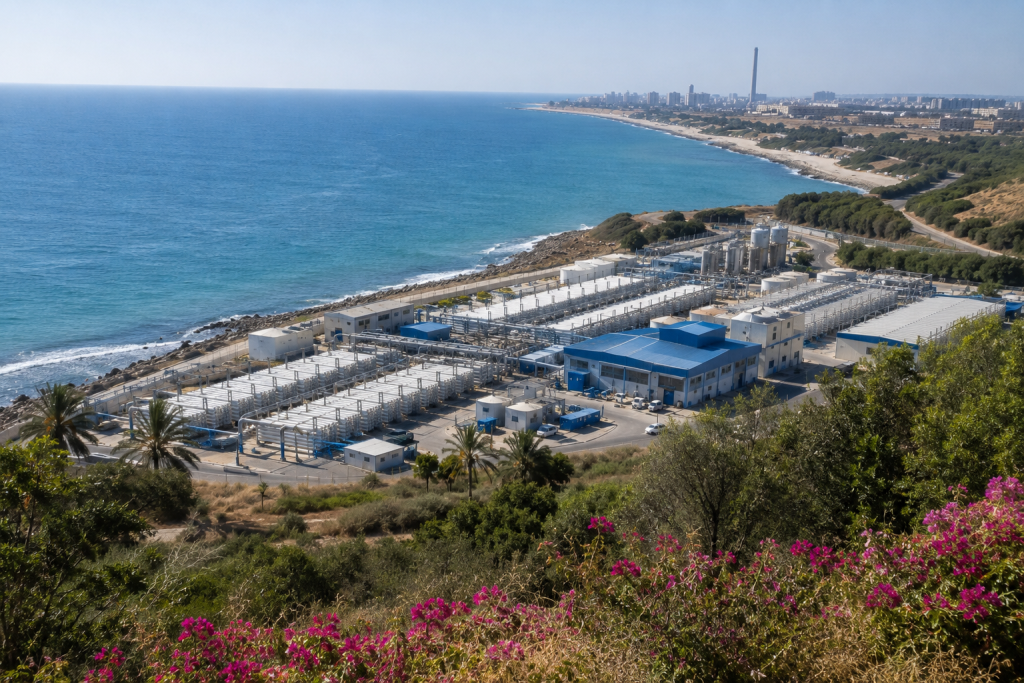
Israel invested heavily in a network of modern desalination plants along its Mediterranean coastline, including some of the largest reverse-osmosis facilities ever constructed.
Today, desalinated seawater supplies roughly 80 percent of the drinking water used by Israeli households, making the country a global leader in large-scale desalination.
Turning Seawater Into Drinking Water
The transformation depends on a process known as reverse osmosis.
Seawater is forced under extremely high pressure through specialized membranes containing microscopic pores. These membranes allow water molecules to pass while blocking dissolved salts, bacteria, viruses, and many other impurities.
The purified water is then treated further to restore essential minerals before entering the national water supply.
What emerges is not simply cleaner seawater—it is freshwater that meets strict drinking-water standards.
Some of Israel’s desalination facilities produce hundreds of thousands of cubic meters of freshwater every day, supplying cities, businesses, and agricultural regions throughout the country.
One Important Detail Often Missing Online
Many viral videos simplify the story by suggesting that seawater is pumped directly into the Sea of Galilee.
That is not what happens.
Introducing untreated seawater into a freshwater lake would dramatically alter its chemistry and could severely damage its ecosystem.
Instead, the seawater undergoes complete desalination before it enters Israel’s national water network.
Only after becoming freshwater can it be transported through an extensive system of pipelines and pumping stations. Under specific conditions, some of this water can help stabilize the Sea of Galilee when water levels require support.
The Mediterranean serves as the original source—but the lake ultimately receives freshwater, not seawater.
Reversing a Historic Flow
Perhaps the most remarkable aspect of Israel’s water strategy is that it has effectively reversed a decades-old pattern.
For generations, the Sea of Galilee supplied water to the nation.
Today, the country’s desalination network can help replenish the lake instead.
Rather than continuously drawing down a limited natural resource, Israel has created a system capable of easing pressure on the lake during periods of drought.
For water engineers and environmental planners, this represents a significant shift in how freshwater resources can be managed in arid climates.
A Model Other Countries Are Watching Closely
Israel is not the only nation using desalination.
Countries such as Saudi Arabia, Australia, Spain, and the United Arab Emirates also rely on desalinated seawater to meet growing demand.
What makes Israel’s approach distinctive is the way desalination has been integrated into a nationwide water management system. Instead of treating desalination as a backup supply, the country has built an interconnected network capable of directing water wherever it is needed most.
This flexibility has attracted international attention, particularly as climate change places increasing pressure on freshwater resources worldwide.
No Technology Comes Without Trade-Offs
Despite its success, desalination is not a perfect solution.
Producing freshwater from seawater requires substantial amounts of electricity, making energy efficiency an ongoing priority. The process also generates highly concentrated brine, which must be carefully discharged back into the sea to minimize environmental impacts.
Building and maintaining desalination plants and supporting infrastructure also requires enormous financial investment.
For many countries, these costs remain a significant barrier.
Even so, for Israel—a nation with limited freshwater resources and recurring droughts—the long-term benefits have been judged to outweigh the challenges.
A Glimpse Into the Future of Water
Climate experts expect water scarcity to become one of the defining environmental challenges of this century.
Growing populations, prolonged droughts, and shifting weather patterns are forcing governments to rethink how freshwater is produced, stored, and protected.
Israel’s experience demonstrates that solving water shortages is not always about finding new rivers or larger reservoirs. Sometimes, it means reimagining how existing technologies can transform an abundant but unusable resource into one that sustains entire communities.
The story of the Sea of Galilee is therefore about far more than a single lake.
It illustrates how engineering, long-term planning, and scientific innovation can reshape the relationship between people and one of Earth’s most essential resources.
What once sounded like science fiction—the idea that water from the sea could help safeguard a freshwater lake—has become a working reality. As water becomes increasingly precious across the globe, projects like this may offer valuable lessons for countries facing similar challenges in the decades ahead.