
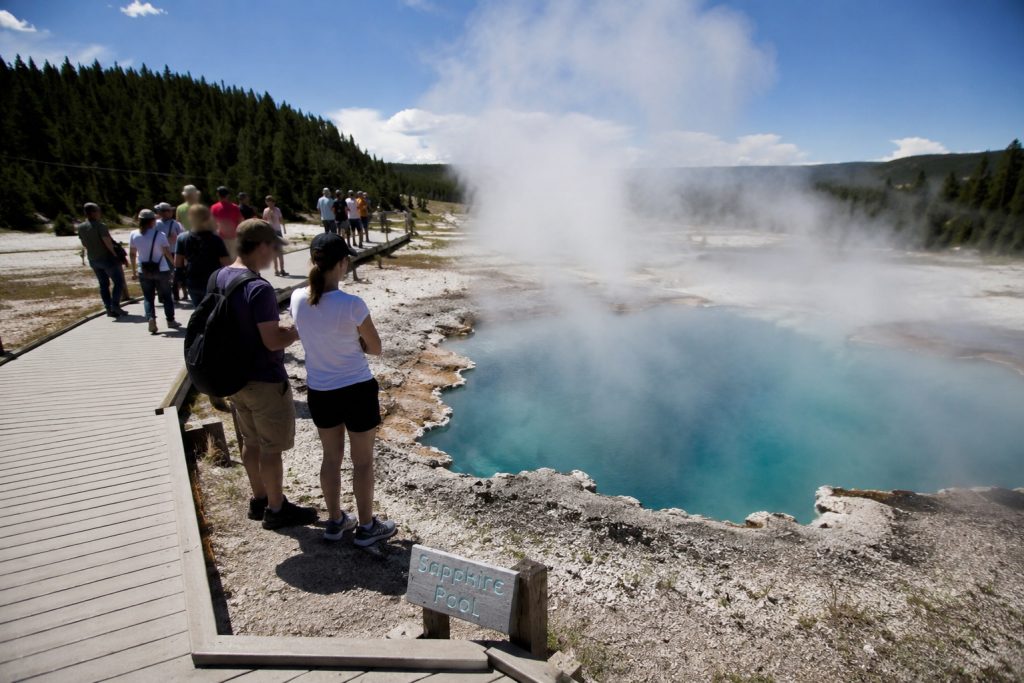
Yellowstone is a place where beauty and danger often occupy the same few feet of ground. Brilliant blue pools shimmer beneath clouds of steam, mineral deposits paint the earth in shades of white, orange and yellow, and wooden walkways carry visitors through scenery unlike almost anywhere else on Earth.
From a distance, the water can look inviting.
It isn’t.
Beneath Yellowstone’s thermal basins lies an active hydrothermal system capable of heating water to near-boiling temperatures. In some areas, the water is highly acidic, while seemingly solid ground may conceal scalding water just below a fragile crust.
On June 7, 2016, 23-year-old Colin Nathaniel Scott ventured away from a boardwalk at Norris Geyser Basin while visiting the park with his sister.
Within a short time, he had fallen into a hot spring.
He did not survive.
What happened afterward would eventually turn the accident into one of Yellowstone’s most widely repeated — and frequently oversimplified — stories.
A search for a place to soak ended in tragedy
Scott, from Portland, Oregon, was exploring Norris Geyser Basin with his sister, Sable, when the pair moved beyond the designated visitor route and entered a restricted thermal area.
Accounts of the subsequent investigation indicated that they were searching for a place where Scott could soak in naturally heated water, an activity often referred to informally as “hot potting.”
But Yellowstone’s thermal features are nothing like ordinary natural swimming holes.
Water temperature can vary enormously from one feature to another, and appearance offers little indication of what lies beneath the surface. A clear, calm pool may contain water hot enough to cause devastating injuries within moments.
As Scott approached one of the thermal pools, he slipped and fell into the water.
His sister witnessed the accident and went for help.
Park rangers responded, but the same environment that had claimed Scott’s life made recovery extraordinarily hazardous. Unstable thermal ground surrounded the area, while deteriorating weather and approaching darkness added to the danger.
His remains could not be recovered that evening.
What rescuers encountered when they returned
By the following day, conditions inside the thermal feature had dramatically altered the situation.
Accounts based on the incident investigation described Scott’s remains as having been severely degraded during the hours they were exposed to the hot spring.
That detail eventually evolved into the version of the story now commonly seen on social media: a tourist fell into an acidic Yellowstone pool and his body “dissolved overnight.”
The phrase is dramatic, but it does not adequately describe the physical processes involved.
A human body does not simply vanish in a hot spring as though dropped into a container of laboratory acid. In an extreme hydrothermal environment, however, prolonged exposure to intense heat combined with the chemistry of the water can cause catastrophic destruction of tissue.
The circumstances at Norris help explain why this particular accident had such an unusual outcome.
Norris Geyser Basin is an extreme environment
Norris is one of the most remarkable hydrothermal landscapes in Yellowstone.
The National Park Service describes it as the hottest and most dynamic of the park’s active thermal areas. Because of the basin’s elevation, water boils there at roughly 199°F, or about 93°C, and very few of Norris’s thermal features are below the local boiling point.
What visitors see on the surface is only a small part of the system.
Water travels through fractures underground, encounters intense geothermal heat and returns toward the surface, producing hot springs, geysers, fumaroles and other hydrothermal features.
The heat beneath Norris is extraordinary. A scientific drilling project once measured a temperature of approximately 237°C, or 459°F, at a depth of only about 326 meters.
The steam rising around the boardwalk is therefore the visible expression of a much larger and far hotter system hidden beneath the landscape.
The water can also be extremely acidic
Heat is only part of the story.
Much of the hydrothermal water at Norris is acidic, although conditions differ considerably between individual features. Yellowstone contains acidic, neutral and alkaline hydrothermal environments rather than one uniform type of water.
Measurements in the Norris area have documented a remarkably broad range of pH conditions, including environments with values around 1.
Yet other Yellowstone thermal systems can be neutral or alkaline.
This distinction matters because describing the park simply as a collection of “acid pools” is inaccurate. The danger varies according to the chemistry and temperature of each feature, and extreme heat alone can be enough to cause fatal injuries.
What makes the landscape particularly deceptive is that none of this can necessarily be determined by looking at the water.
A crystal-clear pool can still be lethal.
Sometimes the most dangerous surface looks like ordinary ground
The pools themselves are only one of the hazards in Yellowstone’s thermal areas.
The ground can be equally deceptive.
In places, a layer that appears solid may actually be a thin mineral crust covering dangerously hot water underneath. There may be no obvious visual clue that the surface is incapable of supporting a person’s weight.
This is why the National Park Service requires visitors to remain on boardwalks and designated trails in thermal areas.
Someone leaving a walkway may believe they are simply stepping onto a dry patch of earth. But conditions can change over extremely short distances, and a crust that holds in one spot may fail only a few steps away.
The danger is hidden precisely where an inexperienced visitor may see nothing alarming.
Even water flowing away from a spring can cause burns
Keeping out of the main pool is not necessarily enough.
Runoff from Yellowstone’s thermal features can remain dangerously hot after leaving the source. Visitors are therefore warned not to touch either thermal features or the water flowing from them.
The striking colors around many pools can make these environments appear almost tropical, but some of those colors are associated with microbial communities specially adapted to extreme conditions.
Thermophiles and other extremophiles can thrive at temperatures and pH levels hostile to humans.
It is one of Yellowstone’s most fascinating contradictions: environments capable of causing catastrophic injuries to people can support complex microscopic ecosystems.
More than 20 people have died from Yellowstone’s hot springs
Scott’s death became particularly well known because of what happened after the fall, but he was not the first person killed by Yellowstone’s thermal waters.
According to the National Park Service, more than 20 people have died from burns after entering or falling into the park’s hot springs.
Others have survived with serious injuries.
In 2017, a visitor suffered severe burns after falling into a hot spring in Lower Geyser Basin. Another man was seriously burned near Old Faithful in 2019. In 2020, a three-year-old child suffered second-degree thermal burns after reaching hot water in a thermal area.
Such incidents help explain why Yellowstone’s safety rules leave so little room for interpretation.
The barriers and boardwalks are not designed to prevent people from experiencing the landscape. They are what make it possible to experience that landscape without stepping directly into an environment whose hazards may be invisible.
Norris is constantly changing beneath the surface
There is another reason experience alone cannot tell a visitor whether an area is safe.
Norris is dynamic.
Changes in underground water circulation, seismic activity, heat and pressure can affect hydrothermal features over time. Springs may change their behavior, existing features can become inactive and new ones can appear.
The landscape a visitor sees is not a permanent arrangement of predictable pools.
It is the surface of an active geological system.
For that reason, the fact that someone previously walked across an unauthorized patch of ground without being injured proves very little about its safety. What matters may be happening beneath the person’s feet.
Why Yellowstone’s boardwalks matter
A wooden walkway can look almost insignificant against the scale of Yellowstone.
Yet in a thermal basin, it serves a critical purpose.
Boardwalks keep visitors away from unstable ground and dangerously hot water while also protecting delicate geological formations and microbial communities from human disturbance.
The rule remains the same even when the nearby ground appears dry, the water looks peaceful or someone else has previously crossed the area without incident: visitors should remain on designated routes.
At Yellowstone, the boundary between safe and dangerous terrain is not always something the human eye can identify.
Beyond the viral story
Years after Colin Scott’s death, his story continues to circulate online, often reduced to a single disturbing claim: he stepped off a Yellowstone boardwalk, fell into a hot spring and “dissolved overnight.”
The reality is more complicated, and it needs no embellishment.
A 23-year-old man entered a restricted thermal area at Norris Geyser Basin and fell into an environment capable of causing fatal burns. His remains were then exposed for hours to extreme hydrothermal conditions, resulting in severe degradation before recovery could be completed.
But the most important part of the story may not be what happened after Scott died.
It is what the accident reveals about Yellowstone itself.
The blue pools, drifting steam and extraordinary mineral landscapes exist because powerful geological processes remain active beneath the park. Water close to its boiling point can lie beneath ground that appears perfectly ordinary, and the difference between a safe viewing area and hazardous terrain may be impossible for a visitor to recognize.
In a place shaped by forces that powerful, a wooden boardwalk is far more than a convenient path through the scenery.
Sometimes, it is the boundary that keeps you alive.