
On the night of June 26, 2023, 14-year-old Ethan Hoac was walking through St Albans, in Melbourne’s north-west, with two friends.
There was no known dispute waiting for him. According to evidence later presented in court, Ethan did not know the three teenagers whose paths were about to cross with his.
Yet within minutes, he would be struck by their vehicle and subjected to a devastating machete attack.
Years later, court proceedings would reveal an unsettling detail from the period immediately before the killing: CCTV footage showed the teenagers stopping to buy ice cream roughly 20 minutes before Ethan was attacked.
It is the kind of detail that naturally attracts attention because of the extraordinary contrast between an ordinary purchase and the violence that followed. But the ice cream itself does not tell us what the teenagers were thinking, nor should it be treated as evidence of a particular psychological condition.
The real story is what happened to Ethan — and how three teenagers who apparently had no previous relationship with him ultimately came to be held responsible for his death.
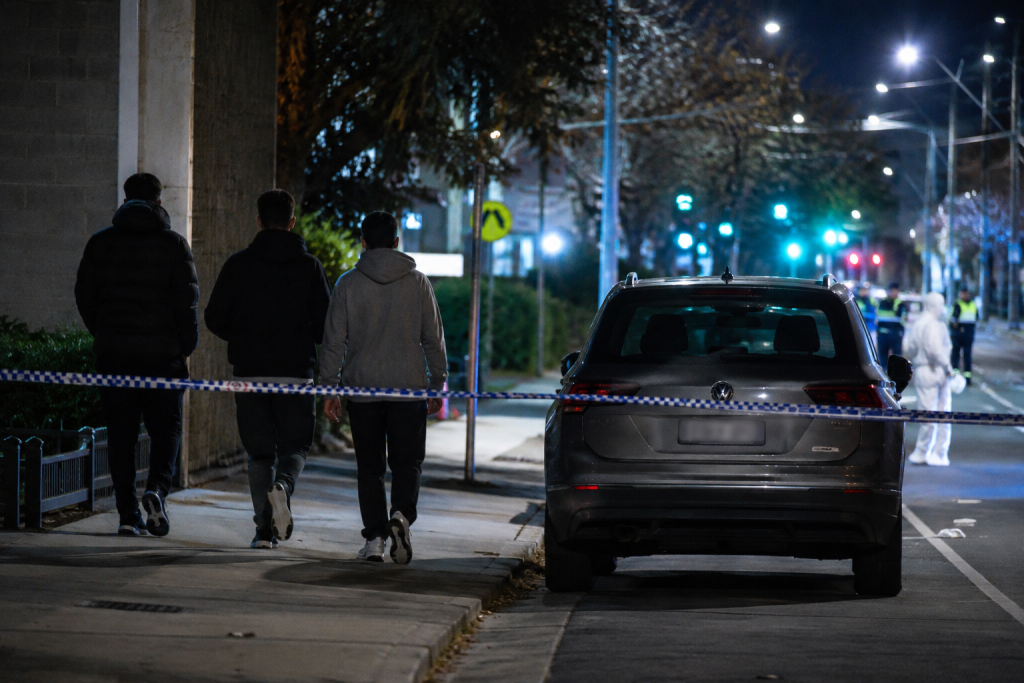
A normal evening ended in less than a minute
Ethan was walking along Furlong Road with two friends at around 10:52 p.m. when a Volkswagen Tiguan carrying three 17-year-olds approached them.
Evidence presented during subsequent proceedings established that the vehicle was driven toward the group and struck Ethan, throwing him into the air.
His two friends managed to escape.
Ethan, however, was left vulnerable on the ground.
Two teenagers got out of the SUV carrying machetes and attacked him.
The violence lasted less than a minute, but Ethan suffered more than 30 stab wounds. He died while being taken to hospital.
He was just 14 years old.
Australian courts would later hear that there was no known previous relationship between Ethan and the teenagers involved in his killing. The attack was described as unprovoked.
CCTV captured the group buying ice cream shortly beforehand
One of the details to emerge during the later trial of the teenager who had been driving the Tiguan was a timeline reconstructed partly through surveillance footage.
At approximately 10:29 p.m., around 20 minutes before the attack, the teenagers were captured at a store buying ice cream.
One of them reportedly used his phone to pay.
They then continued on their way.
At approximately 10:52 p.m., the encounter with Ethan and his friends took place.
That brief sequence explains why the ice cream became such a prominent detail in media coverage of the case. An entirely mundane activity appears on the same CCTV timeline as an extraordinarily violent crime only minutes later.
But there is an important distinction between something being disturbing and something having psychological meaning.
Buying food before or after committing a crime cannot, by itself, establish that someone lacks empathy or remorse. Nor can CCTV footage of an everyday activity be used to diagnose a person.
What the footage can establish is a timeline.
And in this case, that timeline is chilling enough without speculation.
There was no known feud between Ethan and his attackers
One question has remained particularly difficult for Ethan’s family: why him?
This was not presented as the culmination of a longstanding dispute between Ethan and the three teenagers.
There was no established history between them that could provide an obvious explanation for what happened that night.
When one of Ethan’s attackers was sentenced in 2025, Justice Jane Dixon described the killing in extremely strong terms and noted the absence of any provocation from Ethan.
That absence of an apparent motive makes the case particularly difficult to comprehend.
The driver never wielded a machete — so why was he convicted of murder?
The legal proceedings also raised an important question about criminal responsibility.
The teenager driving the Volkswagen did not get out and stab Ethan.
By the time his case went before a jury in 2026, he was 20 years old and had pleaded not guilty to murder.
His defence argued that there had been no agreement to kill Ethan and that events had escalated rapidly and tragically.
Prosecutors presented a very different case.
They argued that the driver was part of an agreement with the other two teenagers to kill Ethan or cause him really serious injury. His role was also not limited to simply being present: he was driving the vehicle that struck Ethan before the other two teenagers got out.
The jury deliberated for four days.
On June 16, 2026, it returned its verdict.
The driver was found guilty of murder.
The verdict is an important reminder that, depending on the circumstances and the applicable law, responsibility for a killing does not necessarily depend on which participant physically inflicted the fatal wounds.
CCTV also documented what happened after the attack
Investigators were able to piece together some of the group’s movements after Ethan was fatally wounded.
Evidence presented in court included CCTV footage from Sydenham Tennis Club, where the teenagers were seen checking the vehicle for damage.
Prosecutors also pointed to footage showing gestures that they argued appeared to mimic a stabbing.
Hours later, the driver and another teenager stopped at McDonald’s.
As with the ice cream purchase, it is easy to attach psychological meaning to such seemingly ordinary behaviour occurring around an act of extreme violence.
That would go beyond what the footage can prove.
These events are significant because they form part of the documented sequence of movements surrounding the killing. Questions about remorse, intent and culpability require much broader evidence than whether someone ate food before or after committing a crime.
One attacker was sentenced to 17 years in prison
By November 2025, one of the two teenagers who had participated directly in the machete attack had been sentenced.
Then 19, he received a maximum prison term of 17 years and will have to serve at least 13 years before becoming eligible for parole.
Justice Dixon described the murder as both “appalling” and “vicious.”
The court also considered his conduct while in youth detention. Evidence showed that he had written violent rap lyrics and recorded material that was subsequently uploaded to YouTube while awaiting the outcome of the case.
The judge found his apparent lack of remorse and prospects for rehabilitation concerning.
Three teenagers, three different roles
The legal paths of the three teenagers did not unfold in exactly the same way.
One of Ethan’s direct attackers received the 17-year maximum sentence in November 2025.
Another pleaded guilty to murder in May 2026.
The teenager who had been driving the vehicle contested the murder charge but was convicted by a jury on June 16, 2026. Sentencing proceedings for the remaining defendants were still continuing during 2026.
Because all three were 17 when Ethan was killed, Australian reporting has been subject to legal restrictions protecting their identities.
The distinction matters. Saying simply that “three teenagers murdered Ethan” captures the eventual legal responsibility but obscures how differently they participated in the events and how their cases progressed through the courts.
Ethan was more than the victim in a shocking headline
The detail about buying ice cream is memorable. It is also the easiest part of this story to turn into a sensational headline.
But Ethan should not become merely “the boy killed after his attackers bought ice cream.”
He was a 14-year-old with a family and a life that extended far beyond the final minutes captured in court evidence.
Ethan came from a large family and was reportedly one of nine children. His family remembered him as kind, funny and deeply loved.
He was particularly close to his mother, Annie Huynh.
Only weeks before his death, Ethan had written her a Mother’s Day letter thanking her for looking after him. When his family later addressed the court, those ordinary details of their life together offered a very different picture from the violent circumstances through which the public came to know his name.
His mother spoke about a grief that had not disappeared with the passage of time.
And even as the criminal cases progressed and responsibility was established in court, one question remained painfully unresolved for the family.
Why Ethan?
A few ordinary minutes, followed by irreversible consequences
There is no need to invent a psychological explanation to make this case disturbing.
At approximately 10:29 p.m., the teenagers were doing something entirely ordinary: buying ice cream.
Around 10:52 p.m., Ethan was struck by their vehicle.
Less than a minute of violence followed.
By the end of that sequence, a 14-year-old boy had suffered fatal injuries.
The criminal justice system has spent years determining the responsibility of the teenagers involved. One received a lengthy prison sentence, another admitted murder, and a third was convicted by a jury.
Those verdicts can establish legal responsibility.
What they cannot do is return Ethan to his family or provide a satisfying explanation for why a child who apparently did not know his attackers became their victim that night.
And perhaps that, rather than the ice cream captured on CCTV, is the most unsettling fact in the entire case.