
Few wildlife encounters leave a stronger impression than seeing a chimpanzee in its natural habitat. Standing just a short distance away from one of humanity’s closest living relatives is an experience many travelers describe as unforgettable. Watching these intelligent primates move through the forest, care for their families, and interact with one another creates a powerful sense of connection.
That feeling of familiarity, however, can also be misleading.
Chimpanzees share much of our DNA, display recognizable emotions, and solve complex problems, but they are still wild animals. Their behavior is driven by instincts that have evolved over millions of years, not by human expectations. Even an animal that appears calm can react unexpectedly if it perceives a threat.
One incident involving a tourist during a guided chimpanzee trek serves as a reminder that nature follows its own rules, regardless of how peaceful a situation may seem.
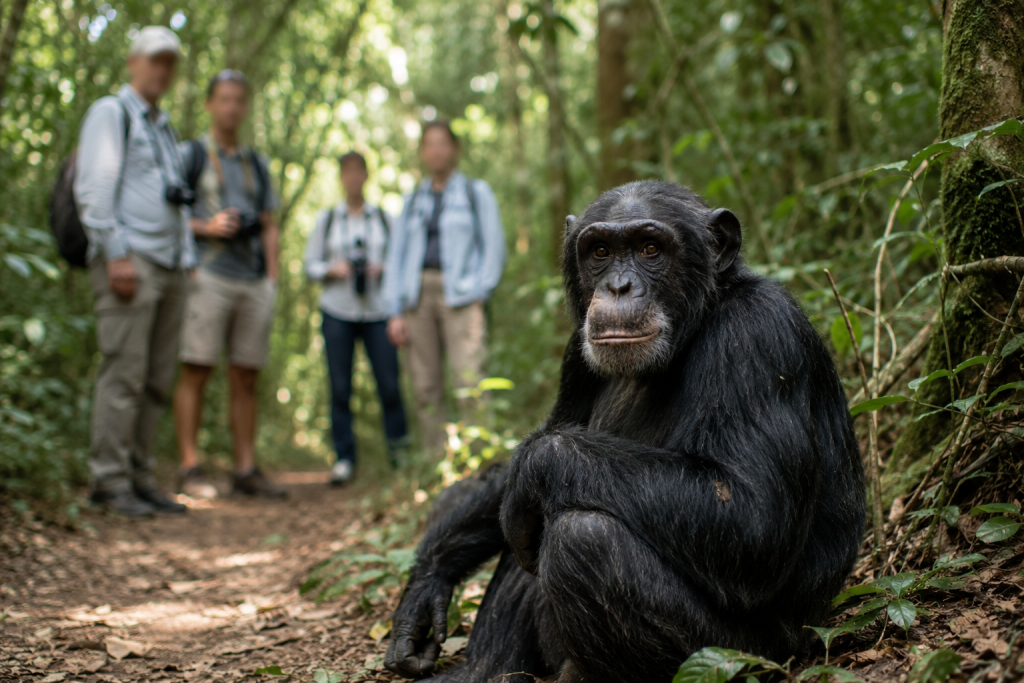
A Peaceful Encounter That Changed in Seconds
Guided chimpanzee trekking has become one of Africa’s most sought-after wildlife experiences. Small groups are led through protected forests by experienced trackers who understand the animals’ behavior and know how to minimize stress for both visitors and wildlife.
These excursions usually end without incident.
During one trek, however, a visitor found herself only a short distance from a chimpanzee that appeared relaxed. The animal showed no obvious signs of aggression, and everything seemed to be unfolding exactly as expected.
Then, almost without warning to those unfamiliar with chimpanzee behavior, the situation changed.
The chimpanzee reacted suddenly, striking the tourist with enough force to cause serious injuries. She suffered fractures to one of her legs and required immediate medical attention.
As the story spread online, numerous exaggerated versions emerged. Some claimed she had broken both legs, while others suggested the animal launched an unprovoked attack. Publicly available reports, however, indicate that the woman sustained fractures to a single leg and survived the encounter. Wildlife specialists have generally described the incident as a defensive reaction rather than an act of deliberate aggression.
Why Calm Doesn’t Always Mean Safe
One of the biggest misconceptions about wild animals is the belief that a relaxed appearance guarantees predictable behavior.
Chimpanzees communicate through body language, facial expressions, posture, and vocalizations. Many of these signals are subtle enough that only experienced guides or researchers recognize them.
A slight shift in body position, prolonged eye contact, or increased muscle tension may indicate rising stress long before any dramatic movement occurs.
To an inexperienced visitor, the animal may appear perfectly comfortable.
To another chimpanzee, those same signals would clearly communicate caution or discomfort.
This difference in interpretation explains why some wildlife encounters can change within seconds.
Intelligence Doesn’t Eliminate Instinct
Chimpanzees are among the most intelligent animals on Earth. They manufacture and use tools, recognize individuals, cooperate within social groups, and pass learned behaviors from one generation to the next.
Their remarkable intelligence has fascinated scientists for decades.
In the early 1960s, primatologist Jane Goodall transformed our understanding of animal behavior when she observed wild chimpanzees modifying sticks to extract termites from their nests. Until then, tool-making had largely been considered a uniquely human ability.
Yet intelligence should never be mistaken for domestication.
Wild chimpanzees remain highly territorial animals. They defend food sources, protect young members of their communities, and constantly assess potential threats within their environment.
If they believe their safety or social group is at risk, their response can be immediate.
Far Stronger Than Many People Realize
At first glance, an adult chimpanzee may not appear especially imposing. Most weigh significantly less than the average adult human.
Their bodies, however, are built for climbing, swinging through dense forests, and competing with other powerful males. Their upper-body musculature is exceptionally well developed, allowing them to generate tremendous force in a very short amount of time.
Because of this, even a single defensive strike can result in severe injuries.
This is precisely why professional guides insist that visitors maintain a safe distance, regardless of how calm the animals appear.
The Rules Protect Everyone
Chimpanzee trekking is governed by strict guidelines across many protected areas in Africa.
Visitors are instructed to keep their distance, avoid sudden movements, speak quietly, and never attempt to touch or feed the animals.
These rules are designed not only to protect people but also to safeguard the chimpanzees themselves.
Because humans and chimpanzees are genetically so similar, diseases can spread between the two species. Even common respiratory infections carried by people have caused serious outbreaks among wild primate populations.
For that reason, some reserves prohibit anyone with cold or flu symptoms from joining trekking groups, while others require face masks during close encounters.
Responsible tourism is as much about protecting wildlife as it is about protecting visitors.
Social Media Doesn’t Show the Full Picture
Videos of chimpanzees hugging people, posing for photographs, or interacting peacefully with caretakers often receive millions of views online.
What many viewers don’t realize is that these scenes typically involve rescued animals, rehabilitation centers, or highly controlled environments.
Wild chimpanzees behave very differently.
They do not seek human interaction, and they have no reason to tolerate close contact with strangers entering their territory.
Confusing these very different situations can lead travelers to underestimate the risks associated with wildlife encounters.
Respect Is the Most Important Safety Measure
Every year, thousands of people participate in chimpanzee trekking experiences without encountering any problems. Careful planning, experienced guides, and strict safety protocols make these adventures remarkably safe when everyone follows the rules.
Incidents like this remain uncommon, but they illustrate an important lesson.
Nature cannot be controlled, no matter how carefully an excursion is organized.
Observing wild chimpanzees is an extraordinary privilege. It offers a rare glimpse into the lives of one of our closest evolutionary relatives and reminds us how complex the natural world truly is.
The safest and most rewarding encounters happen when people remember one simple principle: when we enter the forest, we are visitors in someone else’s home. Respecting that boundary is often the difference between an unforgettable adventure and an avoidable tragedy.