
The way out was close. That was precisely what made the situation so cruel.
On July 9, 1967, three teenagers exploring Carnegie Cave near Shippensburg, Pennsylvania, began making their way back toward the surface. Reaching daylight required passing through an unusual artificial entrance: a narrow corrugated metal pipe running beneath the embankment of Interstate 81.
When the teenagers returned to it, part of that passage was burning.
Outside lay safety. Behind them stretched hundreds of meters of darkness.
One teenager decided to go through the flames.
The other two retreated into the cave.
All three initially survived the immediate emergency, but their decisions led to very different outcomes. The teenager who crawled through the burning section suffered devastating injuries and died three days later. His companions were eventually found alive deep inside the cave.
The Carnegie Cave accident has resurfaced decades later in dramatic social-media videos. The underlying event, however, is not an internet legend. Historical records from the American caving community document the accident in considerable detail, and the real story needs little embellishment.
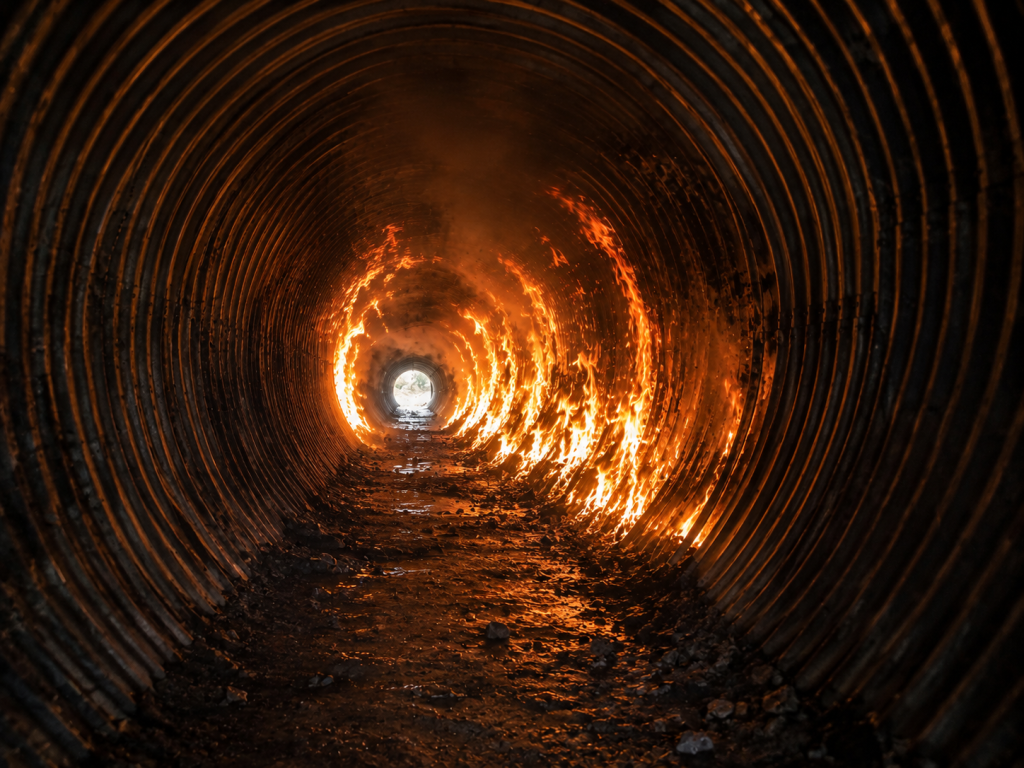
Why did a cave have a metal pipe for an entrance?
Carnegie Cave existed long before Interstate 81 crossed this part of Pennsylvania.
Historical material published by the National Speleological Society describes roughly 1,905 feet, or about 580 meters, of known passages. The cave once had three entrances associated with an old quarry area.
Construction of Interstate 81 in the early 1960s dramatically changed the site.
Two entrances were lost during the work. Local cavers sought to preserve access through the remaining opening, and an unusual solution was created: a corrugated metal pipe was installed through the highway embankment.
It was approximately 155 feet, or 47 meters, long and only about three feet — 91 centimeters — in diameter.
For anyone entering or leaving Carnegie Cave, that meant negotiating a long, confined artificial passage before reaching the natural cave.
Historical accounts also describe a tar-like or bituminous material used around the pipe sections.
Years later, those details would become frighteningly relevant.
Two candles were left burning
Earlier on July 9, another group leaving Carnegie Cave reportedly left two burning candles inside the entrance pipe.
The three teenagers who later entered the cave passed the candles and continued underground.
By the time they returned, something had gone terribly wrong.
A section near the middle of the pipe was on fire. Historical accounts describe roughly 25 to 30 feet — approximately 7.6 to 9.1 meters — of the passage as being involved in the blaze.
The Shippensburg Fire Department’s historical account also describes the tar-lined or tar-sealed area of the pipe burning.
There is an important distinction here. The surviving historical material establishes that candles had been left burning and that a fire subsequently developed in the pipe, where bituminous material was present. It does not provide enough detail to reconstruct every step of the ignition process with certainty.
What happened next, however, is well documented.
The teenagers were inside the cave, and their direct route to the surface now passed through fire.
One teenager tried to reach the outside
Faced with the burning passage, one member of the group attempted to crawl through it.
According to the historical account, he panicked and went through the flames.
He made it to the other side.
When emergency crews arrived, the 16-year-old was found near the entrance with his clothing burning. He had sustained severe second- and third-degree burns.
He was initially taken to Chambersburg Hospital and was later transferred to Temple University Hospital.
For three days, he remained alive.
On July 12, he died from his injuries.
The fact that he physically reached the surface makes the story particularly haunting. Escaping the cave did not mean he had escaped the consequences of crossing the fire.
His two companions made the opposite choice
The other two teenagers did not follow him.
Instead of continuing toward daylight, they turned around and moved farther underground.
Emergency crews were alerted at approximately 3:42 p.m., according to the Shippensburg Fire Department’s retrospective account.
Before rescuers could enter, the fire in the pipe had to be extinguished. The remaining tar-like material was reportedly still so hot that boards were placed over the affected section to allow rescuers to cross it.
A search team then entered Carnegie Cave.
The operation took roughly an hour and 45 minutes before the missing teenagers were located. They had retreated to a ledge on an upper level of the cave, approximately 1,800 feet — close to 550 meters — from the entrance.
They were alive.
At approximately 6:12 p.m., the two teenagers were brought out safely.
One firefighter also required medical attention for smoke inhalation.
Why a few meters of fire could become an almost impossible obstacle
At first glance, a burning section measuring eight or nine meters may not sound insurmountable.
The dimensions of the pipe change that calculation completely.
With a diameter of only about 91 centimeters, this was not a corridor through which someone could sprint. Movement was severely restricted, and there was effectively nowhere to move sideways to escape intense heat.
A person attempting to cross the burning section would remain extremely close to the heated walls and burning material while progressing through a confined space.
Fire also presents dangers beyond direct contact with flames. Heat and smoke can make enclosed spaces rapidly hazardous, while limited mobility makes retreat far more difficult.
One detail from the rescue illustrates the conditions particularly well: even after firefighters had extinguished the blaze, the tar-like material remained hot enough that rescuers needed boards to cross the affected area.
The 16-year-old had attempted to crawl through it while it was still burning.
The highway explains one of the strangest details in the story
Without knowing the history of Carnegie Cave, the presence of a long metal pipe at its entrance can sound almost unbelievable.
It was not a natural feature of the cave.
The pipe existed because Interstate 81 had been built over the area and access to the surviving entrance needed to be maintained through the highway embankment.
Historical descriptions place the natural cave entrance roughly 30 vertical feet, or about nine meters, below the highway. Cavers have even described hearing trucks passing overhead while underground.
A later trip report published by the Mid-Atlantic Karst Conservancy in 2005 still described entering Carnegie Cave through the corrugated pipe beneath I-81.
The strange setting seen in modern reconstructions therefore has a genuine historical basis, even though the viral images themselves should not be mistaken for footage of the accident.
This was not a cave-diving accident
Some modern posts and videos place the Carnegie Cave story alongside cave-diving disasters, which can easily create the wrong impression.
No underwater dive caused this tragedy.
Carnegie Cave is a terrestrial cave, and the fatal emergency occurred at its artificial entrance. Rescue accounts do mention water reaching knee level in parts of the cave, but the three teenagers were not trapped during an underwater exploration.
The obstacle separating them from the surface was fire.
That distinction matters because otherwise a remarkable historical accident gradually turns into a different story as it is repeatedly shared online.
Viral images are reconstructions, not footage from 1967
Modern videos showing a person crawling through a narrow pipe surrounded by flames can be visually convincing.
They should be treated as illustrations.
The Carnegie Cave accident occurred in 1967, and the historical evidence consists of accident reports, caving records and accounts of the emergency response. The dramatic animations circulating online are modern attempts to visualize those descriptions.
There is no reason to make the original event more spectacular than it was.
Three teenagers were underground. Their only direct exit caught fire. One tried to force his way through it and died from his injuries. Two went deeper into the cave and waited for rescuers.
That is the documented story, and it is disturbing enough.
Carnegie Cave did not disappear after the tragedy
The 1967 accident did not mark the end of Carnegie Cave.
Cavers continued to visit and document the site in subsequent decades. A 2005 account, for example, describes another trip through the distinctive pipe entrance beneath the interstate.
Even more recently, National Speleological Society conservation material published in 2025 referenced Carnegie Cave in connection with conservation activities involving Franklin County Grotto and Southampton Township.
Nearly six decades after the fire, the cave therefore remains part of Pennsylvania’s local speological history rather than simply the setting of a forgotten accident.
Three teenagers knew where the exit was. Only one tried to reach it.
Many underground disasters begin because people become lost, water suddenly rises or rock collapses across an escape route.
Carnegie Cave was different.
The teenagers knew exactly where the exit was.
They simply could not safely reach it.
For the 16-year-old facing the flames, the outside world was on the other side of a relatively short burning section. Trying to cross it may have felt like the fastest — perhaps even the only — chance of survival.
His two companions made a decision that must have seemed deeply counterintuitive. They turned away from the exit and moved hundreds of meters back into the darkness, without knowing how quickly help would arrive.
Rescuers eventually found them alive.
Their different choices should not be reduced to a simplistic judgment about who made the “right” decision. Panic, extreme heat, confinement and uncertainty can profoundly affect decision-making during an emergency, and the teenagers did not have the benefit of knowing how events would unfold.
That may be the most enduring part of the Carnegie Cave tragedy.
Sometimes, in an extreme environment, knowing where the exit is and being able to reach safety are two very different things.