
In January 2016, a single photograph stopped millions of people in their tracks. It showed a tiny, exhausted boy standing on a dusty roadside in southern Nigeria, drinking water from a bottle offered by a woman kneeling beside him. His body was painfully thin, his stomach unnaturally swollen, and his expression reflected months of hunger, illness, and neglect.
For many, it was simply another heartbreaking image shared across social media. Few realized they were looking at a child who had been abandoned by his own family after being accused of something almost unimaginable: witchcraft.
The little boy would later become known around the world as Hope, a name that symbolized the new life he was about to receive. Before that moment, however, he had spent months trying to survive alone after being rejected by the very people who should have protected him.
His story remains one of the most powerful reminders of what can happen when fear, misinformation, and deeply rooted superstition outweigh compassion and reason.
When superstition becomes more powerful than facts
To many people, the idea of labeling a toddler as a witch sounds impossible. Yet in parts of Africa, accusations of witchcraft against children have been documented for decades.
In some communities, repeated misfortune—a serious illness, financial hardship, the death of a family member, or a failed harvest—may be blamed on supernatural forces rather than natural causes. During these moments of fear and uncertainty, children can become easy targets.
A child may be accused because of an illness, a disability, unusual behavior, or simply because someone in the community claims to have identified them as the source of the family’s suffering.
International organizations have documented cases in which children accused of witchcraft were beaten, tortured, abandoned, or forced to live on the streets. These accusations are not supported by evidence, but they continue to affect vulnerable children in some regions where traditional beliefs, poverty, and limited access to education intersect.
The child no one wanted
Hope’s biological identity has never been publicly disclosed, a decision made to protect his privacy.
What is known is that he was only about two years old when he was abandoned in Nigeria’s Akwa Ibom State, a region that has drawn international attention over the years because of documented cases involving children accused of witchcraft.
The exact circumstances surrounding his abandonment remain unknown. No public record explains who first accused him or what convinced his family to leave him behind.
What investigators and aid workers do know is that he was left to survive alone.
It is difficult to imagine parents making such a decision, but humanitarian organizations working in the region have long explained that intense social pressure, fear, and deeply rooted cultural beliefs can influence families in devastating ways. While this does not excuse abandoning a child, it helps explain how tragedies like Hope’s can occur.
Surviving one day at a time
One of the most remarkable aspects of Hope’s story is that he managed to stay alive for roughly eight months.
Naturally, many people ask the same question: how could a child so young survive on his own?
The answer is both heartbreaking and surprisingly simple.
Hope was not truly living independently. He survived because, from time to time, strangers gave him scraps of food or a little water. Many people avoided him because they feared that getting close to a child believed to be cursed would bring misfortune into their own lives. Others, however, could not ignore the sight of a starving toddler and quietly offered what little they could.
Those occasional acts of kindness were likely the only reason he remained alive.
Even so, his health deteriorated dramatically. Severe malnutrition had stripped away almost all of his muscle mass, while intestinal parasites and prolonged hunger caused his abdomen to swell. His immune system had become dangerously weak, leaving him vulnerable to infection and disease.
By the time he was found, his condition was critical.
The moment everything changed
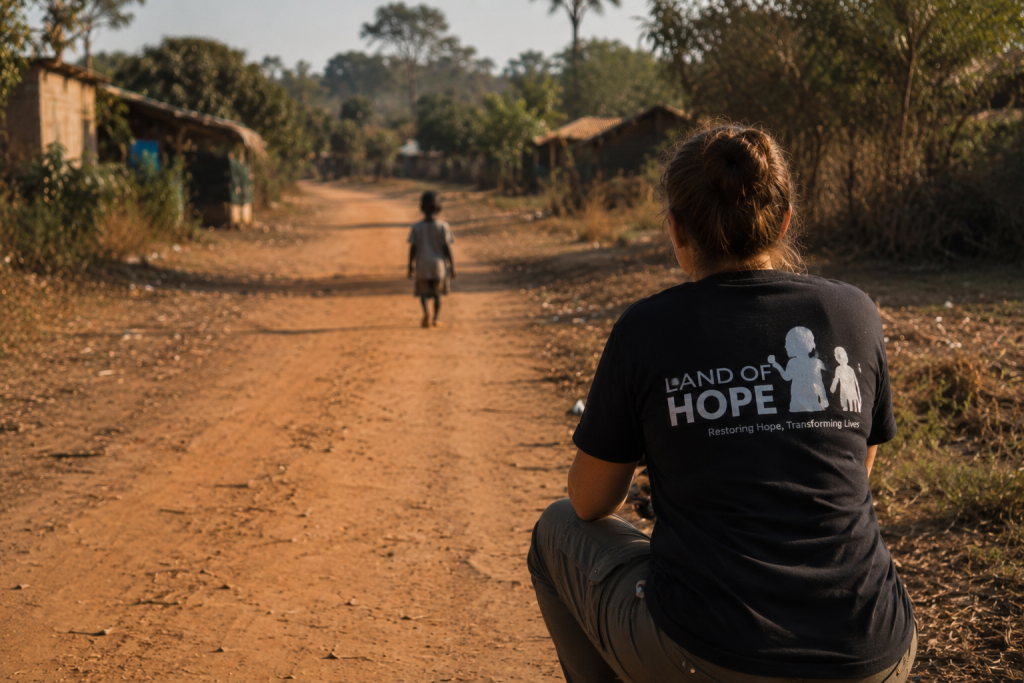
In January 2016, Danish humanitarian Anja Ringgren Lovén was working in Nigeria through her organization, Land of Hope, which rescues children abandoned after witchcraft accusations.
During one of these rescue missions, she came across the young boy.
He was so weak that he could barely stand.
Instead of walking away, she knelt beside him, offered him water, wrapped him in a blanket, and rushed him to a nearby hospital.
A photograph capturing that brief moment spread around the world within days.
It became more than a viral image. It became a symbol of compassion overcoming fear.
A long road back to health
Rescuing Hope was only the beginning.
Doctors diagnosed him with severe malnutrition, dehydration, anemia, multiple infections, and heavy intestinal parasite infestations. His body had been pushed to its limits, and the first days of treatment were critical.
Medical staff carefully stabilized him with fluids, nutritional support, medications, and continuous monitoring. Recovery had to be gradual because a severely malnourished body can react dangerously if food is reintroduced too quickly.
Over the following months, his condition steadily improved.
The frightened child who had once wandered the streets began smiling again. He gained weight, regained his strength, and slowly started experiencing what every child deserves: safety, care, and affection.
A second chance at childhood
After leaving the hospital, Hope remained under the care of Land of Hope.
He was later adopted by Anja Ringgren Lovén and her husband, joining a growing family that included other children rescued from similar circumstances.
Instead of struggling to survive, he began attending school, making friends, playing sports, and discovering everyday experiences that had once seemed impossible.
Over the years, updates shared by his adoptive family have shown a healthy, energetic young boy whose transformation is difficult to believe when compared with the photographs taken in 2016.
A much larger problem
Hope’s story is extraordinary, but it is not unique.
Organizations such as UNICEF and Human Rights Watch have repeatedly warned that accusations of witchcraft continue to place children at risk in several parts of Africa. While governments and local organizations have introduced legal protections and awareness campaigns, harmful beliefs have not disappeared entirely.
Changing long-standing cultural traditions takes time.
It requires education, community engagement, stronger child protection systems, and continued support for families facing poverty and hardship.
Every child rescued is an important victory, but many others still depend on the work of humanitarian organizations and local advocates.
Why Hope’s story still matters
The photograph that introduced Hope to the world is often remembered because of how shocking it was. Yet its true significance lies in something much deeper.
It captures the collision between two very different ways of seeing the world.
One is driven by fear, suspicion, and superstition, where an innocent child becomes the target of blame for events beyond anyone’s control.
The other is built on empathy, evidence, and the belief that every child deserves protection regardless of culture, background, or circumstance.
Today, Hope is no longer recognized as the starving toddler from a viral photograph. He is a healthy young boy with opportunities that once seemed impossible.
His story is not only about survival. It is about the extraordinary difference one person can make by choosing compassion over prejudice.
Had Anja Ringgren Lovén walked past that small child on a dusty Nigerian road, the world might never have known his name. Instead, one simple decision—to stop, offer water, and help—changed the course of an entire life.
Sometimes, history is shaped not by grand gestures, but by the quiet moment when someone refuses to look away.