
For most people, zolpidem does exactly what it was designed to do: it makes them sleepy.
For Sam Goddard, the effect was startlingly different.
At 23, the young Australian suffered catastrophic strokes that left him with profound neurological disabilities. He survived, but the life he had known disappeared almost overnight. He could no longer walk, see or communicate as he once had, and his family faced the possibility that much of the damage might be permanent.
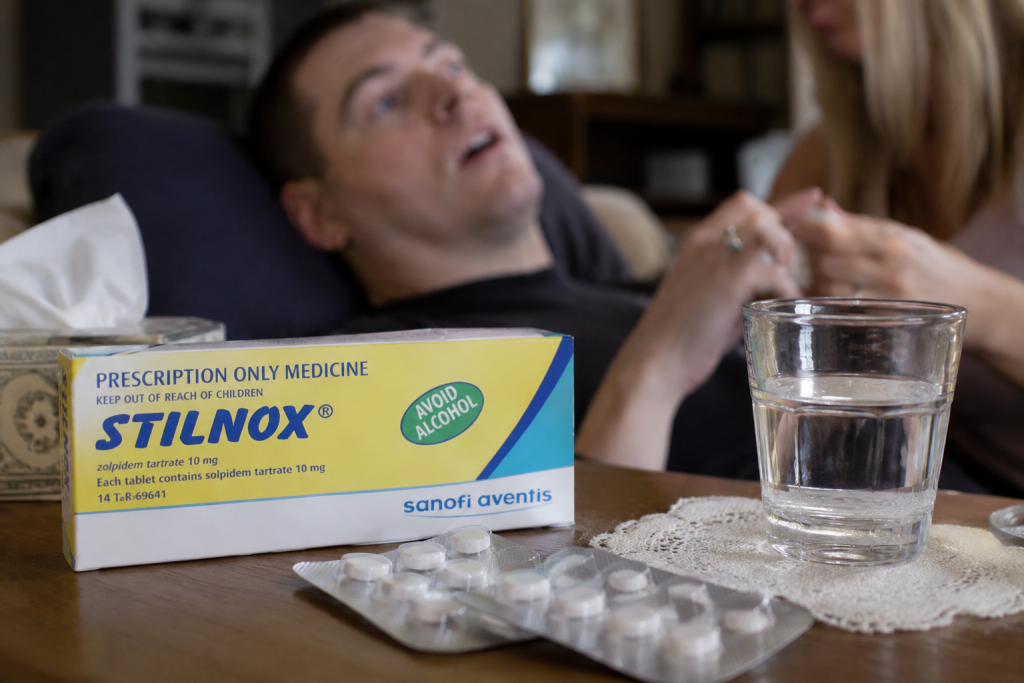
More than a year later, Sam was given Stilnox, the brand name for zolpidem, a prescription drug normally used to treat insomnia.
The first trial did not suddenly restore his speech. But after a later dose, something remarkable happened.
Within about 15 to 20 minutes, Sam’s face relaxed. He smiled. He laughed.
Then he began to talk.
For a brief period, the family who had spent 15 months wondering what was happening inside his mind could finally hear him again.
Yet the extraordinary response to zolpidem was only one chapter in Sam’s story. The effect eventually weakened. Other experimental treatments brought new hopes but no cure. His relationship with the woman he had planned to marry changed in ways neither of them could have imagined, and the serious genetic disease Sam had lived with since infancy continued to threaten his life.
Years after the footage of his remarkable response made his case famous, Sam’s family was confronting a very different reality.
Sam had already spent a lifetime fighting another disease
Sam was diagnosed with cystic fibrosis when he was only about six weeks old.
Despite living with a serious genetic condition, he grew into an active young man. He worked as an accountant, played sport and built a future with his fiancée, Sally Nielsen, whom he had met while studying.
They planned to marry on May 8, 2010, a date that would also mark four years together.
They never reached that wedding.
On February 14, 2010, Sam was taking part in a charity football match in Brisbane. The weather was hot. After heading the ball and scoring, he began feeling unwell.
By around midday, he had developed a severe headache. Sally later recalled that within hours he was rocking back and forth, describing the sensation as though his head were going to explode.
By mid-afternoon, doctors were uncertain whether he would survive the next 24 hours.
Sam had suffered two massive strokes.
The cause was not as simple as the viral story suggested
Some retellings have linked Sam’s strokes directly to heading the football that day. The medical picture was far less certain.
His family later believed that chronic dehydration associated with cystic fibrosis had contributed to what happened. Jeffrey Lipman, the intensive-care specialist involved in Sam’s treatment, was more cautious. In the original reporting, he indicated that the precise cause was unclear and did not consider a simple header of the ball a convincing explanation for the extent of the brain injury.
What was beyond dispute was the severity of the damage.
Sam spent 45 days in intensive care. He survived, but recovery was slow and his ability to interact with the outside world remained profoundly impaired.
His family began searching for anything that might help.
That search eventually led them to a drug that seemed entirely unsuited to the problem they were trying to solve.
Why would a sleeping medication help an injured brain?
Stilnox contains zolpidem, a hypnotic medication prescribed for insomnia. Its effects involve GABA-A receptors, part of the brain’s major inhibitory signalling system.
In ordinary circumstances, that action promotes sedation.
But scattered medical reports had described something unexpected. A small number of people with severe brain injuries appeared to become temporarily more responsive after taking zolpidem. Improvements in speech, movement or awareness had been reported in rare cases.
Sam’s family learned about the phenomenon and wanted doctors to try the drug.
There was understandable reluctance. Zolpidem was not an established treatment for stroke-related brain damage, and using it for this purpose was experimental.
Eventually, Sam was allowed to try it.
The first dose did not produce the famous transformation
The reality was more complicated than the shortened version of Sam’s story that later circulated online.
According to Sally’s account, an initial 10 mg dose appeared to make Sam more alert and responsive, but he did not begin speaking.
Six or seven days later, she described giving him 15 mg.
That detail belongs to Sam’s individual medical story; it is not a dosing recommendation or a treatment that should be attempted without specialist supervision.
Then Sally waited.
Around 15 to 20 minutes later, she noticed a change in his face.
The tension seemed to disappear.
Sam smiled.
He laughed.
And suddenly, he joined the conversation.
His family heard his voice again
The moment was captured by the Australian television program Australian Story.
Sam could answer his father’s questions. He responded to Sally. He laughed and displayed flashes of the personality his family remembered from before the strokes.
More importantly, he could finally express what had been inaccessible to them for more than a year.
When Sally asked what he had most wanted to tell her during the 15 months in which he had been unable to speak, Sam told her how much he loved her.
He also revealed something more unsettling: he described having been aware while unable to communicate, comparing the experience to being trapped inside his own body.
His description should not be interpreted as proof that he had locked-in syndrome, which is a specific neurological diagnosis. Severe brain injuries can affect consciousness, language and voluntary movement in very different ways.
For his family, however, the clinical terminology mattered less than what they had just discovered.
Sam had been trying to reach them.
He still wanted to marry Sally
The strokes had not erased Sam’s memory of the future he and Sally had planned.
Once he could speak, marriage quickly returned to the conversation. Sam wanted them to marry almost immediately. Sally thought that was slightly ambitious, and Sam jokingly pushed the proposed date back by a few days.
For a family that had spent months facing grim prognoses, the exchange offered a glimpse of the man they remembered.
It also made what happened next particularly difficult.
Every day, the voice began to disappear again
Zolpidem had not healed Sam’s brain.
The period of clearer communication lasted for roughly an hour. As the drug wore off, his speech deteriorated again.
His face would tighten. Words became slower and more difficult to understand. Sam knew what was happening and could become distressed as his ability to communicate slipped away.
His father described the family as essentially being given a short window each day in which they could talk to him.
Then the window closed.
Eventually, even Stilnox could no longer give them the same hour
When Australian Story returned to Sam’s life six years later, the dramatic response seen in the original footage was no longer the same.
Sally said the effects had diminished over time. The medication no longer produced the clear speech the family had witnessed earlier, and Sam became increasingly frustrated when he could not make himself understood.
His family kept searching.
In 2012, they noticed another unexpected change after Sam used cannabis with a friend: his speech appeared clearer again. They subsequently explored whether he could legally obtain a cannabis-based medicine, but their efforts were unsuccessful.
Two years later, another possibility emerged.
Sam travelled to Los Angeles with his mother and Sally to receive etanercept, an anti-inflammatory medication that had been promoted experimentally for neurological recovery after stroke. The treatment was not approved for that purpose in Australia.
His family believed they saw some improvements.
For Sam, they were nowhere near enough.
The hoped-for transformation never arrived.
The relationship that survived, but in a different form
Years of severe disability had changed almost every part of Sam and Sally’s relationship.
Sally was no longer simply his fiancée. She had become one of the people responsible for his daily care.
Eventually, both recognised that their relationship could not continue as they had once imagined. Sally later described feeling increasingly like Sam’s caregiver rather than his partner.
They separated.
It would have been an understandable place for their story to end.
It didn’t.
After spending several months away rebuilding her own life, Sally returned to the Goddard family. She and Sam were no longer a couple, but she remained one of the people closest to him.
Then she met someone else.
Sam met the man Sally would eventually marry
In 2015, Sally told Sam’s parents that she was going to become engaged to a man named Phil.
The situation could easily have become painful for everyone involved.
Instead, when Sam saw Sally and Phil together, he told them they looked good as a couple.
Sally eventually married Phil.
Phil, in turn, understood that loving Sally meant accepting the unusual place Sam and the Goddard family would continue to occupy in her life. Sam could even joke with him about having stolen his girl.
Sally continued visiting Sam every week and remained involved in his treatment.
Their wedding never happened, but their bond did not simply disappear when their engagement ended. It had become something different.
While everyone fought the brain injury, cystic fibrosis was advancing
For years, much of the family’s attention had focused on Sam’s neurological recovery.
Meanwhile, the disease he had lived with since infancy continued to damage his lungs.
By 2017, his father said Sam’s lungs had begun failing about a year earlier. Falling oxygen levels made his condition even more difficult, and those closest to him understood that their time together might be running out.
His brother Josh took on a major role in caring for him, spending four days a week as his primary caregiver.
Josh knew he could not change what was coming.
So he concentrated on something he could still do: make his brother laugh.
Sam Goddard died at 31
Sam died in January 2018.
He was only 31.
Available public reporting does not provide enough reliable documentation to state the immediate medical cause of his death with certainty. By the previous year, however, his family’s account had made clear that his cystic fibrosis had progressed severely and that his lung function was failing.
That distinction matters. The deterioration of his cystic fibrosis was documented; assigning it as the formal cause of death without adequate medical confirmation would go beyond the available evidence.
The zolpidem paradox remains one of the strangest phenomena in neurorehabilitation
Sam’s response was remarkable, but it was never evidence that zolpidem could routinely awaken people with severe brain injuries.
Research has produced a far more sobering picture.
In one placebo-controlled study involving 15 patients in a vegetative or minimally conscious state following brain injury, only one showed a significant, reproducible clinical improvement after zolpidem.
Fourteen did not.
Other studies and reviews have similarly suggested that dramatic responders represent only a small minority.
The phenomenon is real enough to have attracted serious scientific investigation, but rare enough that zolpidem has never become a general treatment for severe disorders of consciousness.
What could a sleeping pill have been doing?
There is still no single proven explanation.
One hypothesis focuses on networks connecting the cerebral cortex, thalamus and basal ganglia. Severe brain injury can profoundly disrupt communication and inhibition within these circuits.
In a very particular pattern of brain injury, altering GABA-mediated signalling with zolpidem may temporarily change the activity of networks that have become functionally suppressed. EEG and brain-imaging studies of some responders have documented changes in cerebral activity accompanying behavioural improvements.
That is considerably more complicated than saying the drug “wakes up the brain.”
Zolpidem does not regenerate neurons destroyed by a stroke, and it does not reverse the underlying injury.
The more interesting scientific question is why a tiny number of damaged brains respond to the medication in such an unexpected way.
The real ending is more powerful than the viral version
The famous footage offers an irresistible story.
A young man spends 15 months unable to speak. His family refuses to give up. Doctors try a sleeping medication. Minutes later, he smiles, laughs and talks. He tells his fiancée that he loves her and asks to marry her.
Stop the story there and it almost resembles a medical fairy tale.
But the cameras did not stop Sam’s life from continuing.
The effect of Stilnox weakened. Other experimental treatments failed to restore the life he had lost. The wedding he and Sally had once planned never happened. Their romantic relationship ended, although their affection survived in another form.
His brother became his caregiver. His parents remained beside him. Sally built a new life while continuing to visit the man she had once expected to marry.
And the cystic fibrosis Sam had lived with since infancy continued to take its toll.
He died in January 2018, at just 31.
Stilnox never gave Sam his old life back.
For a time, however, it seemed to open a narrow window between him and the people who had spent more than a year wondering how much of him remained beyond their reach.
And through that window, they heard his voice again.