
You are sitting outside on a warm summer evening with several other people. An hour later, you are covered in itchy mosquito bites while the person beside you has barely been touched.
The familiar explanations quickly appear. Maybe mosquitoes prefer a certain blood type. Perhaps you have “sweeter blood.” Maybe your perfume attracted them.
There is a much more fascinating explanation.
A mosquito searching for a meal does not rely on a single clue. It gathers information from several sources, including the carbon dioxide in our breath, chemicals released from our skin, body heat, moisture and visual cues. Together, these signals create something remarkably close to a biological beacon.
Research has also provided evidence for something frequent mosquito targets have suspected for years: some people really are considerably more attractive to mosquitoes than others.
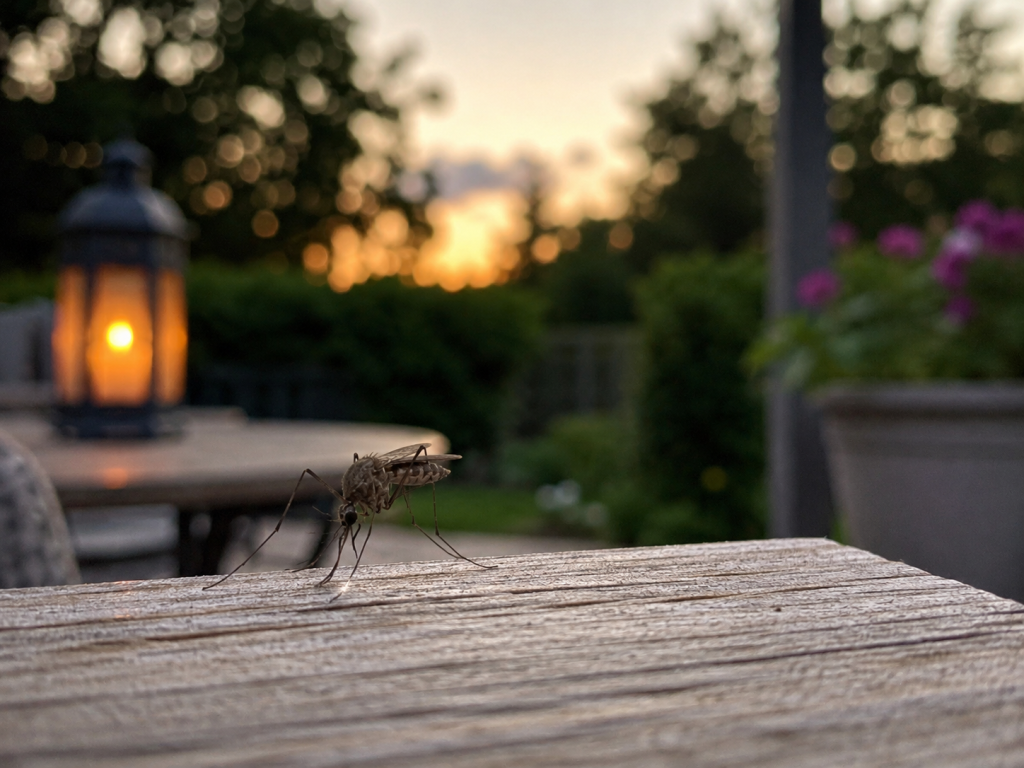
Your breath can reveal where you are
Every moment of the day, cells throughout the body produce carbon dioxide as part of normal metabolism. The blood carries this CO₂ to the lungs, and we continuously release it into the surrounding air when we exhale.
For mosquitoes, that invisible plume can contain valuable information.
Female mosquitoes — the ones that seek blood meals — possess specialized sensory systems that allow them to detect changes in carbon dioxide concentration. Encountering CO₂ can help trigger and guide host-seeking behavior.
It is not, however, a simple case of a mosquito detecting CO₂ and flying directly toward a person’s face.
The insect combines this information with other sensory clues. Research into mosquito behavior has shown that carbon dioxide can influence how mosquitoes respond to additional signals associated with potential hosts.
In other words, our breath can tell a mosquito that a living animal may be nearby. Other senses then help it determine where that animal actually is.
A mosquito searches with more than its sense of smell
As the mosquito gets closer, additional information becomes increasingly useful.
Human skin releases a complex mixture of chemicals. The body also produces heat and creates a humid microenvironment close to the skin. Visual contrast can provide another navigational clue.
Mosquito host-seeking is therefore best understood as a multisensory process rather than a simple attraction to one particular smell.
Even more surprisingly, scientists have discovered another way mosquitoes may detect warm-blooded hosts.
A 2024 study involving Aedes aegypti found that infrared radiation from a source at approximately skin temperature could increase host-seeking behavior when combined with other host-related cues, including human odor and elevated CO₂.
The finding does not mean mosquitoes possess infrared vision in the way the phrase might suggest. Instead, it adds another sensory component to an already sophisticated system for locating warm-bodied animals.
Some people really are mosquito magnets
One of the most interesting experiments in this field addressed a question almost everyone has asked at some point: why do mosquitoes repeatedly choose one person over another?
Researchers reported striking differences in how attractive different people’s skin odors were to Aedes aegypti. Even more intriguing was the persistence of those differences.
People who were highly attractive to the mosquitoes tended to remain highly attractive over time.
When researchers examined the chemical profiles associated with the participants’ skin odors, they found that highly attractive individuals tended to have greater amounts of certain carboxylic acids.
The results, published in Cell in 2022, do not establish a single chemical that determines whether someone will become a mosquito’s favorite target. Human odor is far too complicated for such a simple explanation.
But they provide compelling evidence that the chemical composition of our skin contributes to the enormous differences in mosquito attraction between individuals.
So when someone complains that mosquitoes always find them first, they may be observing a genuine biological phenomenon.
What about “sweet blood”?
The popular explanation that mosquitoes prefer people with sweeter blood does not describe how host selection actually works.
Before piercing the skin, a mosquito cannot sample your blood to decide whether you are worth approaching.
It must first find you.
That decision is influenced by signals available outside the body: exhaled gases, skin odors, heat, moisture and visual information.
Blood characteristics may be relevant to other biological questions, but “sweet blood” is not a scientific explanation for why mosquitoes can locate one person from across a garden.
Exercise can make you easier to find
People often notice more mosquito activity when they are hot and sweaty, and there are several plausible reasons.
Physical activity increases metabolic demand and ventilation, meaning that a person generally exhales more carbon dioxide. Exercise also raises body temperature and increases sweating.
At the same time, human skin and sweat contribute numerous compounds to the odor environment surrounding the body.
Rather than thinking of sweat as a single mosquito attractant, it is more accurate to think of exercise as changing several signals at once.
To a mosquito searching for a host, an exercising human can become a particularly noticeable biological target.
Does carbon dioxide also escape through our skin?
Small amounts of gas exchange can occur through human skin, but this is insignificant compared with the role of the lungs.
Carbon dioxide produced by metabolism is transported through the bloodstream to the lungs, where it moves into the alveoli and leaves the body as we exhale.
For mosquito host-seeking, exhaled CO₂ is therefore particularly relevant.
Scientists and mosquito-control programs can even take advantage of this behavior.
Some mosquito surveillance traps use dry ice, which releases carbon dioxide as it sublimates. Others use chemical lures designed to reproduce aspects of human odor. These methods help attract host-seeking mosquitoes so researchers can collect and identify them.
That tells us something important about mosquito behavior: if researchers want to lure mosquitoes, reproducing signals associated with a living host can be far more useful than simply switching on a bright lamp.
The problem with UV mosquito zappers
This brings us to one of the most recognizable summer gadgets: the glowing ultraviolet bug zapper.
Its apparent effectiveness can be extremely convincing.
You switch it on. Insects begin flying toward it. Every few minutes there is another electrical crack. By morning, the collection tray contains dozens — sometimes hundreds — of dead insects.
Surely the mosquito problem has been solved.
Not necessarily.
Many flying insects respond strongly to light, and UV devices can kill large numbers of them. But the fact that an appliance kills insects does not automatically mean it is efficiently targeting the female mosquitoes that were going to bite you.
A mosquito looking for a blood meal has access to a much richer set of host signals than ultraviolet light alone can provide.
That distinction matters.
A bug zapper can appear extremely productive simply because the evidence — dead insects — is immediately visible. Yet many of those insects may have posed no threat to the people nearby.
Not every trap that uses light is ineffective
There is an important distinction between a basic UV bug zapper and a mosquito trap specifically engineered around mosquito behavior.
Professional surveillance systems may incorporate light while also using carbon dioxide or odor-based attractants.
Some traps release CO₂ from dry ice. Others use synthetic lures that imitate components of human scent. Once mosquitoes approach, a fan may draw them into a collection chamber.
The relevant question when evaluating a mosquito device is therefore not simply:
“Does it have UV light?”
A better question is:
“What specifically makes mosquitoes choose this machine instead of me?”
If the only answer is a glowing ultraviolet bulb, expectations should remain modest.
Turning off the lights does not make you disappear
There is another consequence of mosquito sensory biology that anyone who has shared a bedroom with one will recognize.
You hear the characteristic buzz.
You switch off the lamp.
The room becomes completely dark.
And several minutes later, the mosquito is somehow back beside your head.
That is not particularly mysterious once we understand how these insects locate hosts.
Turning off a lamp does not stop you from breathing. It does not eliminate your body heat, skin odors or the moisture surrounding your body.
From the mosquito’s perspective, many of the signals indicating that a living host is nearby are still present.
Darkness does not make a human invisible to an animal that never depended exclusively on visible light in the first place.
A tiny insect equipped with an extraordinary sensory system
It is tempting to think of mosquitoes as simple insects that randomly fly around until they happen to land on someone.
Their behavior is considerably more sophisticated.
Depending on species, distance and environmental conditions, a host-seeking mosquito can integrate carbon dioxide, body odors, visual information, warmth and humidity. Recent research has added thermal infrared detection under specific conditions to the already remarkable sensory abilities documented in Aedes aegypti.
And the person mosquitoes repeatedly choose may genuinely be different from the person sitting beside them — not because their blood is “sweeter,” but because the chemical signature surrounding their skin is more attractive to the insect.
That also explains why the spectacular crackling of a UV bug zapper can be misleading.
Mosquitoes did not evolve to search for ultraviolet lamps.
They evolved to find living animals.
And every time we breathe, radiate heat and release the complex mixture of chemicals produced by human skin, we provide exactly the kind of information they have become exceptionally good at detecting.