
In February 2022, a man at Philadelphia International Airport finished his coffee and tossed the cup into a trash can before continuing his trip.
It was an ordinary gesture, the kind of thing no one around him would have noticed.
But investigators were watching.
The man was David Sinopoli, and police had already begun to suspect that he might be connected to the 1975 murder of 19-year-old Lindy Sue Biechler in Pennsylvania. What they still needed was a direct DNA sample they could compare with biological evidence preserved from the crime scene.
The discarded coffee cup gave them exactly that.
Yet the cup itself did not solve the case. By the time investigators recovered it, years of forensic work and genetic genealogy had already narrowed the search to Sinopoli. The cup became the crucial confirmation in a case that had remained unsolved for nearly half a century.
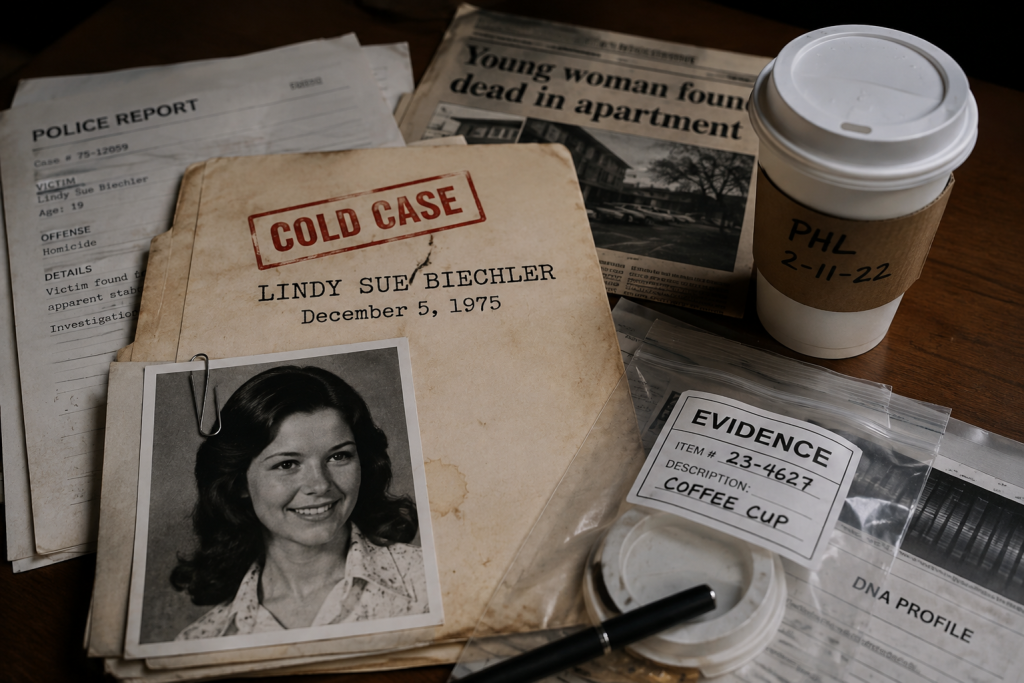
A 19-year-old woman is found murdered in her home
On December 5, 1975, Lindy Sue Biechler returned from shopping to her home in Manor Township, Pennsylvania.
She was only 19 years old and had been married for about a year.
Investigators later determined that she likely arrived home sometime between 6:45 and 7:05 p.m. Grocery bags were still sitting on the dining room table when authorities entered the apartment.
At around 8:46 p.m., Lindy’s aunt and uncle found her and contacted police.
The scene showed clear signs of violence. Blood was found near the entrance, on a nearby wall, and on the carpet. Lindy had been stabbed 19 times in the neck, chest, upper abdomen, and back.
The medical examiner concluded that she died from massive blood loss caused by the multiple wounds.
The weapon was still inside the home.
Investigators found a knife that matched the set kept in Lindy’s kitchen. A kitchen towel had been wrapped around its handle.
Someone had entered the apartment, attacked her, and disappeared.
The investigation went cold
Police in Manor Township, along with Pennsylvania State Police, pursued numerous leads and interviewed many people over the years.
Potential suspects were investigated and ruled out. Evidence was sent to laboratories. Witnesses were questioned.
Still, no one could be definitively connected to the killing.
As the years passed, Lindy’s murder became the oldest unsolved homicide in Lancaster County.
What investigators did have, however, was biological evidence left behind by the person who had attacked her.
In 1975, that evidence could not reveal nearly as much as it can today.
The killer’s DNA had been preserved for decades
More than 20 years after the murder, the case gained new scientific possibilities.
In 1997, evidence from the investigation was submitted for DNA testing. A male genetic profile was successfully developed from biological material found on Lindy’s clothing.
That was a major breakthrough, but it did not immediately produce a name.
In 2000, the profile was entered into CODIS, the U.S. law-enforcement DNA database used to compare forensic profiles with other genetic records collected in criminal investigations.
There was no match.
Investigators knew they had the DNA profile of an unknown man. They still did not know who he was.
New technology brought new possibilities
In 2019, the Lancaster County District Attorney’s Office Cold Case Unit took another look at the investigation.
Authorities began working with Parabon NanoLabs, a company known for using advanced DNA analysis in criminal cases.
One of the early steps involved DNA phenotyping, a technique that can estimate certain physical characteristics from genetic material. Composite images were created based on traits such as likely eye color, hair color, and skin tone.
The images generated public attention, but they did not identify the killer.
The major turning point came later, when investigators turned to genetic genealogy.
Genetic genealogy works differently from a police DNA database
Traditional forensic databases are designed to find close or exact DNA matches.
Genetic genealogy can work even when the unknown person is not in a criminal database at all.
Instead, investigators may find distant relatives who share small portions of DNA with the unidentified individual. Genealogists then build family trees, compare ancestral lines, and look for places where those family histories intersect.
The process can be extraordinarily complex.
In Lindy’s case, the genetic matches were distant and did not immediately point to a clear family.
But genetic genealogist CeCe Moore noticed an unusual pattern.
Several ancestral lines appeared to trace back to the same area in southern Italy.
That area was Gasperina, a small town in Calabria.
A clue hidden in family history
The investigation began moving beyond DNA alone.
Genealogists combined genetic information with historical records, family trees, immigration records, and information about Italian families who had settled in Lancaster County.
Gradually, the number of possible candidates became smaller.
One name began to stand out: David Sinopoli.
His family background fit the genetic pattern, his age was consistent with the suspect investigators were seeking, and there was another important detail.
At the time of Lindy’s murder, Sinopoli had lived in the same apartment complex.
That made him worth investigating, but genetic genealogy was not enough to prove that he was the man whose DNA had been preserved from 1975.
Investigators needed a sample directly linked to Sinopoli.
The coffee cup
On February 11, 2022, investigators followed Sinopoli to Philadelphia International Airport.
At some point during the trip, he used a coffee cup and discarded it in a trash can.
Police retrieved it.
The cup was sent for laboratory analysis, and DNA from a male contributor was recovered.
Specialists then compared that genetic material with the profile obtained from evidence preserved in the Lindy Sue Biechler case.
The result strongly supported the conclusion that the DNA came from the same person.
According to Lancaster County prosecutors, the statistical weight of the comparison was on the order of about 10 trillion.
The genetic genealogy lead now had powerful forensic support.
Investigators tested additional evidence
Police did not rely solely on the coffee cup comparison.
They also revisited other evidence preserved from the original investigation, including blood stains found on Lindy’s clothing.
Two stains on her stockings were submitted for further testing.
Those results were also consistent with the same male genetic profile.
Nearly 47 years after the murder, investigators had finally connected a specific person to the biological evidence from the crime scene.
David Sinopoli is arrested
On July 17, 2022, David Sinopoli was arrested at his home in Lancaster.
He was 68 years old.
At the time Lindy was killed, he had been about 22.
For Lindy’s relatives, the arrest came after decades of unanswered questions.
But the case was not finished yet.
A guilty plea nearly five decades after the murder
On October 19, 2023, David Sinopoli pleaded guilty to third-degree murder, aggravated assault, and burglary in connection with Lindy Sue Biechler’s death.
He was sentenced to 25 to 50 years in prison.
He was also ordered to pay costs associated with the investigation and DNA testing.
During the sentencing hearing, members of Lindy’s family described how the murder had affected them for almost half a century.
Sinopoli apologized to those who had been harmed, including his own wife.
One question, however, remained unresolved.
Authorities never established a clear public motive for the killing.
Did a coffee cup really solve the case?
The popular version of the story is simple: a discarded coffee cup solved a 47-year-old murder.
The reality is more interesting.
Investigators did not randomly test a cup and discover that it belonged to the killer.
By the time they recovered it, genetic genealogy had already led them toward David Sinopoli.
The coffee cup provided the direct DNA sample they needed to test that theory.
In other words, genetic genealogy identified a strong suspect, while the discarded cup helped confirm the connection between that suspect and the biological evidence preserved from 1975.
The distinction matters because it shows how modern cold-case investigations often work.
Rarely is there a single miraculous clue. More often, old evidence becomes useful because new technology finally makes it possible to extract information that investigators could not access decades earlier.
Why old evidence can become valuable again
When Lindy Sue Biechler was murdered in 1975, modern forensic DNA profiling did not yet exist.
Investigators could collect blood, hair, and other biological material, but they could not obtain the detailed genetic information laboratories can produce today.
Over the years, that changed.
DNA profiling became possible. National criminal databases were developed. More sophisticated methods of interpreting biological evidence followed.
Then genetic genealogy added another layer, allowing investigators to work indirectly through relatives and ancestral lines when no direct database match exists.
In Lindy’s case, the search moved from a Pennsylvania apartment to family histories reaching back to a small town in Calabria, and then back again to a man who had once lived in the same apartment complex as the victim.
Nearly 48 years later, the case finally had an answer
Lindy Sue Biechler was 19 years old when she was killed.
David Sinopoli was in his early twenties at the time and remained unidentified for almost half a century.
The case was not solved by one dramatic discovery. It was solved because evidence had been preserved long enough for science to catch up with it.
First came DNA profiling. Then database comparisons. Later came genetic genealogy. Finally, investigators obtained a direct DNA sample from a discarded coffee cup and compared it with evidence that had been stored since 1975.
For Lindy’s family, none of that could restore the life that had been taken or erase decades of uncertainty.
But after nearly 48 years, it could finally answer the question that had remained open since the night of December 5, 1975: who killed Lindy Sue Biechler?