
Jeff Markin was 53 when an ordinary morning turned into a medical emergency that would later become one of the most widely shared modern stories about faith, cardiac arrest and an apparently impossible recovery.
He reportedly arrived at a Florida hospital after becoming seriously ill on his way to work. Soon afterward, his heart stopped.
For roughly 40 minutes, doctors and nurses tried to revive him. CPR was performed, medications were administered and electrical shocks were used in an attempt to restore an effective heartbeat. Eventually, the medical team stopped resuscitation efforts and Markin was pronounced dead.
Cardiologist Dr. Chauncey Crandall was preparing to leave the room.
Then, according to his own account, something made him turn back.
Crandall has said that he felt a powerful spiritual prompting to pray for the man lying on the hospital bed. After praying, he asked that another attempt be made to shock Markin’s heart.
According to Crandall’s testimony, cardiac activity returned.
Markin survived.
The story has since been presented in books, interviews and Christian media as an extraordinary answer to prayer. But once the medical details are examined closely, the case becomes more nuanced — and arguably even more interesting.
Who is Dr. Chauncey Crandall?
Chauncey W. Crandall IV is an American cardiologist with established medical training and a long career in cardiovascular medicine.
His professional background includes postgraduate medical training at Yale, cardiology training at Beth Israel Hospital in New York and additional work in interventional cardiology at the Medical College of Virginia. He is board-certified in cardiovascular disease.
Crandall is also openly Christian and has spoken extensively about faith, healing and events he believes involve divine intervention.
In 2010, he published Raising the Dead: A Doctor Encounters the Miraculous, a book in which Jeff Markin’s case became one of the central stories.
That distinction matters. Crandall is both a physician describing a real medical emergency and a person interpreting that event through a deeply held religious worldview.
What reportedly happened to Jeff Markin?
Accounts published by Christian Broadcasting Network state that Markin began feeling unwell while heading to work. After speaking with his employer, he was encouraged to seek medical attention.
He managed to reach Palm Beach Gardens Medical Center in Florida, where his condition rapidly deteriorated.
Markin suffered a cardiac arrest in the setting of a severe heart attack.
Resuscitation reportedly continued for around 40 minutes. Medical staff performed CPR, administered emergency drugs and attempted defibrillation.
Eventually, the team concluded that further efforts were unlikely to succeed.
Crandall later described Markin as severely cyanotic, with no effective circulation, and said that death was pronounced at approximately 8:05 a.m.
One point is especially important because it is frequently distorted online: the available accounts do not show that Markin had been dead for 40 minutes.
Rather, the roughly 40-minute period refers to the time spent attempting to resuscitate him before he was pronounced dead.
That is a very different medical scenario.
The moment Crandall says changed everything
Crandall has said that after the death was pronounced, he began to leave the room.
He then felt what he interpreted as a direct spiritual prompting to return and pray for Markin.
According to his account, he went back to the bedside and prayed for the patient, asking God to restore him if the man had not yet had an opportunity to know Him.
Crandall then asked the emergency team to make another attempt at defibrillation.
He says that after the additional shock, electrical activity appeared on the monitor and a pulse returned.
Markin ultimately recovered.
For Crandall, the sequence of events was not simply a rare resuscitation success. He has consistently described it as an answer to prayer.
Was Jeff Markin actually dead?
This question depends heavily on what is meant by the word “dead.”
Cardiac arrest occurs when the heart can no longer pump blood effectively through the body. A person quickly becomes unconscious, stops breathing normally and loses a detectable pulse.
Without intervention, the brain and other organs begin to suffer irreversible damage.
However, cardiac arrest is not automatically the same thing as irreversible biological death.
The entire purpose of cardiopulmonary resuscitation is to maintain at least some circulation while doctors attempt to restore normal heart function.
Patients can sometimes regain spontaneous circulation even after prolonged resuscitation efforts, although the likelihood of survival generally decreases as the duration of cardiac arrest increases.
Therefore, a person who is pronounced dead after unsuccessful CPR and later regains circulation represents an extremely unusual event, but it does not necessarily mean that irreversible biological death had already occurred.
The “flatline” problem
One detail in popular versions of the story deserves particular scrutiny.
Some accounts describe Markin as being in a “flatline” rhythm before the final shock.
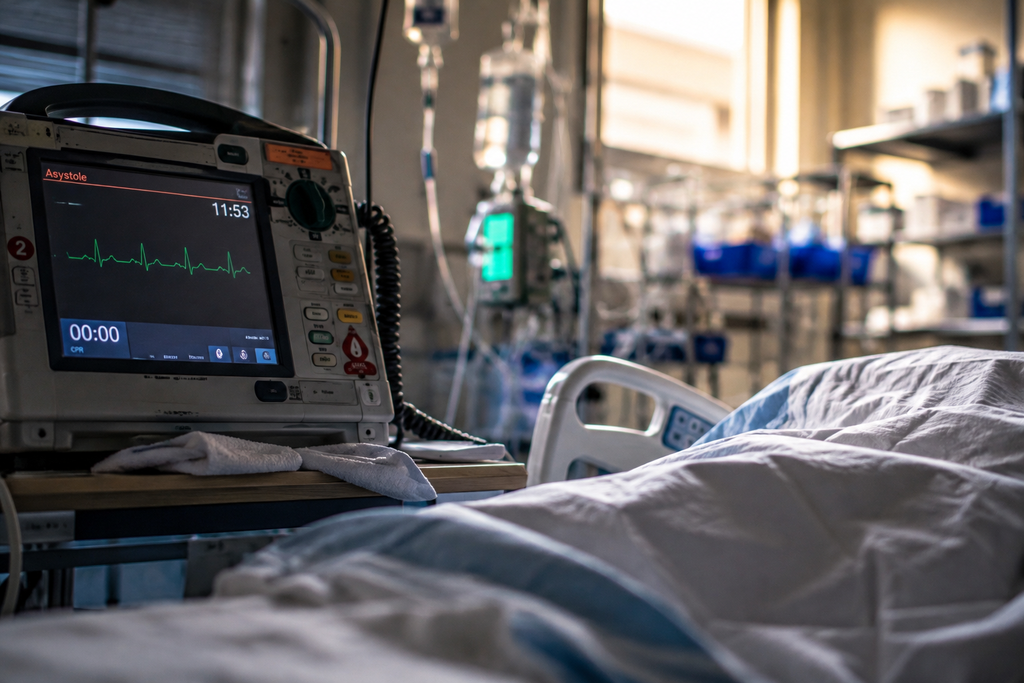
In medical terms, a true flatline usually refers to asystole, meaning there is no detectable electrical activity in the heart.
Asystole is not normally treated with defibrillation.
Modern advanced cardiac life-support protocols reserve electrical shocks primarily for ventricular fibrillation and pulseless ventricular tachycardia. Asystole and pulseless electrical activity are treated with CPR, epinephrine and attempts to identify reversible causes.
That creates an apparent inconsistency in the simplified version of Markin’s story.
There are several possible explanations. “Flatline” may have been used loosely in interviews rather than as a precise description of the rhythm. Markin’s rhythm may also have changed before the additional shock was delivered.
Without the original cardiac monitor recordings and complete resuscitation record, it is impossible to determine retrospectively exactly what rhythm was present at that moment.
The story also contains conflicting details
Even sources sympathetic to the miracle interpretation do not agree on every element of the case.
For example, some accounts place the event on September 20, 2006, while material associated with Crandall’s book gives October 20, 2006.
Descriptions of the number of shocks also differ. One version says Markin was shocked roughly a dozen times before resuscitation was abandoned, while other retellings describe six unsuccessful shocks followed by a seventh attempt.
These inconsistencies do not prove that the underlying event never happened.
They do, however, show why the story should not be repeated as though every detail has been independently verified through published medical documentation.
Medicine has documented something called the Lazarus phenomenon
There is another reason cases like Markin’s deserve careful interpretation.
Medicine recognizes a rare event known as autoresuscitation, often nicknamed the “Lazarus phenomenon.”
It refers to the spontaneous return of circulation after CPR has been stopped.
Although uncommon, it is well documented in medical literature.
Published reviews have identified dozens of reported cases. In one analysis, the median time between stopping CPR and the spontaneous return of circulation was around five minutes.
Most of those patients did not ultimately survive, but a small number recovered with good neurological outcomes.
Several mechanisms have been proposed.
One involves excessive pressure inside the chest during mechanical ventilation. If the lungs become overinflated, blood returning to the heart can be reduced. Once ventilation and resuscitation stop, that pressure may fall and circulation can potentially recover.
Another possibility is delayed delivery of medications. When circulation during CPR is extremely poor, drugs such as epinephrine may take longer than expected to reach the heart.
These mechanisms show that an apparently final loss of circulation can occasionally be followed by an unexpected recovery.
Does the Lazarus phenomenon explain Markin’s recovery?
Not exactly.
Classic autoresuscitation involves the spontaneous return of circulation after resuscitation has stopped and without a new intervention.
Crandall’s version of events includes an additional electrical shock after the prayer.
That means Markin’s recovery does not fit neatly into the standard definition of the Lazarus phenomenon.
Still, the existence of autoresuscitation is important because it demonstrates that the physiology surrounding the end of a resuscitation attempt can sometimes be more complicated than it appears.
A patient may look beyond recovery and yet still retain the possibility of circulation returning.
How could his brain survive such a prolonged cardiac arrest?
This is perhaps the most remarkable part of the story.
Reports about Markin state that he did not suffer the devastating neurological injury that might be expected after such a prolonged emergency.
But again, the widely repeated phrase “dead for 40 minutes” can be misleading.
During much of that period, CPR was reportedly being performed.
Effective chest compressions do not create normal circulation, but they can deliver a limited amount of blood and oxygen to the brain and heart.
That is very different from a situation in which the brain receives absolutely no blood flow for 40 consecutive minutes.
The distinction helps explain why recovery, while unusual, is not medically impossible.
Markin also described an unusual experience while unconscious
After his recovery, Markin spoke about what he regarded as a near-death experience.
He described finding himself in a place resembling a funeral home and encountering a presence that he later interpreted as an angel.
Experiences of this kind have been reported by other survivors of cardiac arrest and remain an active area of scientific investigation.
Researchers have explored changes in consciousness, memory and brain activity around cardiac arrest, but science currently cannot determine whether near-death experiences represent perceptions occurring independently of the brain or neurological experiences generated during extreme physiological stress and recovery.
For the person experiencing them, however, they can be life-changing.
Markin subsequently embraced Christianity more deeply and began publicly sharing his story alongside Crandall.
Can science prove that prayer brought him back?
No.
Science cannot establish that Crandall’s prayer caused Markin’s heart to begin beating again.
To demonstrate causation, researchers would need to exclude alternative physiological explanations and have access to detailed contemporary medical records, including ECG rhythms, medication timing, CPR data and the precise sequence of events.
There is no widely available peer-reviewed case report providing that level of documentation for Markin’s recovery.
Most public information comes from Crandall himself, from Markin, from Crandall’s book and from Christian media organizations that present the event within a religious context.
But the reverse claim cannot be demonstrated either.
Medicine can describe possible physiological mechanisms. It cannot retrospectively test whether a supernatural intervention occurred.
That question belongs to faith rather than experimental science.
The real story is more complicated than the viral version
The strongest evidence supports a more careful version of events.
Jeff Markin appears to have suffered a catastrophic cardiac arrest following a serious heart attack. Medical staff reportedly attempted to resuscitate him for around 40 minutes before stopping and pronouncing him dead.
Dr. Chauncey Crandall says that he then returned to the bedside after feeling spiritually compelled to pray.
Following the prayer, another attempt at defibrillation was made.
Markin regained circulation and survived.
That alone is an extraordinary medical outcome.
What cannot be established from the public evidence is that Markin had been biologically dead for 40 minutes or that prayer can be scientifically identified as the cause of his recovery.
For Crandall, however, the meaning of the event has never been uncertain. He believes he witnessed a direct answer to prayer.
Medicine offers several possible explanations for extraordinary recoveries after cardiac arrest.
Faith offers another.
More than two decades later, Jeff Markin’s story remains compelling precisely because neither perspective completely erases the other.
Sources
American Heart Association — Guidelines for Cardiopulmonary Resuscitation and Emergency Cardiovascular Care and Adult Advanced Life Support guidance.
Gordon L. et al. — research on autoresuscitation and the Lazarus phenomenon in Scandinavian Journal of Trauma, Resuscitation and Emergency Medicine.
Adhiyaman V., Adhiyaman S., Sundaram R. — The Lazarus phenomenon, Journal of the Royal Society of Medicine.
Peer-reviewed literature indexed in PubMed on autoresuscitation after termination of CPR.
Chauncey W. Crandall IV — Raising the Dead: A Doctor Encounters the Miraculous, FaithWords.
Christian Broadcasting Network / The 700 Club — interviews and reports featuring Chauncey Crandall and Jeff Markin.
Professional biographical information published by Dr. Chauncey Crandall.