
There are places that become famous because of what happened there, and others that become famous because nobody can quite agree on what happened there.
Overtoun Bridge, near Dumbarton in western Scotland, belongs firmly to the second category.
For decades, dog owners have reported disturbing incidents in which their pets suddenly moved toward the edge of the bridge and fell or jumped into the ravine below. Some animals survived. Others did not. Over time, the bridge acquired an unsettling nickname in the media: the “Dog Suicide Bridge.”
That label helped turn Overtoun into an international mystery, but it also distorted the story.
There is no good evidence that dogs are deliberately trying to die. There is no reliable database proving the dramatic numbers often repeated online. And despite the ghost stories that have grown around the site, there is no scientific evidence that anything supernatural is drawing animals toward the edge.
What does exist is a genuinely unusual pattern of accidents, a bridge with a very particular design, wildlife living in the valley below, and dogs whose sensory world is radically different from our own.
The real story may be less paranormal than the viral version, but it is considerably more interesting.
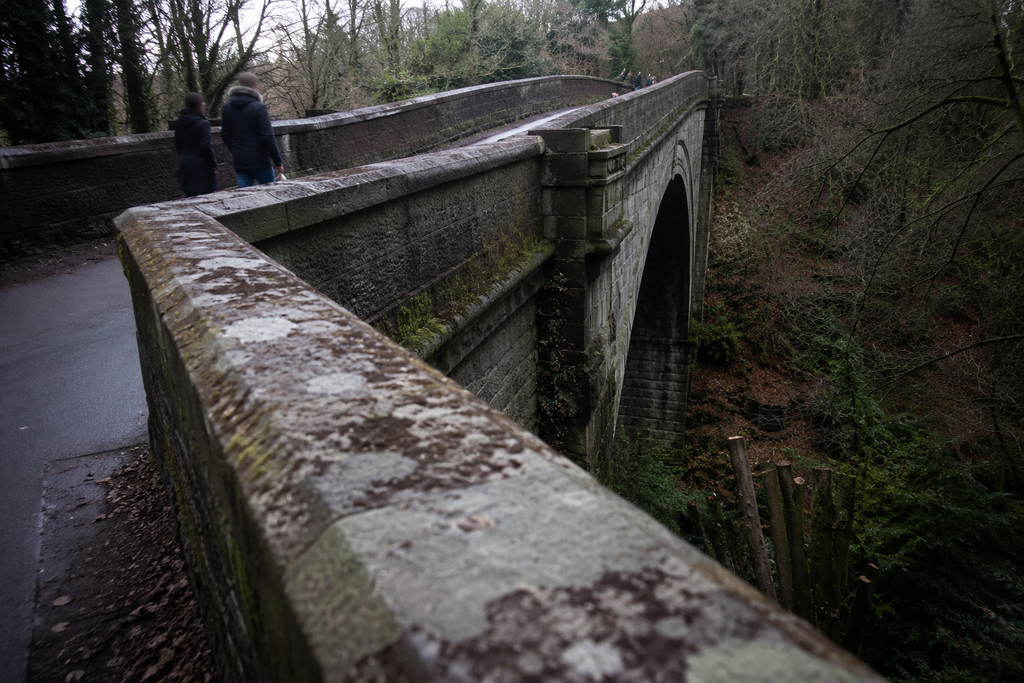
A Victorian bridge with an unexpectedly dark reputation
Overtoun Bridge stands on the grounds of Overtoun House in West Dunbartonshire, Scotland.
The estate was developed during the Victorian era. Industrialist James White purchased the property in 1859, and Overtoun House was completed several years later. The bridge itself was built later as part of improvements to the estate and was opened in 1895.
Nothing about its original purpose was mysterious. It was simply a stone bridge designed to connect parts of the property across Overtoun Burn.
For decades, it appears to have attracted little unusual attention.
Then stories involving dogs began to emerge.
Reports are commonly associated with the period from the 1950s onward, although the lack of a comprehensive historical record makes it difficult to determine exactly when the pattern began.
Owners described dogs approaching certain sections of the bridge, becoming suddenly interested in something beyond the stone wall and, in some cases, going over the edge.
Those stories eventually spread far beyond Scotland.
The incidents are real, but the famous statistics are much harder to prove
One of the first things that becomes apparent when researching Overtoun Bridge is how confidently the internet repeats numbers that are surprisingly difficult to verify.
Some articles claim that approximately 300 dogs have gone over the bridge. Others say 600. Claims of around 50 deaths are also widely repeated.
The problem is that there does not appear to be a complete public record documenting every incident over the many decades involved.
That does not mean the phenomenon was invented.
There are identifiable accounts from dog owners whose animals fell from the bridge, and the location has attracted enough concern that visitors with dogs have repeatedly been advised to use a lead.
One widely reported example involved a Springer Spaniel named Cassie, whose owner described the dog unexpectedly going over the bridge and surviving the fall.
What we cannot responsibly say is that a precise number such as “600 dogs” represents a verified official total.
The most accurate description is simpler: numerous incidents have been reported over the years, some resulting in serious injury or death, but the cumulative number remains uncertain.
That distinction matters because extraordinary statistics often become more certain each time a story is retold.
Why calling it a “suicide bridge” is misleading
The phrase “Dog Suicide Bridge” is memorable. It is also scientifically problematic.
A dog going over a bridge does not automatically mean the animal understands death and has consciously chosen to cause its own.
Researchers studying canine behavior generally approach such events through perception, instinct, sensory information and environmental triggers.
Dogs can experience distress, behavioral changes and complex emotional states. That is very different from demonstrating that they understand suicide as an abstract concept and intentionally act upon it.
At Overtoun, the more plausible question is therefore not “Why do dogs want to die here?”
It is: “What could make a dog fail to recognize the danger?”
That shift changes almost everything about the mystery.
A dog does not experience the bridge the way a human does
Humans are highly visual animals.
When we walk across a bridge, we immediately notice the height, the walls, the landscape and the drop below.
Dogs rely much more heavily on smell.
Their olfactory system is dramatically more sensitive than ours. Estimates vary according to breed and anatomy, but dogs possess vastly more olfactory receptors than humans. For them, scent is not merely an additional sense. It is one of the main ways they interpret the world.
A place that seems visually uneventful to us may contain an extraordinary amount of information for a dog.
Who passed through?
What animals are nearby?
Which direction did they travel?
How recently were they there?
What is moving in the vegetation below?
At Overtoun Bridge, those questions may be much more relevant than anything visible from a human perspective.
The mink theory
One of the best-known attempts to explain the accidents focuses on American mink.
These animals are not native to Britain. They were introduced for the fur trade during the twentieth century, escaped or were released from farms and eventually established wild populations.
American mink are now found in parts of Scotland, particularly around waterways, and produce strong scent markings that can be highly interesting to dogs.
Investigations of Overtoun have therefore considered whether dogs may be detecting mink or other small mammals living beneath and around the bridge.
The idea is biologically plausible, particularly for animals with strong hunting, tracking or retrieving instincts.
But an important distinction is often lost online.
The mink explanation is a hypothesis supported by observations about canine behavior and the environment. It has not been conclusively demonstrated as the cause of every accident at Overtoun Bridge.
There has been no enormous controlled scientific study proving that mink scent makes dogs leap from this particular structure.
That would be both difficult and ethically impossible to test in any straightforward way.
The stone walls may be just as important as the scent
The architecture of Overtoun Bridge provides another crucial clue.
From the perspective of an adult human, it is obvious that the bridge crosses a deep ravine.
A dog sees something very different.
The solid stone parapets can obscure the drop almost completely from the animal’s lower viewpoint. Trees and vegetation rise beyond them, potentially making the landscape appear more continuous than it really is.
Now add a compelling scent.
A dog detects an animal below or beyond the wall. It moves closer to investigate. Because the parapet blocks its view of the ground beneath, the animal may not accurately judge what lies on the other side.
What looks to humans like an inexplicable leap may therefore be something very different: a dog following a powerful sensory cue without understanding that the surface beyond the wall is many metres below.
The animal is not necessarily choosing the drop.
It may not realize there is one.
Why would some dogs react while others do not?
If scent is part of the explanation, another question naturally follows.
Thousands of dogs can presumably visit the surrounding area without incident. Why do only some react?
Individual behavior matters.
Dogs differ significantly in prey drive, curiosity, training, temperament and sensitivity to particular scents. Breed history may also influence how strongly some animals respond to wildlife.
Retrievers, spaniels and other dogs developed for hunting-related tasks often have strong tendencies to investigate scent and movement.
That does not mean a particular breed is inherently at risk of jumping from bridges. There is no robust epidemiological dataset for Overtoun that would justify such a claim.
It simply means that individual dogs may respond very differently to the same environmental stimulus.
The dog that ignores a scent and continues walking experiences an uneventful visit.
The dog that becomes intensely focused on it may move much closer to the parapet.
The most interesting question is not why dogs fall, but why this particular bridge became associated with the phenomenon
Mink live in many parts of Britain.
Small mammals live beside countless rivers and ravines.
Dogs cross bridges every day.
So why did Overtoun develop such an unusual reputation?
The answer may lie in an uncommon combination of ordinary factors rather than one extraordinary cause.
The bridge has high stone walls that limit a dog’s view. Dense vegetation surrounds the ravine. Wildlife lives nearby. Air currents may transport scent upward or across particular sections of the bridge. A dog with a strong prey or tracking response may become highly focused on what it smells beyond the wall.
None of those factors is remarkable by itself.
Together, they could produce a very specific type of accident.
This may also help explain why reports often describe incidents occurring around particular sections rather than randomly along the entire structure.
Why the mystery cannot be completely solved
One reason Overtoun remains difficult to study is that much of the information researchers would ideally want simply does not exist.
We do not know how many dogs have crossed the bridge safely over the decades.
We do not have complete records for every reported fall.
We generally do not know the precise weather conditions, wind direction, wildlife activity or scent environment at the exact moment of each event.
We also do not have consistent information about the dogs themselves: breed, age, training, previous behavior, prey drive and whether they were on or off the lead.
Without that information, researchers cannot calculate the true risk or establish a single cause with confidence.
That is quite different from saying science has “no explanation.”
Several natural explanations fit what is known remarkably well.
They simply cannot be proven retrospectively for every individual incident.
And then came the ghost stories
Overtoun already had everything required for modern folklore: a Victorian mansion, an old stone bridge, Scottish woodland and a disturbing pattern involving animals.
It was almost inevitable that supernatural explanations would follow.
Stories have linked the site to ghosts, unseen energies and the idea that dogs can detect something inaccessible to human senses. One of the legends frequently associated with the estate concerns a mysterious female apparition.
These tales are part of the cultural story surrounding Overtoun, but there is no objective evidence showing that paranormal forces are responsible for the accidents.
Interestingly, the real sensory difference between humans and dogs may have helped such stories flourish.
Dogs genuinely can detect things we cannot.
They hear frequencies outside our range and perceive scents completely inaccessible to us.
But going from “the dog senses something I cannot” to “the dog senses a supernatural presence” is a leap unsupported by evidence.
The invisible stimulus may simply be an animal somewhere beneath the bridge.
How a real phenomenon becomes an internet legend
Overtoun Bridge also illustrates something broader about the way unusual stories evolve.
Imagine the transformation.
A few dogs fall from a bridge.
Local residents begin talking about it.
Newspapers discover the story.
The bridge receives a dramatic nickname.
Approximate numbers become widely repeated.
Television programs investigate.
Paranormal theories emerge.
Then social media compresses decades of uncertain reporting into a single striking sentence:
“Hundreds of dogs have mysteriously committed suicide from exactly the same spot.”
That version is irresistible.
It is also much more definitive than the evidence allows.
Real accidents occurred. That does not make every detail added to the legend equally reliable.
The uncertainty is part of what makes Overtoun fascinating
There is a tendency to think a mystery must have one of two outcomes.
Either scientists explain everything perfectly, or something supernatural remains.
Reality is rarely so tidy.
At Overtoun Bridge, we have enough evidence to make several mechanisms plausible: extraordinary canine olfaction, wildlife scents, limited visibility, the structure of the parapet and individual differences in behavior.
What we do not have is enough historical data to reconstruct every incident.
That leaves uncertainty.
But uncertainty is not evidence of the paranormal. It is simply the point at which the available information ends.
What dog owners should take from the story
Regardless of which combination of factors explains the incidents, the practical lesson is straightforward.
A dog should be kept securely on a lead when crossing Overtoun Bridge.
The surrounding environment contains enough potential distractions that there is no reason to take a risk, particularly with a dog that has a strong tendency to chase wildlife or follow scent.
The mythology can remain a subject of debate.
The safety measure does not need to be.
Perhaps the real mystery is how differently two species can experience the same place
Stand on Overtoun Bridge and you see stone, trees, water and a deep valley.
A dog standing beside you may inhabit a completely different sensory landscape.
The stone wall hides part of the terrain. The woodland is filled with scent trails. Somewhere below, another animal may have passed only minutes or hours earlier. Air moving through the ravine carries information that means nothing to the human beside it.
For us, it is an old Scottish bridge.
For the dog, it may be an intensely stimulating map of invisible signals.
That possibility offers a compelling way to look at Overtoun without dismissing the genuine accidents and without turning uncertainty into a ghost story.
The bridge remains mysterious, but perhaps not because something impossible happens there.
Perhaps it reminds us how easily we assume that other animals experience the world exactly as we do.