
For years, wildlife biologists working on California’s Santa Catalina Island carried out a conservation procedure that sounds almost impossible.
They climbed toward remote bald eagle nests, sometimes on steep cliffs that were difficult to reach from the ground, removed the birds’ real eggs, and replaced them with artificial ones.
The adult eagles kept incubating.
Meanwhile, the real eggs were taken to a controlled facility, where specialists monitored them closely and tried to improve their chances of surviving.
If a chick hatched successfully, the team returned to the nest, removed the dummy egg, and placed the young eagle beside the waiting adults.
In many cases, the parents simply began raising the chick.
Some nests were so inaccessible that reaching them required climbing equipment and helicopter support.
One of the biologists closely associated with this unusual chapter of bald eagle conservation was Peter B. Sharpe, who spent years studying and helping restore eagle populations across California’s Channel Islands.
But the dramatic images of scientists approaching cliffside nests tell only part of the story.
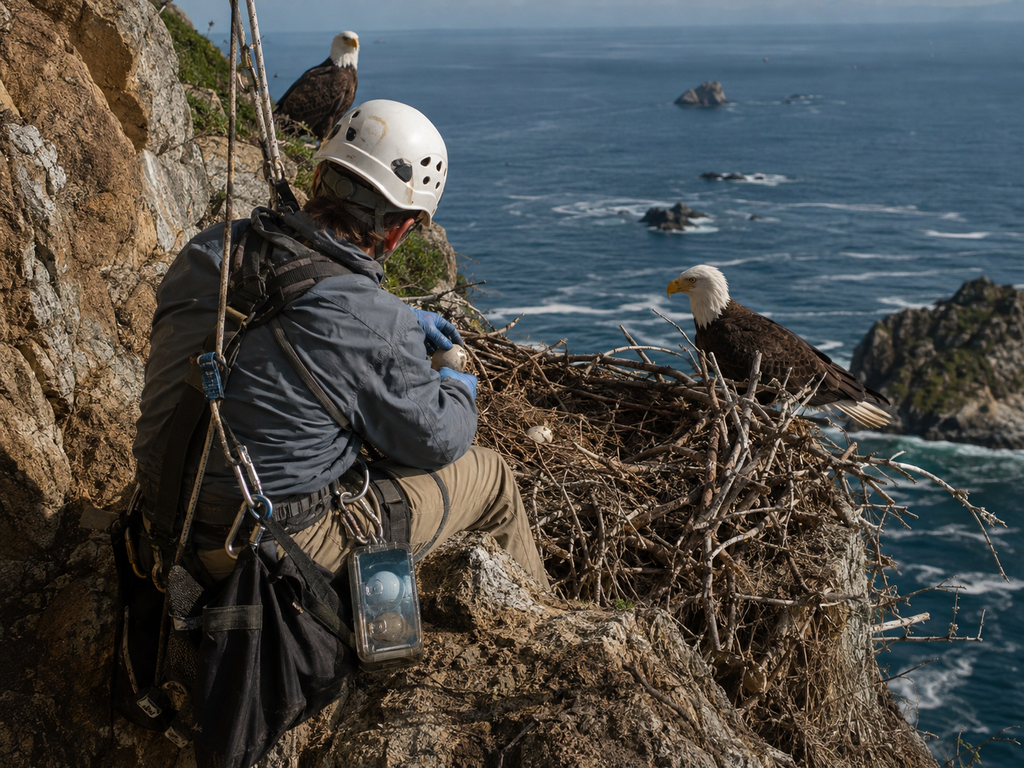
The real reason for these interventions began decades earlier, with one of the most notorious pesticides of the twentieth century.
Bald eagles had vanished from the Channel Islands
Bald eagles, Haliaeetus leucocephalus, once nested throughout California’s Channel Islands.
During the first half of the twentieth century, several breeding pairs were still present across the archipelago. Over time, however, the population collapsed.
By the early 1960s, bald eagles had effectively disappeared from the islands.
There was no single cause. Direct persecution played a role, as did other human pressures. But one of the most important factors was contamination by organochlorine chemicals, especially DDT and its persistent breakdown products.
A major source of that pollution lay on the mainland, near Los Angeles.
Industrial waste left a legacy in the Pacific
For decades, the Montrose Chemical Corporation produced DDT at its facility in Torrance, California.
Waste associated with that industrial activity entered the Los Angeles County sewer system and was ultimately discharged offshore through submarine outfalls.
Large quantities of DDT-related contamination accumulated in marine sediments, particularly around the Palos Verdes Shelf.
The United States banned most uses of DDT in 1972.
But banning a chemical does not immediately erase it from an ecosystem.
Compounds related to DDT can remain in sediments for many years, and they can continue moving through the food web long after the original source of pollution has been reduced or eliminated.
That persistence became especially dangerous for animals near the top of the food chain.
The problem was not the adult eagle — it was the egg
One of DDT’s major breakdown products is DDE.
DDE is highly persistent and tends to accumulate in fatty tissues. As contaminated organisms are eaten by other animals, concentrations can increase farther up the food chain.
Bald eagles on Santa Catalina fed partly on prey connected to the marine environment, which exposed them to contaminants that had already accumulated in fish, seabirds and other animals.
The consequences became most visible during reproduction.
In sensitive bird species, DDE can interfere with the normal formation of eggshells. The result may be a shell that is significantly thinner and weaker than it should be.
That difference can be fatal.
An eagle must incubate its eggs for weeks. If the shell is too fragile, it may crack or collapse under the weight of the parent. Other eggs may lose too much moisture, preventing the embryo from developing normally.
This type of reproductive failure was documented among bald eagles in the Channel Islands.
The adults could survive.
They could pair.
They could build nests.
They could even lay eggs.
But producing healthy young was another matter.
Scientists tried to bring the eagles back
In 1980, conservation organizations and government agencies launched a bald eagle reintroduction program on Santa Catalina Island.
Between 1980 and 1986, 33 young eagles from wild nests in northwestern North America were brought to the island.
Before their release, the birds were housed in special structures known as hack towers, which allowed young raptors to adjust to their new surroundings before they began flying freely.
At first, the effort appeared successful.
The eagles survived.
They matured.
They formed breeding pairs.
Then, in 1987, they began laying eggs.
That should have marked the beginning of a self-sustaining population.
Instead, the eggs failed.
Many broke during incubation.
When researchers analyzed the eggshell fragments, they found high concentrations of DDE.
The eagles had returned to Santa Catalina, but the environmental damage caused years earlier was still preventing them from reproducing normally.
The solution involved artificial eggs
By 1989, wildlife teams began intervening directly in the nesting cycle.
Soon after an eagle pair laid eggs, biologists removed them from the nest and replaced them with artificial replicas.
The goal was not simply to take the eggs away.
The dummy eggs helped keep the adults engaged in normal incubation behavior while the real eggs were protected elsewhere.
The original eggs were taken to a specialized facility and incubated under controlled conditions.
Even then, success was far from guaranteed.
Some embryos had already been so badly affected that they could not survive. Research by Peter Sharpe and David Garcelon showed that hatch rates for some of the collected eggs were extremely low during the earlier years of the program.
Without intervention, however, the odds were often worse.
Some nests could barely be reached
This was not conservation work done entirely inside a laboratory.
Many nests were located on rugged cliffs and remote sections of the island.
Reaching them could involve climbing steep terrain, working with ropes, or using helicopters to access areas that would otherwise have been extremely difficult or dangerous.
Peter Sharpe became one of the best-known figures connected with this phase of the restoration effort.
He joined the Institute for Wildlife Studies in the 1990s and later became deeply involved in bald eagle research and restoration across the Channel Islands.
He personally participated in egg retrievals, chick placements and nest monitoring.
That is why the dramatic images circulating online — a biologist descending toward an eagle nest, artificial eggs in hand — are rooted in a real conservation program.
Still, the project was never the achievement of one person.
It began years before Sharpe became a central figure and depended on the combined work of researchers, veterinarians, pilots, technicians, conservation organizations and government agencies.
When a chick hatched, it went back to a nest
If an incubated egg produced a healthy chick, the conservation team returned to the eagle nest.
The artificial egg was removed.
The chick was placed in its place.
The adults, already in the appropriate stage of their breeding cycle, would often accept the chick and begin caring for it.
They warmed it, fed it and defended it.
The chick did not necessarily need to be their genetic offspring for this to work.
That became especially important because not every egg removed from a Santa Catalina nest produced a viable young eagle.
Some chicks came from breeding programs
When too few chicks survived from the island’s own eggs, conservationists relied on outside breeding programs.
San Francisco Zoo became one of the project’s important partners.
Young eagles produced through the zoo’s Avian Conservation Center could be transported to Santa Catalina and placed with wild eagle pairs.
Those foster parents often raised the chicks successfully.
By 2007, the U.S. Fish and Wildlife Service reported that more than 100 bald eagles had either been released on Santa Catalina or placed into nests as young birds over the course of the restoration effort.
The intervention was remarkable.
But it was never meant to continue forever.
A population can only be considered truly recovered when it is capable of reproducing without constant human assistance.
A breakthrough came in 2006
The first major sign that the restoration was beginning to work appeared not on Santa Catalina, but on nearby Santa Cruz Island.
In 2006, a bald eagle chick known as A-49 hatched naturally there.
According to the National Park Service, it was the first bald eagle known to hatch without human assistance in the Channel Islands in more than half a century.
For conservationists, the event was enormously encouraging.
It suggested that natural reproduction could return to the archipelago.
Santa Catalina would soon reach its own milestone.
Two chicks hatched naturally in 2007
In the spring of 2007, a bald eagle pair on Santa Catalina produced two chicks without their eggs being removed for artificial incubation.
It was the first unaided hatching on the island since the intensive restoration program had begun.
The history of the parents made the event particularly significant.
The male had originally come from British Columbia and had been released on Santa Catalina in 1986.
The female had been produced through the Avian Conservation Center at San Francisco Zoo and released on the island in 1999.
A bird that existed partly because of the restoration program was now raising young without the same level of human intervention.
That was exactly the kind of result the project had been designed to achieve.
But the artificial-egg program did not end overnight
It is tempting to imagine the 2007 hatchings as the final scene of the story.
They were not.
One successful nest did not mean DDE had disappeared from the ecosystem, nor did it mean every eagle pair was suddenly reproducing normally.
Biologists continued assisting nests where intervention was still necessary.
The intensive egg and chick manipulation program on Santa Catalina lasted from 1989 until 2009.
That is roughly two decades of hands-on reproductive management.
The artificial eggs were not abandoned after one encouraging season.
They were phased out only when researchers had enough evidence that the population was becoming capable of maintaining itself.
The eagles were still watched closely
Ending intensive reproductive assistance did not mean conservationists simply walked away.
The birds continued to be monitored.
Researchers tracked nesting success, population growth and the movement of individual eagles across the islands.
Some pairs could still experience unsuccessful nesting seasons, and historic contaminants did not vanish entirely from the ecosystem.
What changed was the basic reproductive pattern.
Earlier in the project, the population depended heavily on humans removing fragile eggs and placing young birds into nests.
Natural reproduction eventually became the norm.
The recovery spread beyond Santa Catalina
The Channel Islands restoration effort expanded well beyond the original Catalina project.
Between 2002 and 2006, dozens of additional young bald eagles were introduced to the northern islands.
Gradually, the birds began occupying territories where they had been absent for decades.
Natural nests appeared on several islands.
More chicks hatched.
More young birds survived long enough to leave the nest.
According to figures published by the Institute for Wildlife Studies for 2022, around 60 bald eagles were living on five of the Channel Islands, including 23 breeding pairs.
For an animal that had disappeared from the archipelago by the 1960s, the change was extraordinary.
Peter Sharpe did not save the entire species
Viral versions of the story sometimes describe Peter Sharpe as the man who saved the bald eagle from extinction.
That is not accurate.
The bald eagle’s broader recovery across the United States resulted from many factors, including legal protection, the ban on DDT, habitat conservation and restoration projects carried out across the country.
By 2007, the species had recovered enough nationally to be removed from the U.S. federal list of threatened and endangered species.
The Santa Catalina story is more specific.
Sharpe and many other conservationists helped restore a local population that could not reproduce successfully because of historic chemical contamination.
That distinction matters.
It does not make the achievement less impressive.
If anything, it makes the real story more interesting than the simplified version.
Pollution can outlive the people who created it
Perhaps the most important lesson from Santa Catalina has little to do with helicopters or artificial eggs.
DDT had already been banned in the United States before the island’s bald eagle reintroduction program even began.
Yet decades later, researchers were still dealing with the biological consequences.
In the early 2000s, studies of Santa Catalina eagles still found evidence that DDE contamination was interfering with normal reproduction.
This is what makes persistent pollutants so difficult to manage.
A factory may close.
A chemical may be prohibited.
Public awareness may change.
But contaminants already embedded in sediments and food webs can remain active for decades.
Wildlife born years later may still experience the consequences.
The most important moment was when intervention became unnecessary
The most memorable photographs from this project show people doing extraordinary things.
A biologist suspended near a cliff.
A fragile eagle egg being carried to safety.
A chick being returned to a nest.
Those images are dramatic because human intervention is visible.
But the true success of the project looked much quieter.
An eagle laid an egg.
The parents incubated it.
The shell survived.
The chick hatched.
It grew.
Eventually, it flew.
No egg needed to be removed.
No artificial replacement was required.
No chick had to be delivered from somewhere else.
For years, conservationists had been essential to the survival of the population.
Eventually, the best thing they could do was watch from a distance.
That may be one of the clearest signs that a conservation project has succeeded.
Not the moment when humans become indispensable.
The moment when nature no longer needs them to be.