
A dried rose petal rests under a camera. Across its fragile surface, shadows and veins seem to form a human face. To some viewers, the features are unmistakable: eyes, a nose, a mouth, long hair. Another petal appears to show the Virgin Mary. Others seem to contain saints or religious figures.
Today, images like these circulate online with dramatic captions about “the face of Jesus appearing on rose petals” or “the miracle that stunned America.” They look exactly like the kind of story that social media would invent.
But this one is older than the viral posts.
The trail leads back to Monterrey, Mexico, in the late 1990s. The case became unusual enough to attract the attention of an American television network and, more importantly, to place actual rose petals in the hands of a horticulture professor at the University of California, Davis.
That does not mean science confirmed a miracle. In fact, the documented story is far more complicated than the version usually shared online.
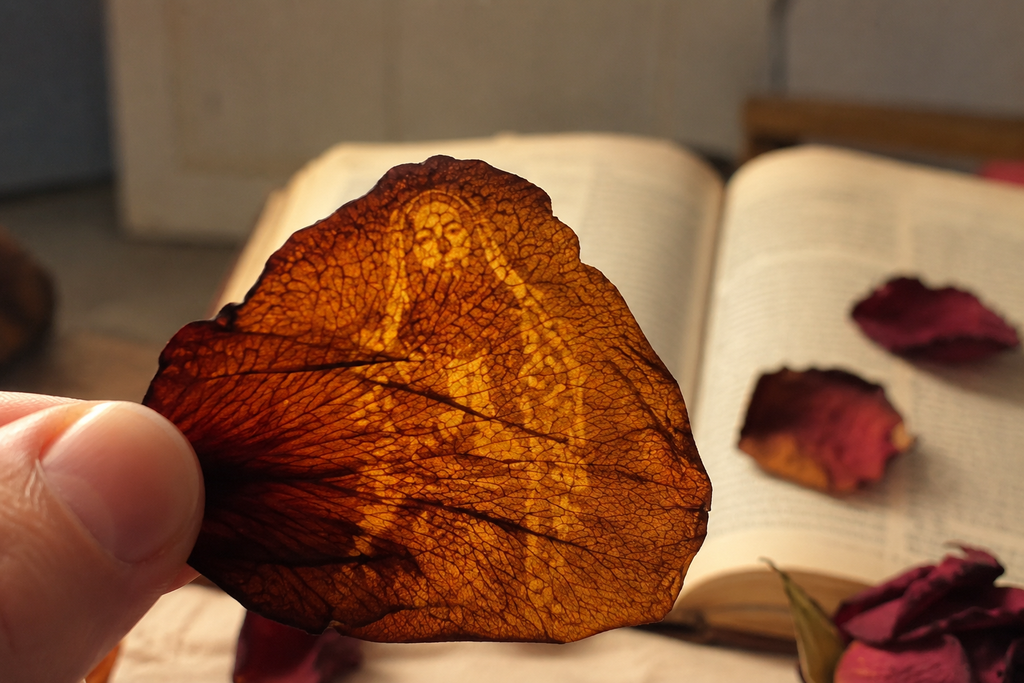
The strange petals from Monterrey
Contemporary religious reports identified the woman at the center of the story as Milla Carrazco de Ortiz, a resident of Monterrey.
Accounts published at the time described her as living in modest circumstances with her family and connected her home with several alleged religious phenomena. Among them were rose petals said to develop images resembling Jesus, the Virgin Mary and various saints after being placed inside Bibles or prayer books.
Those reports are important because they show what believers were claiming while the events were still current. They should not, however, be confused with independent scientific confirmation. Religious publications were reporting a phenomenon already being interpreted through the language of faith.
The strongest independent evidence that the petals themselves were real comes from somewhere else entirely.
A UC Davis professor examined the petals
On July 16, 1999, the University of California, Davis published a short report about horticulture professor Michael Reid.
According to the university, Reid had been asked to examine rose petals bearing images that resembled Christ and the Virgin Mary. The petals were said to have come from the home of a woman in Monterrey, Mexico, and they were being investigated for an upcoming FOX television program.
Reid’s task was not to determine whether God had created the images.
It was much more practical: he was asked to consider whether the markings appeared to be naturally formed or artificially produced.
That distinction matters.
The UC Davis report establishes something that modern viral posts often obscure: real petals connected to the Monterrey story were physically examined by a university scientist. The episode was not invented decades later by a Facebook page.
But the same source does not say that Reid proved the images were supernatural.
The television special that brought the story to America
The petals appeared in the FOX program Signs From God: Science Tests Faith, broadcast in July 1999.
The two-hour special explored several alleged religious phenomena, including reported stigmata, statues said to bleed and the rose petals carrying sacred-looking images.
The concept was irresistible for television: place miracles in front of scientists and see what happens.
Yet after the program aired, skeptics criticized the way some of the evidence had been presented. Their concern was not simply that religious people believed in the phenomena. The criticism focused on whether ordinary explanations had been given enough weight.
The rose petals became one of the clearest examples.
Could the images be made by human hands?
According to a response published by the Committee for the Scientific Investigation of Claims of the Paranormal, specialists demonstrated that similar images could be produced by pressing religious medallions against rose petals.
That experiment matters because it establishes a plausible physical mechanism.
If a raised object is pressed into delicate plant tissue, changes in pressure, bruising, moisture and pigment can create a visible pattern. On a dried petal, the result can remain strikingly detailed.
This directly challenges the popular claim that scientists examined the Monterrey petals and concluded that no human method could explain them.
The available documentation does not support that version of events.
At the same time, reproducing a similar effect does not automatically prove the history of every original petal.
That is a different question.
A possible method is not the same as proof of fraud
Imagine that investigators discover a technique capable of producing an image nearly identical to an unexplained object.
That tells us something important: a supernatural explanation is no longer necessary to explain how such an image could exist.
But it does not, by itself, prove that a particular object was created using that technique.
To establish deliberate fabrication of an individual petal, investigators would ideally need secure information about its origin, handling and storage, along with detailed physical examination and comparison samples.
For the Monterrey collection, there does not appear to be a peer-reviewed scientific study documenting such a complete investigation of every alleged miraculous petal.
So two sweeping conclusions should both be avoided.
We cannot reasonably say that science proved the petals were miraculous.
But we should also be cautious about claiming that every individual specimen was conclusively demonstrated to be fraudulent.
The surviving evidence does not justify either certainty.
What did Michael Reid actually say?
One sentence associated with the UC Davis investigation is often repeated because it sounds almost like an endorsement of the miracle.
Reid reportedly said:
“To me, every rose petal is a miracle.”
It is an elegant line, but its meaning should not be exaggerated.
The statement expresses appreciation for the complexity and beauty of nature. It is not a scientific verdict declaring that the images were supernatural.
The UC Davis material does not say that Reid proved divine intervention, nor does it report that he concluded natural or human explanations were impossible.
Turning his comment into “a scientist confirmed the miracle” changes what he actually communicated.
Why do the faces look so convincing?
There is another reason stories like this are so powerful: the human brain is extraordinarily sensitive to faces.
We recognize them almost instantly, even when very little information is available. That ability is so strong that we routinely perceive faces in clouds, rock formations, electrical outlets, tree bark, stains and shadows.
The phenomenon is known as pareidolia.
A dried rose petal provides an especially rich surface for it. Veins form lines. Pigments fade unevenly. Plant tissue shrinks as it loses moisture. Small areas darken while others become translucent.
Together, those changes can create intricate patterns.
Once someone says, “Look, that is the face of Jesus,” perception can become even more powerful. Instead of seeing random markings, the brain begins organizing them into familiar features.
Two dark areas become eyes. A central line becomes a nose. An irregular border becomes hair.
Pareidolia does not tell us exactly how every Monterrey petal acquired its markings. It simply explains why the resulting images can feel remarkably clear and meaningful to the people looking at them.
Believers and skeptics interpreted the same experiment differently
Contemporary religious coverage offered a different interpretation of the attempt to reproduce the images.
Supporters of the Monterrey phenomenon acknowledged that art conservator Will Shank had experimented with pressing an object against a petal. They argued, however, that the resulting image lacked the fine detail seen in the petals they considered authentic.
This is where the story becomes especially revealing.
To skeptics, the experiment showed that the basic effect could be created without invoking anything supernatural.
To believers, producing a rough imitation did not explain the apparent complexity of the originals.
Both sides were looking at essentially the same test and drawing different conclusions from it.
The disagreement was no longer only about the petal. It was about what would count as convincing evidence.
Monterrey was not the only place where such stories appeared
The Mexican case also fits into a broader history of religious images appearing on natural materials.
Reports from the Philippines during the same general period described rose petals allegedly bearing Christian imagery, including cases associated with a man named Carmelo Cortez.
That does not make either set of claims true. It does show, however, that the Monterrey story did not emerge in isolation.
Images perceived in flowers, fruit, walls, wood and other ordinary objects have appeared repeatedly across cultures and religious traditions. Sometimes they become local curiosities. Sometimes they attract pilgrims. Occasionally, as in this case, they reach television studios and scientists.
Did the Catholic Church officially recognize the petals as a miracle?
There is an important distinction that often disappears in online retellings.
A phenomenon being reported by Catholics is not the same as the Catholic Church formally declaring it miraculous.
No reliable documentation has surfaced showing that the Vatican officially recognized the Monterrey rose petals as a supernatural event.
That matters because the Church has traditionally approached alleged apparitions, healings and extraordinary signs with considerable caution. A devotional story can spread widely among believers without ever receiving formal ecclesiastical approval.
So the petals should not be described as a Vatican-confirmed miracle.
What science can, and cannot, say
Stories involving religion and unexplained phenomena often create a misleading choice.
Either science explains the event completely, or God must have done it.
That is not how scientific reasoning works.
If investigators cannot explain something, the responsible conclusion is simply that the cause has not been established. A gap in knowledge is not evidence of supernatural intervention.
Likewise, finding a plausible natural mechanism does not tell a person what they should believe about God, prayer or religious meaning.
Science can examine the petal.
It can study pigment, tissue damage, pressure marks, chemical residues and the effects of drying.
It can test whether similar images can be reproduced.
What it cannot do is convert a spiritual interpretation into a laboratory measurement.
What can actually be confirmed today?
More than 25 years later, several parts of the story remain well supported.
Rose petals associated with the Monterrey case really were examined by Michael Reid at UC Davis.
Some of those petals carried patterns interpreted as images of Christ and the Virgin Mary.
The investigation was connected to the 1999 FOX special Signs From God: Science Tests Faith.
And contemporary skeptical investigators reported that comparable images could be created by pressing medallions into rose petals.
What has not been established is equally important.
There is no strong scientific evidence demonstrating that the images had a supernatural origin, and there is no documented official Catholic recognition of the Monterrey petals as a miracle.
That leaves us with something more interesting than the viral headline.
The mystery is not the same as the miracle
It is tempting to end stories like this with certainty.
The petals were miraculous.
Or the entire affair was a hoax.
The surviving evidence is not quite that neat.
The objects existed. People genuinely saw sacred images in them. Scientists examined at least some of the material. A technique capable of creating comparable impressions was demonstrated.
Beyond that point, certainty becomes harder to justify.
For a believer, the existence of God does not depend on whether a pattern on a rose petal survives laboratory scrutiny. For a scientist, the emotional or spiritual meaning someone finds in that pattern is not evidence that can be measured with an instrument.
Perhaps that is why Michael Reid’s brief comment has aged better than the sensational claims surrounding the case.
Asked to examine petals that others hoped might provide evidence of something supernatural, he did not announce that science had discovered a divine signature hidden in a flower.
He simply observed that, to him, every rose petal was already a miracle.
And perhaps the strangest part of the Monterrey story is that, in the search for an extraordinary image hidden inside a flower, it is easy to overlook how extraordinary the flower itself already is.