
On April 9, 2005, what began as a group trip into an Arkansas cave turned into a complicated rescue operation. Twenty-year-old Richard Harness became wedged inside a narrow vertical crevice, unable to move forward and unable to retreat.
The incident was later documented in American Caving Accidents, a publication associated with the National Speleological Society. Over the years, the story has resurfaced online, sometimes with incorrect details. One of the most common errors places the accident in Tennessee. Contemporary accounts, however, identify the location as Devils Den Cave in Arkansas.
The Group Reached a Passage That Was Much Tighter Than It Looked
Harness was accompanying a group of roughly 12 children through the cave when they encountered a narrow vertical crack connecting larger sections of the underground passage.
The children were small enough to squeeze through.
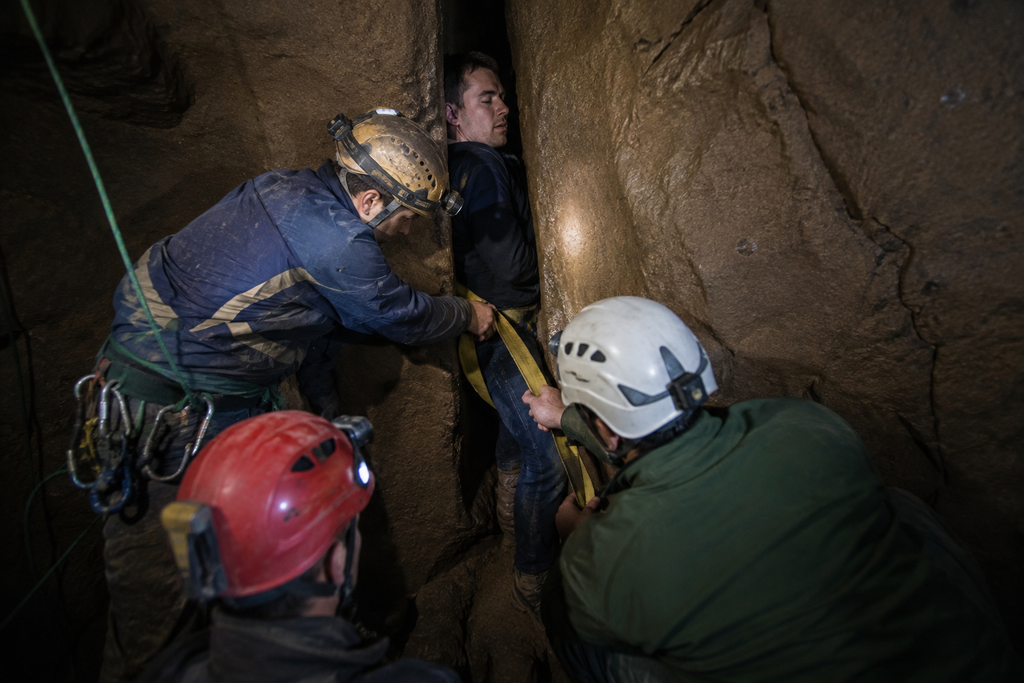
Harness followed them, but partway through the opening, his body became firmly wedged between the rock walls. He could no longer continue through the passage, yet reversing his position was also impossible.
Situations like this can become extraordinarily difficult underground. A person trapped in a confined passage may have almost no room to reposition their arms, legs or torso, and rescuers cannot simply pull with more force without risking injury.
Concern Grew When the Group Failed to Return
Another adult, Melissa Jones, had remained outside the cave.
When the group failed to emerge at the expected time, she alerted park personnel. Rangers and local firefighters entered the cave and began working on a way to free Harness.
Their first approach focused on the rock itself. If the crevice could be widened, they reasoned, perhaps enough space could be created for him to escape.
They attempted to remove rock using a sledgehammer and chisel.
The effort was unsuccessful, and during the operation a ranger suffered a broken hand.
Harness remained trapped.
A Different Team Saw a Different Way Out
Approximately two hours into the rescue, members of Washington County Search and Rescue arrived.
This detail may also explain one of the geographical mistakes that later appeared in social-media versions of the story. The name of the rescue team referred to Washington County in Arkansas; it did not mean the accident had taken place in Washington County, Tennessee.
After assessing the crevice, the rescuers reconsidered the basic assumption behind the earlier attempts.
Harness might not need to be pulled backward at all.
The passage became wider above him.
Instead of trying to force him out along the path he had entered, the team decided to lift him upward until his body reached a section where the rock walls offered more room.
That change in direction became the key to the rescue.
Even His Clothing Was Taking Up Valuable Space
In an opening measured in inches rather than feet, small differences matter.
The rescuers cut away Harness’s jeans and used tubular webbing, the strong flat material commonly used in climbing and technical rescue, to create a system that would allow them to raise him in a controlled manner.
Once the straps were properly positioned and the new technique was put into action, the final extraction reportedly took only about ten minutes.
By then, Harness had been trapped for approximately five hours.
He Was Able to Walk Out After Being Freed
One of the more remarkable details of the incident is what happened next.
Despite spending hours immobilized inside the crevice, Harness was able to make his way out of the cave under his own power after being released.
The children who had been exploring the cave with him were not injured.
The event was reported locally at the time and was later included in American Caving Accidents, where it became more than simply an unusual survival story. It also illustrated a fundamental challenge of cave rescue: techniques that seem obvious at the surface may not work in a confined underground environment.
Why Cave Entrapments Are So Difficult to Solve
Technical cave rescues are shaped by space.
Rescuers may have little room to work beside the trapped person. Equipment can be difficult to position, communication may be complicated, and even turning someone’s body by a few degrees can be impossible.
Pulling harder is therefore not necessarily the answer.
In Harness’s case, the important breakthrough came from understanding the shape of the crevice. Once rescuers recognized that the opening widened higher up, the problem changed from trying to drag him backward to moving him toward the available space.
It was a relatively simple idea, but only after the geometry of the passage had been correctly understood.
Devils Den Is Known for Its Rock Crevices
Devil’s Den State Park lies in the Boston Mountains of northwestern Arkansas and is known for its sandstone formations, caves and narrow rock fractures.
Some of the underground features in the area are described as crevice caves, meaning that they developed largely through the separation and movement of blocks or layers of rock rather than through the same processes associated with many large limestone cave systems.
The result can be passages that change dimensions dramatically over very short distances. An opening navigable by a child may become impassable for a larger adult, even when both appear to be following exactly the same route.
That difference seems to have been crucial in the accident involving Harness.
The Internet Got Most of the Story Right, but Not Everything
Unlike many viral rescue stories, the central elements of this one are supported by contemporary documentation.
Richard Harness was 20 years old. He was accompanying a group of children. He became trapped in a narrow vertical crevice and remained there for roughly five hours. Rescuers eventually freed him by moving him upward into a wider section of the passage.
What is incorrect in some later retellings is the location.
The accident occurred at Devils Den Cave in Arkansas, not in Tennessee. The involvement of Washington County Search and Rescue appears to have contributed to the confusion as the story was repeatedly copied and shortened online.
More than two decades later, the case remains a striking example of why cave rescue is a specialized discipline. The breakthrough did not come from applying more force or removing more rock. It came from recognizing that the safest route out was not necessarily the same route in.