
When migraine seems to return at almost the same point every month, it may be more than coincidence.
Some women notice attacks just before their period begins. Others are hit during the first few days of bleeding. For some, the pattern is less obvious: the headache comes several days later or seems to cluster around the middle of the cycle.
That naturally raises a question: are hormones actually triggering the migraine?
They can be.
Migraine is influenced by female sex hormones, particularly changes in estrogen. But the popular phrase “hormonal migraine” is broader than the medical definition of menstrual migraine. That distinction matters, because not every monthly headache pattern is truly menstrual—and the timing of attacks can influence the way they are treated.
Why hormones can affect migraine
Migraine becomes much more common in women after puberty, and its pattern can shift during periods of major hormonal change, including menstruation, pregnancy, the postpartum period, perimenopause, and menopause.
One of the best-known explanations involves the fall in estrogen that occurs before menstruation.
The important factor may not simply be that estrogen is “low.” Instead, some migraine-prone brains appear to be sensitive to rapid hormonal change.
That helps explain why attacks around menstruation can behave differently from migraine at other times of the month. Menstrual attacks are often reported as longer-lasting, more disabling, and sometimes harder to control with usual treatment.
Hormones, however, are not the entire explanation. Migraine remains a complex neurological disorder, and hormonal fluctuations are better understood as one influence on an already susceptible nervous system rather than a single universal cause.
What doctors actually mean by menstrual migraine
This is where everyday language and medical terminology begin to diverge.
People often use “hormonal migraine” for any migraine that appears to follow the menstrual cycle.
The clinical definition is much more specific.
Under the International Classification of Headache Disorders, the menstrual window extends from two days before menstruation begins through the third day of bleeding.
If the first day of bleeding is day 1, the relevant window is therefore day −2 through day +3.
For a consistent menstrual association, attacks should occur during this window in at least two out of three menstrual cycles.
So if a period begins on the 10th of the month, the classic menstrual migraine window would roughly run from the 8th through the 13th.
A migraine that repeatedly appears a week after menstruation begins may still be influenced by the cycle, but it does not fit the strict definition of menstrual migraine.
Pure menstrual migraine and menstrually related migraine are not the same thing
There are two useful patterns.
In pure menstrual migraine, attacks occur during the menstrual window but not at other times of the cycle.
In menstrually related migraine, attacks occur around menstruation but also happen on other days of the month.
That difference can affect treatment decisions.
Someone with one highly predictable monthly attack may benefit from a very different strategy than someone who experiences migraine throughout the month with an additional cluster around menstruation.
What if the migraine comes after the period is over?
This is where it becomes important not to force every monthly pattern into the label “menstrual migraine.”
If attacks repeatedly occur outside the day −2 to +3 window, they do not technically meet the standard definition.
That does not automatically rule out hormonal influence.
Estrogen and progesterone continue to change across the entire menstrual cycle. The nervous system is therefore exposed to a sequence of hormonal shifts, not a single event when bleeding starts.
The safest conclusion is often that there may be a cycle-related pattern until a headache diary shows exactly when attacks are happening.
Can ovulation trigger migraine too?
Some women report migraine around the middle of their cycle and assume ovulation is responsible.
There is biological logic behind that idea because estrogen levels change around ovulation, and hormonal fluctuations can affect migraine susceptibility.
But “ovulation migraine” is not defined as neatly or consistently as menstrual migraine.
That means an attack occurring mid-cycle should not immediately be attributed to ovulation without evidence of a repeated pattern.
A diary is usually far more useful than guessing.
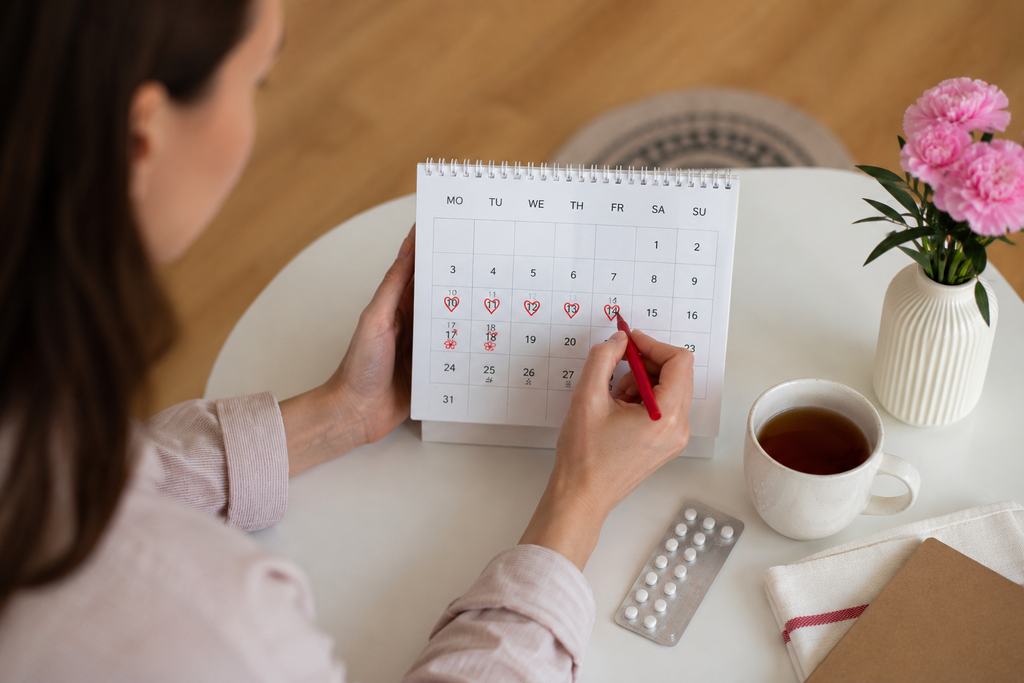
The most useful test may be a calendar
When people try to remember headaches retrospectively, the pattern can feel more consistent than it really was.
“I think it always happens after my period” may be completely accurate—or it may be based on two particularly memorable months.
That is why prospective tracking is so valuable.
NICE recommends using a headache diary across at least two menstrual cycles when menstrual migraine is suspected. Tracking for three cycles can make the pattern even easier to interpret.
Useful details include the first day of menstruation, the exact day and time the migraine starts, how severe it becomes, how long it lasts, whether aura occurs, nausea, sensitivity to light or sound, sleep, missed meals, unusual stress, which medication was taken, when it was taken, and how well it worked.
After a few months, the difference can become obvious.
An attack occurring on day −1, then day +2, then day +1 strongly suggests a menstrual relationship.
Attacks falling on widely different cycle days may point toward a less specific hormonal effect—or entirely different triggers.
Do hormone blood tests diagnose hormonal migraine?
Usually, no.
There is no single estrogen or progesterone test that can confirm that a particular migraine was caused by hormones.
A woman can have completely normal hormone levels and still experience migraine related to normal hormonal fluctuations.
The issue may be the brain’s sensitivity to change rather than an abnormal laboratory value.
Hormone testing can still be useful when there are separate reasons to investigate—such as irregular cycles, abnormal bleeding, fertility concerns, possible perimenopause, or another endocrine or gynecologic problem.
But for menstrual migraine itself, the history and timing of attacks are usually much more informative.
Why menstrual attacks can be unusually stubborn
Many women recognize the same frustrating pattern: the migraine that appears around menstruation feels harder to stop.
Research supports that observation.
Menstrual attacks may last longer, cause greater disability, and sometimes respond less reliably to usual acute treatment than attacks occurring at other times.
That is also why timing matters.
A medication taken while the migraine is still developing may work much better than the same medication taken after the pain has become severe.
This does not mean, however, that taking painkillers for several days “just in case” is automatically a good preventive strategy.
Is taking paracetamol in advance a form of prevention?
Not in the usual medical sense.
Paracetamol is mainly an acute treatment. It is not considered a standard short-term preventive treatment for menstrual migraine.
If attacks are extremely predictable, clinicians may instead use a strategy sometimes called mini-prevention or short-term perimenstrual prevention.
That is different from taking an analgesic every month before symptoms appear without a treatment plan.
Frequent use of headache medication also deserves caution because medication-overuse headache can develop when acute drugs are taken too often.
With paracetamol, aspirin, and NSAIDs, the usual concern arises with use on at least 15 days per month for three months or longer. For triptans and some combination medicines, the threshold is lower.
A few days of use each month does not automatically mean medication overuse—but it still does not make paracetamol an ideal preventive treatment.
What is short-term menstrual migraine prevention?
One advantage of menstrual migraine is predictability.
Many migraine attacks arrive without warning. A menstrual attack may return within a narrow window every month.
That gives doctors an opportunity to treat the high-risk period rather than the entire month.
Short-term prevention may include selected anti-inflammatory medicines or longer-acting triptans taken around the expected migraine window.
NICE, for example, advises that frovatriptan or zolmitriptan may be considered for predictable menstrual migraine that is not adequately controlled by standard acute treatment. This use may be off-label depending on the specific regimen.
That does not mean every woman with menstrual migraine needs a triptan.
It means that predictability can sometimes be turned into a treatment advantage.
What if triptans are not wanted or are not suitable?
There are other approaches.
Depending on the person’s medical history and migraine frequency, a clinician may consider NSAIDs, a better-timed acute treatment plan, continuous preventive therapy when attacks are frequent throughout the month, or newer migraine-specific treatments.
Therapies targeting the CGRP pathway have expanded the options available for both acute and preventive migraine care.
The key point is that treatment is not one-size-fits-all.
Someone with one disabling attack each month is a very different patient from someone with ten migraine days a month, even if three of those days cluster around menstruation.
Can magnesium help?
Magnesium is one of the better-known supplements studied in migraine prevention, and there is some evidence supporting its use in people with menstrual-related migraine.
Some short-term regimens have been studied beginning in the second half of the menstrual cycle and continuing until menstruation.
That does not mean every woman should start magnesium on a specific cycle day.
The formulation, dose, kidney function, gastrointestinal side effects, and other medicines all matter.
Supplements can be useful, but they should not be presented as a universal cure for hormonally influenced migraine.
Can birth control improve hormonal migraine?
Sometimes. Sometimes it makes things worse.
Certain hormonal strategies aim to reduce the fluctuations in estrogen that may trigger migraine. Continuous contraceptive regimens, for example, may reduce the hormone-free interval that can provoke attacks in some women.
But hormonal contraception is not a simple migraine treatment.
Particular caution is required in people with migraine with aura, because combined estrogen-containing contraceptives may not be appropriate due to vascular risk considerations.
That is why contraceptive choice should take the migraine subtype into account, especially whether aura is present.
Why migraine can become unpredictable during perimenopause
A woman may have a stable migraine pattern for years and suddenly find that it changes in her 40s.
Perimenopause is one reason this happens.
Estrogen levels can fluctuate considerably during this period, while menstrual cycles may become irregular and less predictable.
For some women, that means more frequent or more erratic migraine.
After menopause, when hormonal fluctuations settle, migraine improves for many women—although not for everyone.
This is another clue that the relationship is often about hormonal instability rather than one particular hormone level.
What happens during pregnancy and after childbirth?
Hormonal changes during pregnancy provide another example of this relationship.
Many women with migraine without aura experience fewer attacks during pregnancy as estrogen levels rise and become more stable.
After delivery, hormones fall sharply, and migraine may return.
Still, a new, severe, or unusual headache during pregnancy or the postpartum period should never automatically be blamed on hormones. These stages of life also carry risks for secondary causes of headache that may need urgent medical assessment.
When is it worth seeing a neurologist?
An occasional migraine that responds well to treatment is very different from an attack that repeatedly wipes out one or more days every month.
Medical review becomes particularly useful when attacks are severe, prolonged, difficult to treat, frequent, accompanied by new aura or other neurological symptoms, or require repeated use of pain medication.
Taking a headache diary to the appointment can dramatically improve the discussion.
Instead of saying:
“I think I get migraines around my period,”
you can show:
“Cycle one: migraine on day −1.
Cycle two: migraine on day +2.
Cycle three: migraine on day +1.”
That is no longer a vague impression.
It is a pattern.
And patterns can influence treatment.
When hormones should not be blamed automatically
Menstruation is common. Migraine is common. That does not mean every severe headache occurring around a period is necessarily hormonal.
A sudden explosive headache, a headache unlike anything experienced before, new weakness on one side of the body, new speech difficulty, vision loss, confusion, seizures, or other unusual neurological symptoms require medical assessment.
The fact that a headache happened “at that time of the month” should never be used to explain away a symptom that is genuinely different from previous migraine attacks.
The bigger picture
Some migraines seem to follow a calendar.
They return at nearly the same time month after month, and eventually the connection with the menstrual cycle becomes difficult to ignore.
For some women, that connection is very real.
But menstrual migraine has a specific medical definition: attacks occur predominantly between two days before menstruation begins and the third day of bleeding, in at least two out of three cycles.
Migraine occurring at other points in the cycle may still be influenced by hormones, but it should not automatically be labeled menstrual migraine.
And the most revealing investigation may not be an expensive hormone panel.
It may simply be three months of careful tracking.
Because once you know when the migraine consistently appears, you are much closer to understanding what is influencing it—and, in some cases, to stopping the attack before it reaches its worst.
This article is for general information only and does not replace medical advice. Acute treatment, short-term menstrual prevention, supplements, and hormonal therapies should be individualized according to migraine type, aura status, medical history, and other medications.