
Squishy sensory toys are designed to be squeezed, stretched and handled at room temperature. They are soft, colorful and usually marketed as calming or satisfying objects for children and adults alike.
That harmless image is exactly why the accidents linked to them have been so surprising.
Over the past few years, several children have suffered serious burns after heating squishy toys in microwave ovens, often while copying an online trend or repeating something they had heard from friends. In some cases, the material inside the toy became hot enough to stick to the skin and cause injuries that required specialist burn care.
One of the brands involved in several reported incidents is NeeDoh, made by Schylling. The company now gives a very clear warning: its products should not be heated, frozen or microwaved because misuse can cause injury.
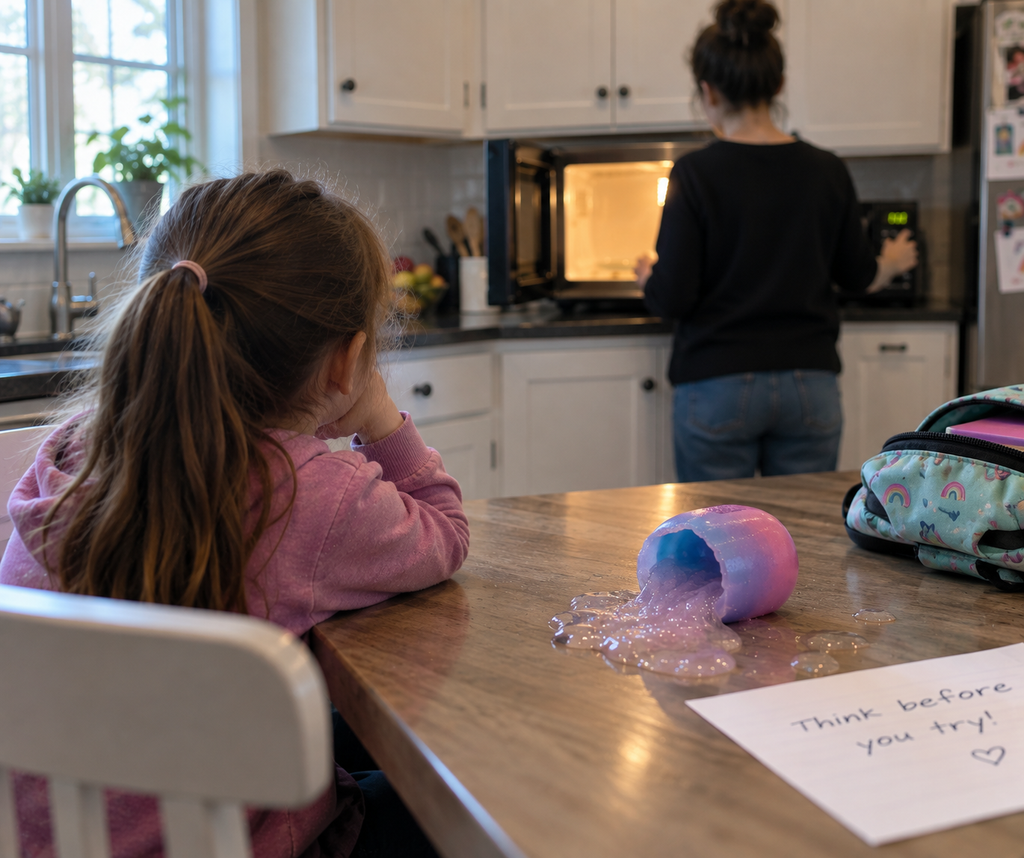
A seven-year-old girl ended up in intensive care after trying the experiment
One of the most widely reported cases involved Scarlett Selby, a seven-year-old girl from Missouri.
According to her family, Scarlett had placed a NeeDoh toy in the freezer overnight. The following day, after it had become hard, she tried to soften it again by heating it in the microwave, an idea she had seen in online videos.
The toy ruptured after heating, and the hot material inside spread across her face and chest.
Scarlett was taken to St. Louis Children’s Hospital with severe burns. Doctors were particularly concerned about the injuries around her mouth because swelling in that area could compromise her airway.
She was placed in a medically induced coma for three days and remained hospitalized while doctors treated her injuries. The accident also left visible scarring.
The significance of the case is not simply that it was dramatic. Similar injuries have been reported in other children.
Other children were injured in remarkably similar circumstances
In early 2025, an eight-year-old girl named Gia suffered facial burns after a heated NeeDoh toy ruptured. Her mother later said that the family would have to wait to know how permanent the scarring might be.
Another case was documented directly by Loyola Medicine.
In January 2026, nine-year-old Caleb put a NeeDoh Cube in the microwave after learning from another child that heating it would make it softer and easier to squeeze.
His mother initially thought he was heating breakfast.
Instead, she heard him scream.
Loyola Medicine reported that when Caleb opened the microwave, the heated toy burst and hot material landed on his face and hands. One burn was close enough to his eye that he also needed an ophthalmology examination. His vision was not damaged.
ABC News reported that the toy had been heated for roughly 40 seconds.
At around the same time, Loyola Medicine said it had treated several patients with burn injuries linked to similar toys over a period of only a few months.
That matters because it suggests these incidents are not simply isolated accidents involving one family or one child.
What is actually inside a NeeDoh toy?
The contents of squishy toys are often described online simply as “gel,” but that description can be misleading.
Different NeeDoh products can use different filling materials.
Schylling CEO Paul Weingard has explained that some products use polyvinyl alcohol, or PVA, while others use ingredients such as cornstarch or maltose, depending on the texture the product is designed to have.
The original NeeDoh uses PVA. Snowball Crunch uses cornstarch to create its distinctive feel, while maltose, a type of sugar, has been used in products including Nice Cube and Dream Drop.
Schylling’s current product information for Nice Cube describes the filling more generally as a non-toxic, dough-like compound rather than publicly listing an exact formula.
So the popular assumption that every squishy toy contains the same mysterious “chemical gel” is inaccurate.
There is another important distinction: a toy that merely looks like a NeeDoh may have nothing to do with Schylling. Many similar products and imitations exist, and their contents may differ considerably.
Is the filling poisonous if the toy breaks?
For its own products, Schylling describes the fillings as non-toxic.
That does not mean the contents are intended to be eaten or played with once the outer shell has ruptured. A damaged toy should be discarded, and young children or pets should not be allowed to ingest the filling.
But the severe accidents associated with microwaved NeeDoh toys should not automatically be described as chemical poisoning or chemical burns.
The main hazard in the reported cases has been heat.
A substance can be considered non-toxic and still cause a serious injury if it becomes extremely hot.
Why can the burns be worse than people expect?
The texture of the heated filling is part of the problem.
Hot water usually runs off the skin relatively quickly. A thick, sticky material can remain in place, continuing to transfer heat into the tissue.
Loyola Medicine described the material involved in Caleb’s accident as gel-like.
Parents involved in other cases have compared the overheated filling to thick glue because it was difficult to remove from the skin.
This matters because the severity of a thermal burn depends not only on temperature, but also on how long the hot substance remains in contact with the body.
A sticky material that stays attached to the skin can continue delivering heat after the initial accident.
Burns to the face are particularly concerning because of the risk to the eyes, mouth and airway.
Why microwave heating is especially unpredictable
Microwave ovens do not necessarily heat materials evenly.
Anyone who has reheated food has probably experienced this: one section may feel barely warm while another is extremely hot.
The same basic problem applies to a sealed sensory toy. A child has no practical way to determine how hot the filling has become simply by looking at the outside.
Heating can alter the filling and the flexible outer shell, and the toy may rupture during handling or when it is removed from the microwave, sending hot material outward.
The fact that one reported accident occurred after approximately 40 seconds does not mean a shorter heating time is safe. Microwave power levels vary, different toys contain different materials and there is no manufacturer-approved heating time.
Schylling’s instruction is not “heat briefly.”
It is not to microwave the product at all.
What about freezing the toy instead?
Schylling also warns against freezing its products.
Scarlett’s accident involved a toy that had first been frozen and then heated in the microwave.
There is no basis for claiming that freezing alone caused her burns. The thermal injury occurred after the toy was subsequently heated.
Still, the case illustrates how online “texture hacks” can encourage children to use products in conditions for which they were never designed.
Heat outside a microwave may also matter
A separate concern emerged during hot weather.
In 2026, the family of a 12-year-old boy in the United Kingdom reported that a NeeDoh toy left in strong sunlight on a windowsill became very hot and ruptured, causing a deep burn to his leg. The child later required a skin graft.
That case should be interpreted carefully. The details came primarily from the family’s account reported in the press, and there is no publicly available technical investigation proving exactly why the toy failed.
It would therefore be misleading to say that any squishy toy left in sunlight will burst.
What the case does reinforce is the broader safety principle that sealed sensory toys should not be exposed to extreme temperatures.
What should you do if hot filling gets onto the skin?
Burn first aid matters because tissue damage can continue after the original heat source has been removed.
The British Burn Association recommends cooling a thermal burn under cool running water for 20 minutes as soon as possible. Cooling can still provide benefit when started within the first few hours after the injury.
Ice and ice-cold water should not be applied directly because extreme cold can cause additional tissue damage.
Clothing or jewelry close to the burn can be removed if it is not stuck to the skin, but anything firmly attached to the injured area should not be pulled away.
Home remedies such as butter, oils or toothpaste should not be applied to burns.
Burns involving a child’s face, eyes, hands, major joints, airway or a large or deep area of skin warrant medical assessment. Serious injuries require urgent medical care.
Why do children try something that seems obviously unsafe to adults?
The answer is not always “because of TikTok.”
Caleb had not learned the idea directly from a social media platform. Another child had told him about it.
That detail is important.
Once a trend becomes popular, it no longer belongs to the platform where it started. Children discuss it at school, demonstrate it to friends and repeat instructions they heard from someone else.
A nine-year-old does not assess risk in the same way an adult does.
If a child hears that heating a toy makes it “more squishy,” and knows that other children have already tried it, the experiment may sound harmless rather than dangerous.
Short viral videos can make that effect even stronger because they tend to show the interesting outcome, not the emergency department visit that can follow when something goes wrong.
The toy itself is not the whole story
It would be easy to read these cases and conclude that NeeDoh toys are inherently dangerous.
That would not accurately reflect the evidence.
The products are designed to be squeezed and handled at normal temperatures. Schylling describes the filling of Nice Cube as non-toxic and markets the product for children aged three and older, while also warning specifically against heating, freezing or microwaving it.
The serious burn cases discussed here involved use outside those instructions.
That distinction matters because good safety information should not create unnecessary fear. At the same time, warnings printed on toys should not be dismissed simply because the product looks harmless.
If a squishy toy develops a tear or begins leaking during ordinary play, the safest response is to discard it and prevent children from putting the contents in their mouths or eyes.
If the toy has been heated, however, the situation becomes a potential burn emergency.
One simple rule is easier to remember than every viral trend
Scarlett was seven. Gia was eight. Caleb was nine.
None of them were trying to hurt themselves.
They were experimenting with something that looked ordinary enough to feel safe.
Parents cannot realistically know every trend that will circulate on TikTok, YouTube or through conversations at school. A more useful approach is to teach children a rule that applies far beyond one particular toy.
Do not heat, freeze, cut or otherwise modify a sealed toy simply because someone online says it produces an interesting result.
With NeeDoh, the manufacturer’s own instructions are already unambiguous: keep the toy away from extreme temperatures and do not put it in a microwave.
A squishy toy should remain exactly what it was designed to be — something to squeeze, not an experiment.